Physical Address
23,24,25 & 26, 2nd Floor, Software Technology Park India, Opp: Garware Stadium,MIDC, Chikalthana, Aurangabad, Maharashtra – 431001 India
Physical Address
23,24,25 & 26, 2nd Floor, Software Technology Park India, Opp: Garware Stadium,MIDC, Chikalthana, Aurangabad, Maharashtra – 431001 India
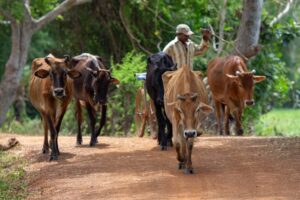
When Sri Lankans talk about climate change, the conversation usually turns to vehicle exhaust, coal fired electricity, plastic waste, or shrinking forests. Farming rarely enters the frame. Yet agriculture is tied to roughly 20 percent of the country’s greenhouse gas emissions. And within agriculture, one source keeps slipping past public attention: the animals in the country’s pastures and dairy sheds.
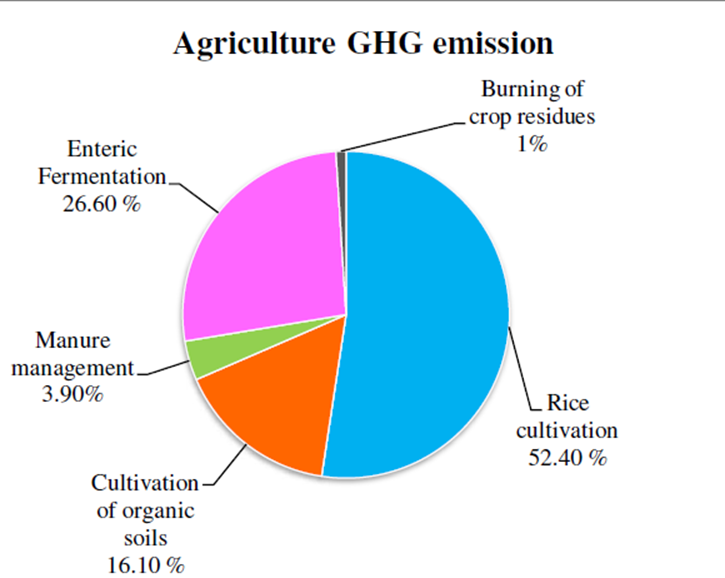
Rice cultivation is the single largest share of agricultural emissions, at about 52 percent. But the livestock sector, through enteric fermentation (around 27 percent) and manure management (around 4 percent), is the country’s largest source of agricultural methane. Together, livestock accounts for roughly 30 percent of agricultural emissions, most of it methane released by cattle and buffalo as they digest feed and from decomposing manure. Unlike carbon dioxide, methane is a short lived but far more potent gas, trapping roughly 80 times more heat than CO2 over a 20 year window and around 27 to 30 times more over a century (IPCC AR6). Emissions from rice paddies, cultivated organic soils, and crop residue burning also matter, but they either mix several gases or occur seasonally. Livestock, by contrast, emits methane steadily through the year, creating a persistent warming effect.
Sri Lanka’s livestock footprint is modest next to agricultural giants such as India and Brazil. But it is not a small source of climate impact at home. With the country aiming for carbon neutrality by 2050 and raising its ambition under the Paris Agreement, experts say livestock emissions deserve far more attention in national climate policy.
Methane: The Invisible Climate Threat
Livestock methane comes mainly from enteric fermentation, a natural digestive process in ruminants such as cattle and buffalo. It is released largely through belching as microbes in the rumen break down fibrous plant material. Manure management is the other major source: when animal waste is stored in low oxygen conditions, it decomposes and releases both methane and nitrous oxide, another potent greenhouse gas.
Sri Lanka’s dairy cattle sector emitted about 2.3 million tonnes of CO2 equivalent in 2014, and methane made up over 93 percent of the livestock sector’s greenhouse gas emissions, according to the Food and Agriculture Organization (FAO). That makes methane, and the ruminants that produce it, the dominant climate concern within animal agriculture.
An Overlooked Contributor to Sri Lanka’s Emissions
Livestock emissions rarely sit at the centre of public debate about climate mitigation. This is not because renewable energy, electric vehicles, and forest restoration are absent from the agenda. They are firmly on it. But methane from animal agriculture is seldom part of the mainstream environmental conversation.
Why Cattle Matter More Than Other Farm Animals
Not all livestock carry the same climate weight.
Cattle and buffalo are ruminants, with a specialised stomach that lets them digest grasses and other fibrous plants. That same digestive system produces large quantities of methane. Chickens, pigs, and most other non ruminants emit relatively little, because their digestion works differently. So cattle are the main driver of livestock emissions even though poultry make up the majority of Sri Lanka’s livestock population.
Millions of cattle and buffalo support dairy production and rural livelihoods across the country, but productivity remains low. Domestic milk covers only around 25 to 30 percent of national demand, with the gap filled by imported milk powder, according to the FAO. When productivity is low, more animals are needed to produce the same volume of milk, which pushes up emissions per litre.
The Hidden Cost of Manure
Methane does not stop once cattle leave the pasture.
Manure stored in pits, lagoons, or heaps keeps decomposing, releasing methane and nitrous oxide into the atmosphere. Poor manure management can therefore be a significant source of agricultural greenhouse gases, especially in intensive dairy systems. Agriculture is one of the priority sectors for emission reduction in Sri Lanka’s Carbon Net Zero 2050 Road Map, prepared by the Ministry of Environment.
The Climate Power of Dietary Choices
Technological fixes matter, but many scientists say consumers have a crucial role too. Almost 80 percent of the world’s agricultural land is devoted to livestock, yet it supplies less than a fifth of the calories people eat. Animal agriculture also demands large amounts of feed crops, freshwater, and land, making it one of the most resource intensive food systems.
International research, including the landmark Poore and Nemecek (2018) study in Science, finds that shifting toward more plant based diets is among the most effective actions individuals can take to shrink their environmental footprint. The study concluded that reducing animal products could sharply cut greenhouse gas emissions, land use, freshwater use, and water pollution from food production.
For Sri Lanka, dietary change need not mean overnight veganism. Easing overconsumption of red meat and leaning on locally available plant foods, such as lentils, cowpea, green gram, chickpeas, vegetables, and traditional grains, could lower agricultural emissions while improving health. The country already has a rich culinary heritage built around rice, pulses, jackfruit, yams, leafy vegetables, and coconut, much of it naturally lower in carbon footprint than meat heavy diets. The EAT-Lancet Commission similarly recommends diets high in plant foods and lower in animal source foods to serve both human health and environmental sustainability.
A Conversation Sri Lanka Can No Longer Avoid
Sri Lanka has committed to a low carbon future, and reaching it will take action not only in transport, electricity, and industry, but in agriculture too. Livestock, and cattle in particular, may not raise smokestacks or clog highways, but their methane quietly adds to the country’s greenhouse gas burden every day. Overlook it, and the country may miss one of the fastest available levers to slow warming. Encouraging plant based foods, meanwhile, can cut emissions and support rural development at the same time.
References
https://www.fao.org/in-action/enteric-methane/countries/asia-a/sri-lanka
https://faolex.fao.org/docs/pdf/srl239976.pdf
https://www.slcarp.lk/upload/Book.pdf
https://www.science.org/doi/10.1126/science.aaq0216
Banner Image: Photo by Urban Johnsson on Unsplash
Sections of this article may have been developed with the assistance of artificial intelligence tools to support research, drafting and language refinement. All information has been reviewed, edited and verified by the author/editor to ensure accuracy, context and editorial integrity. The responsibility for the final content, interpretations and conclusions rests solely with the publisher.