Physical Address
23,24,25 & 26, 2nd Floor, Software Technology Park India, Opp: Garware Stadium,MIDC, Chikalthana, Aurangabad, Maharashtra – 431001 India
Physical Address
23,24,25 & 26, 2nd Floor, Software Technology Park India, Opp: Garware Stadium,MIDC, Chikalthana, Aurangabad, Maharashtra – 431001 India

How long could the electricity used by the average Sri Lankan at home in an entire day power an air conditioner?
Just 39 minutes.
This startling statistic reveals a little-known reality about Sri Lanka’s energy landscape. According to a recent analysis by Hannah Ritchie of Our World in Data, published in February 2026, the average residential electricity consumed per person in Sri Lanka each day is enough to operate a typical room air conditioner for only 39 minutes. While people in many high-income countries can comfortably cool their homes for several hours, the average Sri Lankan’s daily household electricity consumption would not provide even an hour of air conditioning.
Sri Lanka is one of at least 45 countries where, the analysis found, average daily residential electricity use per person is less than what a standard air conditioner needs to run for a single hour. The comparison is particularly striking because Sri Lanka is already experiencing rising temperatures, more frequent heat stress and growing demand for indoor cooling.
At first glance, the statistic may suggest that Sri Lankans simply need to consume more electricity. However, the real story is far more complex. It reflects the intersection of household incomes, electricity affordability, climate change, urbanisation and the country’s evolving energy system.
As global temperatures continue to climb, access to cooling is increasingly recognised not as a luxury but as a necessity for protecting human health, maintaining productivity and adapting to climate change. Yet for many Sri Lankan households, the cost of operating an air conditioner remains prohibitive.
The World Is Getting Hotter, and So Is Sri Lanka
Extreme heat is becoming one of the fastest-growing climate risks worldwide. According to the World Meteorological Organization (WMO), the past eleven years (2015 to 2025) have been the eleven warmest ever recorded, with 2024 the warmest year on record and 2023 to 2025 the three warmest years in every major global dataset, driven primarily by human-induced climate change.
Sri Lanka is no exception. Although blessed with a tropical climate, the island has witnessed increasing average temperatures, more frequent hot days and longer warm periods over recent decades. Dense urban centres such as Colombo, Kandy and Galle are particularly vulnerable because concrete buildings, asphalt roads and limited green spaces trap heat, creating an urban heat island effect that can make cities significantly warmer than surrounding rural areas.
Heat is more than an inconvenience. It increases the risk of dehydration, heat exhaustion and cardiovascular illness, reduces labour productivity, affects students’ ability to learn and places additional pressure on hospitals and public health systems. Outdoor workers, including farmers, construction workers and street vendors, often bear the greatest burden.
Against this backdrop, cooling technologies are becoming increasingly important.
Cooling Is Becoming a Basic Need
For decades, air conditioners in Sri Lanka were associated mainly with luxury hotels, corporate offices and affluent households. Today, that perception is gradually changing.
As temperatures rise and incomes improve, more middle-income families are purchasing air conditioners, while businesses, hospitals, schools, hotels and shopping centres increasingly depend on cooling systems to maintain safe and comfortable indoor environments.
The International Energy Agency (IEA) identifies space cooling as one of the fastest-growing drivers of global electricity demand. In its report The Future of Cooling, the agency projects that billions of new air conditioners will be installed worldwide over the coming decades, particularly across Asia, where rising incomes coincide with rapidly warming climates. Ownership today remains highly unequal: IEA data cited by Our World in Data shows that only around 5 percent of households in India had air conditioning, compared with near-universal ownership in some wealthy countries.
Sri Lanka is expected to follow the regional trend. Although household ownership of air conditioners remains relatively low compared with wealthier Asian countries, demand is steadily increasing, especially in urban and suburban areas.
What Does ‘39 Minutes’ Really Mean?
The 39-minute figure does not mean that Sri Lankans only use electricity for 39 minutes each day.
Instead, it compares two quantities:
By converting household electricity use into equivalent air conditioner running time, Our World in Data created an intuitive way of comparing access to cooling across countries.
The results reveal stark global inequalities.
People living in wealthier countries can often run air conditioners for many hours each day using the electricity consumed by the average household. In contrast, residents of many low- and middle-income countries have access to only a fraction of that electricity.
Sri Lanka sits somewhere in the middle, but much closer to countries with limited electricity access than to those where cooling has become an everyday convenience.
For comparison:
| Country | Daily residential electricity, expressed as AC running time |
| United States | More than 6 hours |
| Australia | More than 5 hours |
| Japan | More than 4 hours |
| India | 44 minutes |
| Sri Lanka | 39 minutes |
| Pakistan | 37 minutes |
| Nigeria | 13 minutes |
| South Sudan | 4 minutes |
Figures for India, Sri Lanka, Pakistan, Nigeria and South Sudan are from the Our World in Data analysis. Figures for the United States, Australia and Japan are conservative estimates derived from the same method, using IEA residential electricity consumption and population data; actual equivalent running times in these countries are higher still.
The comparison highlights a critical challenge: as Sri Lanka warms, the need for cooling is growing faster than the average household’s electricity budget can accommodate. Per capita electricity consumption figures for individual countries can be explored through the IEA Energy Statistics Data Browser.
A Paradox in a Warming Climate
The irony is striking. Sri Lanka contributes only a tiny share of global greenhouse gas emissions, yet it is already experiencing many of the consequences of climate change, including rising temperatures and more frequent heat stress.
At the same time, the very technology that helps people adapt to extreme heat, air conditioning, requires electricity. If that electricity comes from fossil fuels, widespread adoption of cooling can increase carbon emissions and place additional strain on the national power grid.
This creates a difficult balancing act. Sri Lanka must expand access to affordable cooling to protect public health and support economic development, while ensuring that growing electricity demand does not undermine its climate commitments or energy security.
The question is therefore not whether Sri Lankans should use air conditioning. It is how the country can provide cooling in a way that is affordable, energy-efficient and environmentally sustainable.
That challenge will become increasingly important in the years ahead, as rising temperatures, urbanisation and economic development drive a steady increase in demand for electricity.
References
https://ourworldindata.org/four-minutes-of-air-conditioning
https://wmo.int/news/media-centre/wmo-confirms-2025-was-one-of-warmest-years-record
https://www.iea.org/reports/the-future-of-cooling
https://www.iea.org/data-and-statistics/data-tools/energy-statistics-data-browser
https://en.wikipedia.org/wiki/List_of_countries_by_electricity_consumption
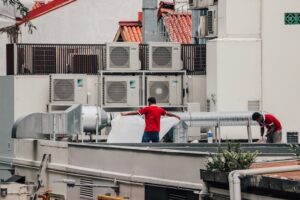
Banner Image: Representative. Photo by Singapore Stock Photos on Unsplash
Sections of this article may have been developed with the assistance of artificial intelligence tools to support research, drafting and language refinement. All information has been reviewed, edited and verified by the author/editor to ensure accuracy, context and editorial integrity. The responsibility for the final content, interpretations and conclusions rests solely with the publisher.