Physical Address
23,24,25 & 26, 2nd Floor, Software Technology Park India, Opp: Garware Stadium,MIDC, Chikalthana, Aurangabad, Maharashtra – 431001 India
Physical Address
23,24,25 & 26, 2nd Floor, Software Technology Park India, Opp: Garware Stadium,MIDC, Chikalthana, Aurangabad, Maharashtra – 431001 India

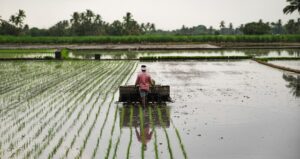
India’s rice production could decline far more sharply under climate change than previously believed, according to a new study that found the country’s rice yields may fall by 6.6% for every 1°C rise in global mean temperature. The estimate is more than three times higher than earlier projections and raises fresh concerns for India’s food security, where rice remains the staple diet for nearly two-thirds of the population. Published in the journal Science Advances, the study found that short periods of extreme heat above 30°C, rather than gradual warming alone, are the primary driver of yield losses, particularly during the crop’s reproductive stage.
Extreme heat could slash India’s rice yields
The research, led by the Helmholtz Centre for Environmental Research (UFZ) with contributions from the Potsdam Institute for Climate Impact Research (PIK), analysed data from 214 field-warming experiments across major rice-growing regions and compared them with projections from seven widely used crop models. It found that existing models significantly underestimate the impact of extreme heat on rice production because they fail to adequately capture heat stress during the crop’s reproductive stage, when panicles and grains develop.
After correcting these model biases using real-world observations, researchers estimated that global rice yields could decline by 8.1% for every 1°C rise in global temperature, compared with the 3.8% decline projected by existing crop models. For India, Pakistan and Bangladesh, the estimated loss rises from the earlier projection of 2.1% to 6.6%, making South Asia one of the regions most vulnerable to climate-driven declines in rice production.
The study found that temperatures exceeding 30°C account for more than half of warming-related yield losses at over 70% of the observed field sites. Researchers said brief episodes of intense heat can inflict disproportionate damage on rice during flowering and grain formation, reducing harvests even if seasonal average temperatures appear only moderately higher.
South Asia faces the biggest risks
The findings suggest that South and Southeast Asia will experience the largest revisions in projected rice losses because of the region’s extensive rice cultivation and increasing exposure to extreme heat. Countries including Thailand, the Philippines and Myanmar could see yield losses rise from 3.7% to 7.7% for every 1°C of global warming after accounting for real-world heat exposure.
For India, the projections carry significant implications for food security, rural livelihoods and inflation. Rice is one of the country’s most important food crops and supports millions of farmers while serving as a staple food for nearly two-thirds of the population. Scientists warn that more frequent heatwaves could increase production risks even in years with favourable rainfall.
The authors emphasised that the estimates isolate the effects of temperature alone and should not be interpreted as forecasts of future rice production, which will also depend on rainfall, irrigation, carbon dioxide levels, farming practices and adaptation measures. However, they argue that current crop models need to better represent heat extremes to produce more reliable projections of future food security.
Adaptation will be critical as temperatures rise
Researchers say the findings highlight the need to develop rice varieties that can better tolerate extreme heat, particularly during the reproductive stage. They also recommend adjusting planting calendars, improving irrigation management and strengthening soil health to reduce the impacts of high temperatures on crop productivity.
The study comes amid growing evidence that climate change is already affecting agricultural production across India. Previous research has linked rising temperatures and increasingly frequent heatwaves with declining yields in several major crops, including maize and pearl millet. Scientists say improving crop models to capture the effects of extreme heat will be essential for designing effective adaptation strategies and ensuring food security as global temperatures continue to rise.
References:
https://doi.org/10.1126/sciadv.aed9226
https://phys.org/news/2026-07-global-threatens-rice-harvests-crop.html
Banner image: Photo by Ayrus Hill on Unsplash
Sections of this article may have been developed with the assistance of artificial intelligence tools to support research, drafting and language refinement. All information has been reviewed, edited and verified by the author/editor to ensure accuracy, context and editorial integrity. The responsibility for the final content, interpretations and conclusions rests solely with the publisher.