Physical Address
23,24,25 & 26, 2nd Floor, Software Technology Park India, Opp: Garware Stadium,MIDC, Chikalthana, Aurangabad, Maharashtra – 431001 India
Physical Address
23,24,25 & 26, 2nd Floor, Software Technology Park India, Opp: Garware Stadium,MIDC, Chikalthana, Aurangabad, Maharashtra – 431001 India

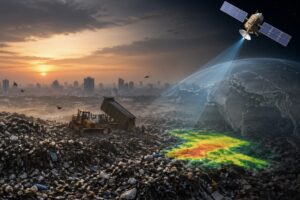
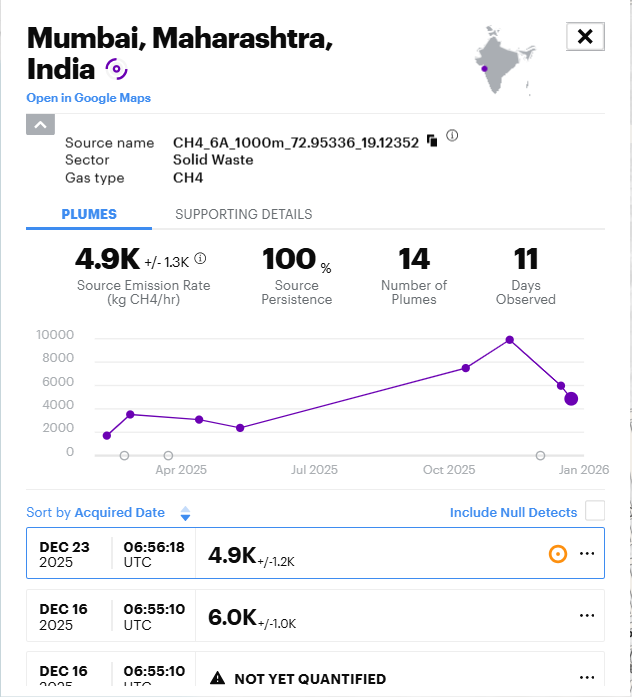
Satellites have revealed a startling truth: some of the world’s largest methane emitters are ordinary landfills. In a 2026 analysis by UCLA’s STOP Methane Project (using Carbon Mapper and GHGSat data), two Indian landfills rank among the top 25 methane hotspots globally. Secunderabad’s Jawaharnagar dump (Hyderabad) emits ~5.9 tonnes CH₄ per hour (4th largest worldwide), and a Mumbai landfill emits ~4.9 t/hr (12th). Read here
These findings upend assumptions. Traditionally, landfill methane has been underestimated in inventories. A recent Harvard study found US landfill CH₄ emissions are 51–77% higher than the EPA’s bottom-up estimates. Facilities that collect gas often recover only ~50% (vs. 75% assumed). Read here . Similarlly, a global satellite survey of 151 disposal sites found no correlation between reported and observed emissions. Read here. In short, top-down sensing often greatly exceeds “official” numbers, highlighting huge blind spots.
Why landfills are consider as methane factories
Landfills produce methane when organic waste, such as food, paper, and garden material, breaks down without oxygen. This process, called anaerobic decomposition, turns everyday garbage into a powerful climate threat.
What makes methane particularly dangerous is not how long it stays in the atmosphere, but how intensely it traps heat. Over a 20-year period, methane is about 86 times more potent than carbon dioxide, making it a major driver of short-term global warming.
What Satellites Are Revealing
New satellites (e.g., TROPOMI, GHGSat, and Planet/Tanager) can pinpoint CH₄ plumes from space. The new analysis, conducted using data from Carbon Mapper and the Stop Methane Project, identified 2,994 methane plumes from 707 waste sites worldwide. Among them, the Indian landfill sites stood out, not just for their presence but also for their scale.
Some of the largest sites were found to emit between 3.6 and 7.5 tonnes of methane per hour. To put that into perspective, a single large landfill can have a warming impact comparable to a coal power plant or up to a million vehicles. Thus, this is not marginal pollution. These are “super-emitters”, large, concentrated sources that significantly accelerate warming.

Tracking from space makes methane visible: whereas previous accounting only estimated decay from waste, satellites show real leaks. The result is a treasure map of super-emitters that were “hiding in plain sight”. In essence, any large open dump or poorly managed landfill can become a detectable methane volcano.
Who Is Responsible?
The new data cast a spotlight on particular companies and municipalities as “potentially responsible operators”. They must now answer for staggering emissions. Similarly, Mumbai’s massive dump was ranked 12th largest emitter. Neither company has publicly disputed the findings. But satellite data has tied their names to tonnes of CH₄ leakage each hour. Read here
Whether officially mandated or not, these operators wield undeniable responsibility. In countries with large landfills, private contractors often manage waste on behalf of cities. Now that we know who they are, pressure will grow to install methane control.
Why This Matters Beyond India
Methane itself is short-lived (nearly 9 years in air), but its heating is intense. Reducing it yields quick climate benefits. More immediately, the effects of excess warming reach Sri Lanka and other regional countries regardless of origin. Climate studies of recent floods show extreme rainfall is already more intense than in the past. For example, a 2025 analysis found the month-long heavy rains in Sri Lanka were roughly 28–160% more intense due to just ~1.3°C of global warming. Read here. Methane-driven near-term warming contributes to this trend.
If India’s landfills keep leaking, regional countries will keep catching the results via hotter oceans and fatter storm systems. In other words, whether Indian or global, every tonne of methane ultimately adds to the monsoonal deluges and heatwaves in Sri Lanka (and across South Asia). The pollution doesn’t care about borders.
Regulatory Gaps in South Asia
Landfill methane is only recently on the regulatory radar. India’s 2016 Solid Waste Management Rules do require gas capture systems at landfills. They mandate methane collection and use (or flaring) rather than passive venting. In theory, this should reduce emissions. In reality, many “dumps” never got formal authorisations at all, and enforcement is spotty. Read here
Sri Lanka has no equivalent large-scale programme. Its urban waste still largely goes to dumps without gas recovery. An assessment notes “no landfill gas industry in operation yet”. Without monitoring, methane from these sites is completely overlooked in emissions inventories. Read here
On the bright side, there are initiatives: e.g., a UNDP-backed biogas plant in Colombo’s suburbs (Kaduwela) converts 10 tonnes/day of organic waste to energy, cutting ~1,000–1,300 tCO₂e of emissions annually. But such projects are rare. Most waste in the region still decays anaerobically, leaking CH₄. Read here
Conclusion
In sum, landfill methane is no longer “invisible”. Space-based sensors have exposed super-emitters that demand urgent action. Cutting methane is one of the fastest climate fixes available, and addressing these plain-sight emissions could significantly slow warming. If we ignore them, the resulting heat and rain will keep battering vulnerable regions like Sri Lanka, far from the source of the pollution.
Reference
https://www.epa.gov/agstar/how-does-anaerobic-digestion-work
Banner Image: AI-generated
Sections of this article may have been developed with the assistance of artificial intelligence tools to support research, drafting and language refinement. All information has been reviewed, edited and verified by the author/editor to ensure accuracy, context and editorial integrity. The responsibility for the final content, interpretations and conclusions rests solely with the publisher.