Physical Address
23,24,25 & 26, 2nd Floor, Software Technology Park India, Opp: Garware Stadium,MIDC, Chikalthana, Aurangabad, Maharashtra – 431001 India
Physical Address
23,24,25 & 26, 2nd Floor, Software Technology Park India, Opp: Garware Stadium,MIDC, Chikalthana, Aurangabad, Maharashtra – 431001 India

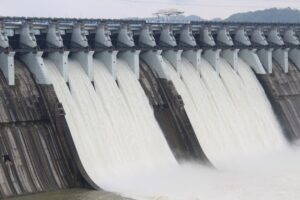
India’s network of large dams and reservoirs, once considered a backbone for water security, power generation and flood control, is slowly losing its strength. A new study by the Indian Institute of Science Education and Research (IISER) Bhopal has revealed that sediment build-up is draining the designed capacity of many reservoirs across the country. The research warns that by 2050, several major water bodies could lose more than half of their storage space, putting millions at risk of shortages and climate-driven disasters.
Shrinking Storage Across the Country
The IISER team studied over 300 large reservoirs with storage of more than 100 million cubic metres. Their study shows that many of these facilities have already lost close to 50 per cent of their designed capacity, with the situation set to worsen in the coming decades. Once a dam loses this volume of storage, its ability to perform key functions such as supplying drinking water, irrigation, hydropower generation and flood regulation diminishes sharply.
Regions most vulnerable to this decline include the Himalayan states, the Indo-Gangetic plains, the Narmada-Tapi basin and the Western Ghats. These areas are not only home to millions of people but also serve as vital agricultural zones. The report highlights that the shrinking of storage in these reservoirs is not a distant problem but one already unfolding and likely to spread further by mid-century.
Causes of Sediment Build-Up
Sediment accumulation, according to the study, is primarily driven by human activity upstream. Soil erosion linked to unsustainable farming, widespread deforestation and repeated flooding all contribute to the silt and debris that fill reservoirs over time. The scale of this sedimentation problem is growing, making reservoirs steadily less effective and, in some cases, almost obsolete for the purposes they were designed for. Unchecked, the process threatens to create a silent water crisis across India.
Communities that rely on these reservoirs for drinking water, irrigation and protection from floods will find themselves increasingly vulnerable. The gradual decline is also a significant blow to India’s hydropower sector, which depends on steady water flows to generate electricity.
A Call for Better Management
India’s Dam Safety Act, 2021, was introduced to improve inspections and reduce the risk of structural failures across more than 5,700 large dams. But as Dr Somil Swarnkar, assistant professor at IISER Bhopal and lead author of the study, pointed out, safety cannot be limited to walls and gates alone. “A reservoir that loses half its storage may not collapse but becomes functionally ‘unsafe’ by failing the communities that depend on it,” he said.
The study recommends afforestation in catchment areas, construction of check dams, adoption of sediment flushing systems and regular hydrographic surveys to prevent further decline. Without such steps, many of India’s reservoirs risk becoming ineffective long before the end of their intended lifespans, leaving millions of people more vulnerable to water scarcity and climate pressures.
References:
https://link.springer.com/article/10.1007/s00477-025-03095-w
Banner image:
Photo by Prateek Srivastava on Unsplash

Comments are closed.







x0i6es
Казино Вавада привлекает внимание пользователей.
Бездепозитные бонусы обеспечивают новичкам удобный старт.
Игровые конкурсы увеличивают азарт.
Игровой каталог обновляется регулярно.
Начать игру можно быстро, и промокоды активируются моментально.
Узнай больше прямо здесь: играть в vavada
fvbx1w