Physical Address
23,24,25 & 26, 2nd Floor, Software Technology Park India, Opp: Garware Stadium,MIDC, Chikalthana, Aurangabad, Maharashtra – 431001 India
Physical Address
23,24,25 & 26, 2nd Floor, Software Technology Park India, Opp: Garware Stadium,MIDC, Chikalthana, Aurangabad, Maharashtra – 431001 India

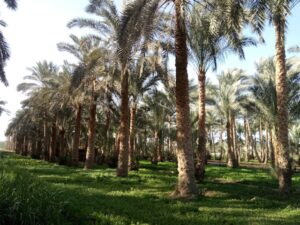
Saudi Arabia has long been known for its vast sand seas, but officials now envision a very different future.Crown Prince Mohammed bin Salman’s Saudi Green Initiative (SGI) promises to plant 10 billion trees and rehabilitate tens of millions of hectares . The idea invokes “Green Arabia” – a prehistoric era when heavier monsoon rains turned the peninsula into savannah . Modern studies confirm that the Arabian Desert was periodically lush, with rivers, lakes and abundant wildlife . But those wet periods were tied to ancient climate cycles and eventually ended. Today, nearly 95% of Saudi land is arid with scant rainfall . Can 10 billion trees really flourish here again, or is the plan too ambitious?
Green Arabia’s Legacy
A moist past: New paleo-climate research shows that for millions of years the Arabian Peninsula saw repeated humid phases. For example, one study found an ancient lake in the Empty Quarter ,Rubʿ al-Khali, lasting ~11,000–5,500 years ago, covering an area nearly twice Lake Geneva’s . During these phases, vegetation stretched across what are now sand dunes, creating grasslands and savannah. Fossils crocodiles, hippos, elephants and other water-dependent animals in Arabian sediments underscore this green past . Arabia’s episodic wet intervals likely facilitated mammalian dispersals across continents . However, these humid intervals steadily weakened over time: researchers note that “precipitation during humid intervals decreased and became more variable” as monsoons retreated . By about 5,500 years ago the climate had returned to an arid state, forcing ancient peoples to migrate to greener lands.More details can be read here
Even today, a few hardy trees survive in the desert margins – places like Al-ʿUla – hinting at the resilience of life under extreme conditions. Such groves recall the kingdom’s ancient oases and highlands.But the scale and frequency of those natural savannahs cannot simply be replicated: the monsoon system that fed “Green Arabia” has long since vanished. In short, history shows that Arabia can be green, but only under a climate very different from the present.
Saudi’s Billion-Tree Campaign
Ambitious targets: Launched in 2021 under Saudi Vision 2030, the SGI is a major pillar of the kingdom’s environmental strategy. It links land restoration to broader goals of cutting carbon, managing water and improving public health . By 2030 Saudi aims to plant over 600 million trees – roughly 3.8 million hectares of land – and eventually reach 10 billion trees on about 74.8 million hectares . To put this in context, 10 billion trees would cover ~1% of global afforestation targets and about 20% of the Middle East’s 50 billion-tree goal . Other SGI commitments include protecting ≥30% of land and marine areas by 2030, cutting emissions by 278 Mt CO₂/year, and raising renewable power to 50% by 2030 .
Science-based roadmap: Behind these headline figures, Saudi agencies conducted detailed feasibility work. In late 2023 the government unveiled a two-phase implementation plan . Phase 1 (2024–2030) takes a “nature-based approach” – planting in places identified as most suitable by 1,150+ field surveys and geospatial analysis. The goal is to use native, drought-hardy species that match local soil and water conditions . Phase 2 (post-2030) will involve more intensive interventions where needed. SGI leaders stress they are not “erasing desert identity” but rather stabilizing an extreme environment through science-led restoration . Over 2,000 wild plant species in Saudi ,from mountain forests to mangroves,provide a seedbank for restoration, and more than 600 million trees are already slated for planting by 2030 .
Early Progress
The kingdom reports steady, measurable progress so far. By mid-2025 about 151 million new trees had been planted and 500,000 ha rehabilitated, according to the Environment Minister . Saudi has also expanded protected areas from 4.5% to 18.1% of land, and increased air quality monitoring and other infrastructure . In sum, the SGI has catalyzed large-scale activity in conservation, park development and green jobs . Park managers like Abdullah Alissa speak of transformed landscapes: he reports that afforestation of Thadiq National Park which has 250,000 trees, 1 million shrubs plus terraced rain dams, turned degraded hills into a verdant nature reserve . The UN Environment Programme (UNEP) praises these efforts as examples of how traditional knowledge and government policy can “manage the natural environment” under stress.
Feasibility and Limits
Despite the momentum, experts caution on key constraints. Chief among them is water scarcity. Even with new dams and reclaimed water, researchers note that 10 billion trees would require staggering volumes of water. A 2022 study estimates about 1.53 billion m³ of treated sewage water would be needed to irrigate all the planned trees – roughly 4.2 million m³ per day . That is a significant fraction of Saudi’s total freshwater capacity. In other words, sustaining 10 B trees would demand nearly one-quarter of the kingdom’s current daily desalination output. Critics worry that this could strain resources or shift water away from crops and cities. Saudi is conscious of this: the official roadmap emphasizes sustainable irrigation methods and native species to minimize water stress .
Some wild acacias stand defiantly in the Empty Quarter, but most desert zones are barren. Ecologists stress that outside such small oases, tree survival is far from assured. Young saplings face scorching heat, poor soils, grazing pressure, and dust storms. Saudi’s planners therefore focus first on nature-friendly sites and use climate models to choose species. But the fundamental climate hasn’t changed: with global warming, Saudi summers are getting worse .A KAUST report warns the kingdom’s environment is “on the verge of livability”. This raises questions about long-term tree mortality.
Other analysts point out that planting trees alone cannot solve climate change. Saudi’s greening is conducted without cutting oil production – indeed, Aramco plans to raise output and has meanwhile committed to plant 100 million trees by 2030 ,offsetting about 45 Mt of CO₂ . Critics worry this is a mismatch of priorities. As one UN reviewer notes, afforestation yields many benefits like biodiversity, water regulation, cooling and but it won’t substitute for real emissions cuts . In the words of climate researcher Matthew Archer, an oil-dependent economy that expands drilling while touting offsets is “not just greenwashing, it’s dangerous and delusional”.
Nonetheless, Saudi emphasizes co-benefits. Greening urban areas is expected to improve air quality and public health , while the overall campaign will create new jobs in forestry, irrigation and eco-tourism.Supporters argue that even a partial success would showcase Saudi leadership on land restoration. As UNEP puts it, “land protection and restoration activities deliver positive biodiversity outcomes as well as multiple benefits… including water and food security, public health…and climate mitigation” .If the desert indeed turns greener in measurable ways, Saudi Arabia could claim a major environmental achievement.
Conclusion
The Saudi Green Initiative has catalyzed perhaps the world’s most ambitious desert greening plan. Its success will depend on meticulous execution and vast technical resources. As Saudi ministers like to say, the desert won’t disappear – but smart planning and science-backed restoration may make it more livable .Observers will watch whether this grand experiment yields healthy oasis and forests on the dry plains, or whether it proves too costly or reliant on unsustainable water use. In either case, Saudi Arabia’s drive to “go green” is sending a powerful signal – one that the kingdom argues is a form of climate leadership in the Middle East. But as history shows, reviving a once-green Arabia in today’s climate remains a daunting challenge.
References
https://www.sgi.gov.sa/knowledge-hub/how-do-you-plant-10bn-trees
https://www.sciencedaily.com/releases/2025/04/250407114252.htm
https://www.sciencedaily.com/releases/2025/04/250409114653.htm
https://www.arabnews.com/node/2610137/saudi-arabia
https://www.sciencedirect.com/science/article/pii/S1658077X22000674
https://www.sgi.gov.sa/sgi-initiatives
https://www.aljazeera.com/news/2021/10/26/green-or-greenwashing-saudi-arabias-climate-change-pledges
Banner Image:
Photo by Youhana Nassif on Unsplash