Physical Address
23,24,25 & 26, 2nd Floor, Software Technology Park India, Opp: Garware Stadium,MIDC, Chikalthana, Aurangabad, Maharashtra – 431001 India
Physical Address
23,24,25 & 26, 2nd Floor, Software Technology Park India, Opp: Garware Stadium,MIDC, Chikalthana, Aurangabad, Maharashtra – 431001 India

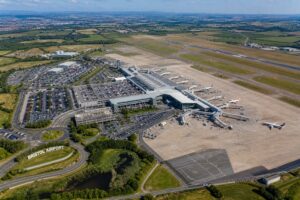
In Bristol, what began as a contentious local planning dispute has evolved into a defining moment in the debate over aviation and climate responsibility. The expansion of Bristol Airport is no longer just about regional growth: it has become a symbol of the difficult balancing act between economic ambition and environmental commitments.
Bristol: the story so far
Bristol Airport has long sought to expand its capacity to meet growing passenger demand. Its plans aim to increase annual traffic to around 15 million passengers, alongside upgrades to terminal facilities and infrastructure. Supporters argue this would boost regional connectivity, create jobs, and strengthen the local economy.
However, the proposal has faced persistent resistance. In 2020, local authorities rejected the expansion, citing environmental concerns and the broader implications for climate change. Campaigners warned that increasing air traffic would lead to higher emissions and worsen the region’s carbon footprint.
What followed was a prolonged legal and planning battle. Appeals, public inquiries, and court proceedings stretched over several years. Ultimately, the expansion received approval, with legal challenges dismissed, allowing the airport to move forward with its plans.
While this may appear to be a resolved local issue, the underlying questions remain far from settled.
A local issue with national implications
The Bristol case reflects a broader tension playing out across the UK and beyond. Airports are seeking to expand in response to rising demand for air travel, yet governments are simultaneously committing to ambitious climate targets.
This contradiction is particularly stark in aviation. Unlike sectors such as energy or road transport, aviation is far more difficult to decarbonise. Aircraft still rely heavily on fossil fuels, and while incremental efficiency gains have been made, large-scale low-carbon alternatives are not yet widely available.
As a result, every airport expansion raises the same question: can increasing passenger numbers be reconciled with reducing emissions?
Can aviation expansion and climate goals co-exist?
Supporters of aviation growth argue that expansion and climate commitments can coexist. They point to advances in aircraft efficiency, improvements in air traffic management, and the development of sustainable aviation fuels as evidence that the industry is moving in the right direction.
There is also a regional argument. Expanding airports like Bristol could reduce the need for passengers to travel long distances by road to larger hubs, potentially cutting emissions from ground transport.
From this perspective, the focus should not be on limiting aviation growth but on making flying cleaner and more efficient over time.
Critics, however, argue that this optimism overlooks a fundamental issue: total emissions. Even if aircraft become more efficient, a significant increase in the number of flights could outweigh those gains.
Aviation emissions are particularly complex because of their impact at high altitudes, where they contribute more significantly to warming. This makes the sector’s overall climate footprint larger than it might initially appear.
Environmental groups also question the reliance on future technologies. While sustainable fuels and zero-emission aircraft are being developed, they are not yet available at the scale required to offset near-term growth. Betting on these solutions, critics argue, risks delaying meaningful action today.
A deeper policy dilemma
The situation in Bristol highlights a broader policy challenge. Governments face competing priorities: supporting economic growth and connectivity while also meeting legally binding climate targets.
Some experts suggest that addressing this tension will require more than technological solutions. It may involve managing demand for air travel through policy measures such as taxation, investment in alternative transport, or limits on airport capacity.
Yet these options are politically sensitive. Air travel has become a routine part of modern life, and restricting it could have economic and social consequences.
More than a local story
Bristol Airport’s expansion is not an isolated case. It is part of a wider global debate about the future of aviation in a warming world.
The decision to move ahead reflects confidence in economic benefits and technological progress. At the same time, it underscores the growing pressure to ensure that such growth does not come at the expense of climate goals.
The core question remains unresolved: can aviation continue to expand without undermining climate commitments?
For now, Bristol offers no definitive answer. Instead, it serves as a reminder of the difficult choices ahead. As demand for air travel continues to rise, governments and industries will need to confront the limits of growth in a carbon-constrained world.
Whether aviation can truly align with climate targets will depend not just on innovation, but on the willingness to make hard policy decisions: decisions that go beyond local disputes and speak to the global challenge of balancing development with sustainability.
References:
https://www.bbc.com/news/articles/cdj7vjxl033o
https://www.sciencedirect.com/science/article/abs/pii/S2210539521000833
https://bura.brunel.ac.uk/bitstream/2438/32060/5/FullText.pdf
Banner Image: AI Generated
Sections of this article may have been developed with the assistance of artificial intelligence tools to support research, drafting, and language refinement. All information has been reviewed, edited, and verified by the author/editor to ensure accuracy, context, and editorial integrity. The responsibility for the final content, interpretations, and conclusions rests solely with the publisher.