Physical Address
23,24,25 & 26, 2nd Floor, Software Technology Park India, Opp: Garware Stadium,MIDC, Chikalthana, Aurangabad, Maharashtra – 431001 India
Physical Address
23,24,25 & 26, 2nd Floor, Software Technology Park India, Opp: Garware Stadium,MIDC, Chikalthana, Aurangabad, Maharashtra – 431001 India

For millions of people, dogs are more than pets. They are companions, family members and familiar faces waiting at the door after a long day. Yet while we often think about their health in terms of food, vaccinations and exercise, another factor is quietly reshaping their lives: the changing climate.
August 26, observed as International Dog Day, offers an opportunity to look beyond conventional pet care and ask a less obvious question: What happens to our fur babies when the world around them becomes hotter, wetter and more unpredictable?
From extreme heat and scorching pavements to thunderstorms, flooding and shrinking access to water, climate change is creating risks that dogs cannot escape on their own.
When Heat Becomes a Health Threat
Heat does not affect every dog equally. Some breeds are naturally more vulnerable because of their physical characteristics. Dogs with thick coats, larger bodies and, particularly, short or flattened snouts can struggle to cool themselves efficiently.
Studies involving hundreds of thousands of dogs have found considerable differences in susceptibility to heat-related illness among breeds. Bulldogs, French Bulldogs and Chow Chows, among others, have been identified as particularly vulnerable. Flat-faced breeds such as Pugs can also face greater difficulty because their shortened airways make efficient cooling through panting more challenging.
This matters in a warming country like India, where temperatures can remain high for prolonged periods and humidity can further increase heat stress. Breeds that evolved in colder environments can also struggle when exposed to intense Indian summers.
Heatstroke is far more serious than ordinary discomfort. As a dog’s body temperature rises, it can lead to severe physiological stress, organ damage and, in some cases, death. Older dogs, puppies, overweight animals and those with certain health conditions may be especially vulnerable.
The Pavement Problem and the Water Crisis
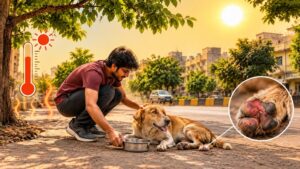
For dogs living in cities, the danger can literally be under their feet. Concrete and asphalt absorb enormous amounts of heat and can become substantially hotter than the surrounding air. A pavement that feels merely warm to a person wearing shoes can burn a dog’s unprotected paw pads.
Redness, blisters, peeling skin and raw patches can result from walking on overheated surfaces. During severe summer conditions, shifting walks to early morning or late evening, choosing shaded or grassy routes and avoiding hot roads can make a significant difference.
The simplest protection, however, remains access to clean drinking water and shade.
Dogs cool themselves primarily through panting, making hydration especially important during hot weather. This becomes an even bigger concern for street dogs, which cannot simply enter an air-conditioned room or find a fresh water source whenever they need one. Construction, disappearing open spaces, reduced shade and drying water sources can make survival increasingly difficult.
A bowl of clean water placed in a shaded and accessible location may appear insignificant, but during an extreme heat event, it can be a lifeline.
When Storms Become a Source of Fear
Climate-related risks are not limited to temperature. More intense storms and heavy rainfall can also affect dogs, particularly through fear and disruption.
Thunderstorms can trigger severe anxiety in some animals. Trembling, pacing, whining, hiding, excessive barking and attempts to escape are common signs. Research has shown that dogs with storm phobia can experience substantial physiological stress during thunderstorms. For pet owners, extreme weather means ensuring that dogs remain indoors and secure during severe storms. A frightened animal can easily bolt through an open gate or door. For street dogs, the problem is even more difficult. Heavy rain and flooding can destroy familiar resting places, disrupt feeding locations and leave animals exposed to dangerous conditions. This is why climate resilience for animals needs to be considered at the community level too. Covered spaces, accessible water points, shaded areas and safe shelter can help street animals cope with increasingly harsh weather.
A Climate Issue With Four Paws
Veterinarian Shubhi Saxena told CFC India that she has observed more dogs struggling with extreme heat, including dehydration, heat stress and painful paw-pad injuries caused by hot asphalt and concrete. She noted that owners sometimes realise the seriousness of the problem only after their dogs begin limping or refusing to walk.
Climate change is often discussed through graphs showing temperature records, rainfall patterns and carbon emissions. But its effects are also visible at street level: in a dog searching for shade, refusing to cross a hot road or seeking shelter before a storm.
This International Dog Day, caring for man’s best friend can therefore mean something more than a treat or a longer walk. It can mean leaving out a bowl of water, creating a shaded corner, avoiding the afternoon heat and keeping animals secure during storms.
These may seem like small actions. But in a climate that is becoming increasingly extreme, small acts of protection can become acts of survival.
References:
https://www.dw.com/en/indias-forgotten-stray-animals-suffer-under-record-heat-waves/a-62233286
https://www.researchgate.net/publication/393003762_A_Comprehensive_Review_of_Indian_Stray_Dogs
https://www.nature.com/articles/s41598-020-66015-8
Banner Image: AI generated
Sections of this article may have been developed with the assistance of artificial intelligence tools to support research, drafting, and language refinement. All information has been reviewed, edited, and verified by the author/editor to ensure accuracy, context, and editorial integrity. The responsibility for the final content, interpretations, and conclusions rests solely with the publisher.