Physical Address
23,24,25 & 26, 2nd Floor, Software Technology Park India, Opp: Garware Stadium,MIDC, Chikalthana, Aurangabad, Maharashtra – 431001 India
Physical Address
23,24,25 & 26, 2nd Floor, Software Technology Park India, Opp: Garware Stadium,MIDC, Chikalthana, Aurangabad, Maharashtra – 431001 India

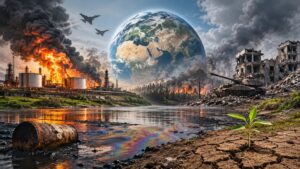
From 311M tonnes of CO2 in Ukraine to toxic aquifers in Gaza, discover how ongoing global wars are devastating ecosystems and accelerating climate change.
Wars are usually measured in human casualties, displacement, damaged cities and economic losses. Yet another victim receives far less attention: the environment. Oil facilities burn, pollutants enter waterways, forests are damaged and farmland becomes unsafe. These effects cross borders and can undermine livelihoods long after fighting stops.
The International Day for Preventing the Exploitation of the Environment in War and Armed Conflict, observed on November 6, reminds us that environmental protection is inseparable from human security. The conflict involving Iran, Israel and the United States, alongside Russia’s war in Ukraine, shows how modern warfare leaves behind pollution, damaged ecosystems and weakened essential services.
War’s Invisible Casualty: The Environment
Environmental harm is not limited to deliberate attacks on natural resources. Strikes on oil depots, refineries, power stations, factories and water infrastructure can release hazardous substances or disrupt services essential to public health. Explosions and fires add smoke and fine particles to the air; damaged storage tanks can leak fuel; and disrupted sewage treatment can send untreated wastewater into rivers.
Assessing the damage during active fighting is difficult. Monitoring stations may be destroyed, access to affected areas restricted and emergency services overwhelmed. Damage to soil, groundwater, wildlife and health may become clear only later.
West Asia: Oil Fires and the Threat of Toxic Pollution
The conflict involving Iran, Israel and the United States has shown how attacks on energy infrastructure can quickly become an environmental emergency. In March 2026, strikes on oil storage facilities around Tehran triggered large fires and sent thick plumes of smoke across the capital. Burning petroleum releases soot, fine particles and hazardous pollutants into the air. After the fires, residents reported dark deposits and rain described as ‘black rain’. Human Rights Watch documented soot covering outdoor surfaces and raised concerns about hazardous substances. Fallout can settle on soil and vegetation before washing into waterways. Its full extent requires systematic testing.
The risks extend across the region. Oil spills and damage to ports or vessels threaten Persian Gulf marine habitats and fisheries. Water infrastructure is also vulnerable. In an arid region where several countries rely heavily on desalination, damage to plants, power supplies or distribution networks could further threaten freshwater security. The Conflict and Environment Observatory (CEOBS) identified more than 300 potential environmental-harm incidents across the region between February 28 and March 10, 2026, while noting that its rapid assessment required further verification. This highlights the geographical scale of environmental risks arising from the conflict.
Ukraine: A Landscape Scarred by Prolonged Warfare
In Ukraine, environmental damage has accumulated over years of fighting. Attacks on energy and industrial facilities, fires and the use of explosive weapons have affected air, soils, water bodies, forests and agricultural land. The United Nations Environment Programme (UNEP) has documented risks to biodiversity, protected areas, water resources and food security.
The destruction of the Kakhovka Dam in June 2023 showed how damage to critical infrastructure can devastate an entire river system. The breach flooded settlements and farmland, drained the reservoir and damaged wetlands. A UN-backed assessment warned that some environmental impacts could be irreversible, with consequences for ecosystems and human health lasting for decades.
In another cross-border incident, a Russian attack on energy infrastructure on March 7, 2026, was followed by reports of oil pollution in the Dniester River. Ukrainian authorities said oily slicks were detected along the river and laboratory tests found petroleum products above permitted levels. As the Dniester also flows through Moldova, the incident highlighted how wartime pollution can affect neighbouring countries. Landmines and unexploded ordnance leave fields and natural areas unsafe, complicating restoration and threatening both people and wildlife.
The Environmental Fallout Will Outlast the Wars
A ceasefire cannot automatically remove contaminants from soil, restore wetlands or make mined land safe. Polluted water needs treatment, habitats need time to recover, and communities face lasting risks. War also generates greenhouse gas emissions through military fuel use, fires, damaged infrastructure and reconstruction.
International humanitarian law includes protections against certain forms of widespread, long-term and severe environmental damage during armed conflict. But rules matter only when respected and enforced. Recovery must include environmental assessments, pollution clean-up, removal of explosive remnants and ecosystem restoration. These measures should be built into post-war reconstruction rather than postponed until other priorities have been addressed.
November 6 should be more than a commemorative date. It should prompt governments and international institutions to treat the environment as an essential part of conflict prevention, humanitarian response and peacebuilding. Rivers do not stop at borders, toxic smoke does not recognise ceasefires, and damaged ecosystems cannot be rebuilt overnight. Peace must mean more than the silence of weapons; it must also mean the return of clean air, safe water, fertile soil and functioning natural systems.
References:
https://www.researchgate.net/publication/387591902_The_Impact_of_War_on_the_Environment
https://www.un.org/en/observances/environment-in-war-protection-day
https://ijsshr.in/v9i10/Doc/51.pdf
Operation Epic Fury: emerging environmental harm and risks in Iran and the region
Banner Image: AI generated
Sections of this article may have been developed with the assistance of artificial intelligence tools to support research, drafting, and language refinement. All information has been reviewed, edited, and verified by the author/editor to ensure accuracy, context, and editorial integrity. The responsibility for the final content, interpretations, and conclusions rests solely with the publisher.