Physical Address
23,24,25 & 26, 2nd Floor, Software Technology Park India, Opp: Garware Stadium,MIDC, Chikalthana, Aurangabad, Maharashtra – 431001 India
Physical Address
23,24,25 & 26, 2nd Floor, Software Technology Park India, Opp: Garware Stadium,MIDC, Chikalthana, Aurangabad, Maharashtra – 431001 India
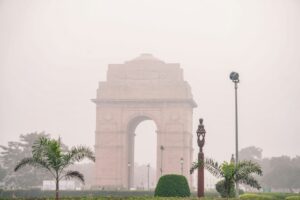
Delhi's winter AQI crosses 400 into the Severe zone as CSE reports a 3-year high in PM2.5 driven by traffic and local emissions. Read the full analysis.
Delhi’s air pollution remained in the ‘very poor’ category on November 14, with the city’s average Air Quality Index (AQI) recorded at 348 at 7 am, a day after it crossed 400 and entered the ‘severe’ category. At least seven monitoring stations reported severe pollution levels, with North Campus recording an AQI of 421, followed by IIT Delhi at 419, ITO at 415 and Burari Crossing at 410. The latest deterioration follows a troubling pattern identified in a new analysis by the Centre for Science and Environment (CSE), which found that Delhi’s average PM2.5 concentration during the week before Diwali reached a three-year high in 2026. The findings point to persistent pollution from vehicles, regional emissions and other urban sources, extending beyond the annual spike caused by firecrackers.
Delhi’s pre-Diwali PM2.5 pollution reaches a three-year high
Delhi recorded an average PM2.5 concentration of 236 micrograms per cubic meter (µg/m³) in the week preceding Diwali, according to the CSE analysis. This was 97% higher than the 120 µg/m³ recorded during the same period in 2025 and 32% higher than the 179 µg/m³ recorded in 2024. PM2.5 is fine particulate matter with a diameter of 2.5 micrometres or less. These particles can enter deep into the respiratory system, and long-term exposure is a major public health issue. The national 24-hour permissible limit for PM2.5 is 60 µg/m³, which means the pre-Diwali average was almost four times that benchmark.
Pollution levels kept going up during the festival. Delhi’s AQI stood at 376 at 4 pm on November 8, the most polluted Diwali day in five years, Times of India reported. Average concentration of PM2.5 on Diwali was 257 µg/m3 as against 228 µg/m3 in 2025 and 201 µg/m3 in 2024. The Indian Institute of Tropical Meteorology recorded an average PM2.5 concentration of 671.1 µg/m³ at midnight. But the CSE analysis suggests firecrackers added to an already polluted atmosphere, rather than being the sole reason for the deterioration. Delhi had mostly recorded higher levels of pollution in 2026 as compared to 2025, barring a brief respite from the rains in late September.
Vehicles and regional emissions drive Delhi’s winter smog
CSE study, using data from the Decision Support System of the Indian Institute of Tropical Meteorology, found that 54.43% of Delhi’s PM2.5 burden between November 1 and 8 was due to pollution transported from neighbouring National Capital Region districts. Transport was the largest contributor to local pollution sources in Delhi, contributing 52%. Residential activities accounted for 13 per cent and peripheral industries for 11 per cent. Construction accounted for 7 per cent, followed by energy use and waste burning at 5 per cent each.
The findings show that daily urban emissions and pollution carried from all over the region continue to be major contributors to the worsening air quality in Delhi. Contribution of stubble burning also declined near Diwali, but pollution levels remained high. On November 4, the peak of the season, farm-fire smoke accounted for 16.2% of Delhi’s PM2.5 pollution, before dropping to around 8% on November 6, when the city’s AQI hit 382, and GRAP Stage III restrictions were invoked.
CSE also found that the emergency traffic restrictions implemented in early November had little impact on weekday congestion. The average daily Travel Time Index for November 2-6 was 2.40, virtually unchanged from 2.38 on Oct. 30. Nitrogen dioxide, an important marker for vehicular pollution, peaked at 67 µg/m³ at 7 pm and stayed above 55 µg/m³ until midnight. This means that air quality is affected by evening traffic emissions long after the rush hour congestion has cleared.
Long-term exposure raises concerns over respiratory and cancer risks
Polluted air can lead to irritated eyes and throat, coughing and trouble breathing, but these are not the only health concerns. The International Agency for Research on Cancer (IARC), part of the World Health Organisation, placed outdoor air pollution and particulate matter in Group 1, meaning they are known to cause cancer in humans. This does not mean everyone exposed to polluted air will develop cancer. It means that staying exposed over many years raises the risk across the population.
Delhi’s yearly pollution figures show why daily AQI readings do not tell the whole story. A report submitted to the Rajya Sabha last year put the city’s average PM2.5 level at 104.9 µg/m³ in 2024. This was over twice India’s annual limit of 40 µg/m³ and almost 21 times the WHO’s annual guideline of 5 µg/m³. Children, older people, pregnant women, outdoor workers and people with existing breathing problems are more likely to face health effects. Wearing a well-fitted mask that filters fine particles and avoiding strenuous outdoor activity when pollution is severe can help reduce exposure. But these steps cannot take the place of reducing pollution at its source.
CSE has called for better public transport, less use of private vehicles, tighter checks on industrial emissions and action on pollution across Delhi-NCR. The findings show that cleaner air will require cuts in emissions throughout the year, not just emergency restrictions brought in when winter smog becomes severe.
References:
Delhi AQI remains very poor at 348, several monitoring stations record severe pollution
CSE releases early-winter post-Diwali air pollution analysis for Delhi-NCR
PR 221 – IARC: Outdoor air pollution a leading environmental cause of cancer deaths
Banner image: Photo by Ashish Kushwaha on Unsplash
Sections of this article may have been developed with the assistance of artificial intelligence tools to support research, drafting, and language refinement. All information has been reviewed, edited, and verified by the author/editor to ensure accuracy, context, and editorial integrity. The responsibility for the final content, interpretations, and conclusions rests solely with the publisher.