Physical Address
23,24,25 & 26, 2nd Floor, Software Technology Park India, Opp: Garware Stadium,MIDC, Chikalthana, Aurangabad, Maharashtra – 431001 India
Physical Address
23,24,25 & 26, 2nd Floor, Software Technology Park India, Opp: Garware Stadium,MIDC, Chikalthana, Aurangabad, Maharashtra – 431001 India


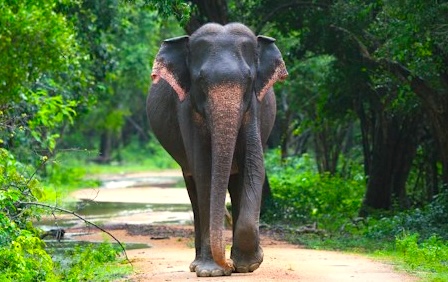
The elephant-headed god is in the pandals. The temple parades, fort safaris and interstate transfers that keep thousands of Asian elephants in harness are still running, and the rising heat is making the work more dangerous for the animals and the crowds around them.
Ganeshotsav is in its third day. Across Maharashtra, Goa, Karnataka, Telangana and Gujarat, clay idols of an elephant-headed god sit in homes and pandals, receiving two aartis a day. On September 25, Anant Chaturdashi, most of them will be carried out in procession and dissolved in water, taking the household’s obstacles with them. Several Mumbai mandals have built this year’s themes around animal welfare.
Several hundred kilometres away, a different set of elephants is also at work this week. Not clay ones. These have ownership certificates, ankle chains, mahouts, veterinary files of uneven quality, and in some states a booking rate.
India told the Supreme Court in August that it holds 2,725 captive elephants across 27 states and union territories. Of those, 1,678 are with private persons, 768 with forest departments, 332 in rehabilitation centres, 96 with temples, 63 in zoos and 47 still with circuses. The number has barely moved in years; a previous census counted 2,675. For scale, India’s first DNA-based wild elephant estimate, released in October 2025, put the free-ranging population at 22,446, a figure the Wildlife Institute of India asked people to treat as a fresh baseline rather than a comparison with older visual counts.
There is a newer finding that has drawn less attention than it deserves. Environment ministry data recorded in February and reported this month shows that of 2,075 captive elephants whose DNA has been mapped, roughly 40 per cent were classified as being of unknown origin and about 25 per cent as wild-caught, with only 34 per cent confirmed as born in captivity. Around two-thirds of the mapped population, in other words, cannot be documented as legitimately captive-bred. Wild capture has been illegal for decades.
The court that asked for the elephant to be treated like the God
On August 18, a bench of Chief Justice Surya Kant, Justice Joymalya Bagchi and Justice V Mohana issued directions on captive elephant welfare. Ownership or transfer without documentation of transferor, transferee and purpose is out. Owners must take elephants for medical checkups and keep records. The Union was asked to work with states on elephant clinics with specialised services, to set minimum standards for housing and upkeep, and to build a mechanism for renewing ownership certificates rather than treating them as permanent title.
When a counsel for an elephant owners’ association argued that Hindu temple traditions were being singled out, Justice Bagchi’s reply was blunt: “Take care of the elephant equivalent to a deity. Not your servant.” The bench also noted that an ownership certificate does not make anyone the owner of a wild animal, since elephants are a natural resource vested in the state.
What the court did not do is order an end to captivity. The reasoning was practical: with only four rehabilitation centres in the country, one each in Mathura, Gujarat, Kerala and Karnataka, a blanket ban risks producing abandoned elephants that nobody feeds. That is the bind. The system is large enough to be harmful and too small to be undone quickly.
Five elephants on the road from Assam
The test of those directions arrived within weeks, and it is being argued in the Madras High Court today. Five young captive elephants from Assam have been lined up for donation to temples and a mutt in Tamil Nadu. The first, a five-year-old female named Durga, left Assam on September 7 and reached the Meenakshi Amman Temple in Madurai on September 13, a journey of roughly 3,000 kilometres. Four others, named in correspondence as Hiralal, Shiva, Rupsing and Bijuli, are destined for the Arunachaleswarar Temple at Tiruvannamalai, the Vaidyanatha Swamy Temple at Vaitheeswaran Koil, and the Kanchi Kamakoti gajashala at Kancheepuram. Applications for those four remain under review, and the court has asked the state to decide them within a week.
The legal door opened earlier this month, when the Madras High Court clarified that its earlier bar on taking elephants into captivity was aimed at fresh capture from the wild and did not cover the transfer or donation of animals already in captivity. That reading sits alongside the Captive Elephant (Transfer or Transport) Rules, 2024, which allow a chief wildlife warden to permit interstate movement where an owner can no longer maintain an elephant or where the animal would have better upkeep elsewhere. Welfare groups warned when those rules were notified that “better upkeep” is a phrase capable of moving a great many elephants.
Objections to the current transfers are procedural rather than sentimental, which makes them harder to wave away. The environmental activist Rohit Choudhury wrote to the Supreme Court-appointed High Powered Committee on September 11 asking it to halt the four pending moves and examine Durga’s, arguing that a chief wildlife warden can issue travel permits only on that committee’s recommendation.
Reports also note that the Madurai facility was inspected on the same day the recommendation for interstate transfer was issued. Tamil Nadu has been here before: the case of Joymala, leased from Assam in 2008 and never returned, ran through two high courts after PETA India released video of her being beaten inside a temple.
Kerala runs the busiest calendar
Kerala is where the numbers get uncomfortable. The state has somewhere around 400 captive elephants, with published estimates ranging between roughly 345 and 430 depending on the year and the counter. Of those, about 300 are male elephants in active festival use, servicing an estimated 5,000 temple festivals that peak between January and April. Campaigners have documented individual elephants taken to two or three events in a single day, sometimes carrying untreated wounds.
The economics explain the pace. One tusker, Thechikottukavu Ramachandran, fetched Rs 6.75 lakh for a single festival booking, a record at the time, despite having been linked to at least 13 human deaths and being under court-monitored parading limits. Most animals paraded by temples are not owned by them; they are leased from private holders and moved between venues, which is why the official count of 96 temple elephants badly understates religious use.
The consequences run both ways. Nine people died in rampages at Kerala temple festivals in 2024, and by mid-February 2025 six more had been killed, a toll then close to deaths caused by wild elephants in the same state. Campaign groups keep their own tallies, which are not official statistics: the Heritage Animal Task Force puts the count at 526 deaths over 15 years, and the Centre for Research on Animal Rights says 138 captive elephants died between 2018 and 2023.
Impact of a Changing Climate
An elephant is a badly shaped animal for a warming country. Mass rises faster than surface area, so a five-tonne body generates heat quickly and sheds it slowly. Asian elephants manage thermal load through ear flapping, skin surface, shade, and above all water and mud, which is why free-ranging elephants organise their day around bathing and wallowing. An elephant standing on tar at a festival, under decorative caparisons, surrounded by drums, firecrackers and a crowd, has almost none of those options.
The research base is thin for India but consistent in direction. Work on Sumatran elephants published this year found that ambient temperature, humidity and the combined temperature-humidity index were significant predictors of cortisol levels, the standard physiological marker of stress. A long-running study of captive Asian elephants in Thailand found the same index correlating with oxidative stress markers and with faecal glucocorticoid metabolites. This is the heat-stress literature familiar from dairy cattle, extended to a larger and less heat-tolerant animal.
Kerala’s own forest department figures point the same way. Numbers from its social forestry division, reported in April, showed Thrissur recording 19 incidents of captive elephants running amok in the first four months of this year, against 26 across the comparable previous season. Ernakulam logged six against three. Palakkad, dry and hot, recorded nine in four months, already past the seven of the full previous season, and officials expected the totals to climb through May.
This needs stating carefully, because the temptation to overclaim is strong. Nobody has run a formal attribution study linking a specific festival season’s heat to a specific number of elephant incidents in India. Departmental counts are shaped by reporting practice, by how many festivals were held and by which animals were available. What can be said is narrower and still serious: heat stress in elephants is well established physiologically, Indian festival seasons increasingly run through hotter conditions, and the people closest to these animals are reporting more incidents as temperatures rise. Treating that as coincidence takes more faith than treating it as a warning.
Forts, safaris and a claim worth checking
The tourism side of captivity is concentrated in Rajasthan, where elephants carry visitors up the ramp to Amer Fort in Jaipur. An Animal Welfare Board of India examination in 2017-18 looked at 102 elephants there and found 19 blind in one or both eyes, 10 with tuberculosis, 28 aged over 50, foot problems in every single animal, and stereotypic swaying consistent with severe psychological distress. Inspectors recorded loads above the 200 kg legal maximum for hilly terrain. Tuberculosis in these animals is not only their problem. It transmits to humans, mahouts and tourists included.
At the August hearing, a counsel told the Supreme Court that parading of elephants at Rajasthan’s forts had stopped. That claim deserves scrutiny. Operator listings updated through 2026 still describe Amer Fort rides as bookable on the day, and PETA India was petitioning the Rajasthan chief minister in April after two elephants fought at the fort and a passing motorcyclist was hospitalised. Removing unfit animals is not the same as ending the practice.
What is actually changing
Some of the movement is technological and strange. Since a mechanical elephant named Raman was gifted to a Thrissur temple by PETA India in 2023, a small industry has grown around the idea. In a backyard workshop in Chalakudy, a mechanical engineer builds animatronic elephants with ears that flap, tails that swish and trunks that squirt water. Traditionalists say the substitution hollows out the ritual. The counter-argument, made by the Centre for Research on Animal Rights among others, is that scripture does not require a live elephant in a procession at all.
Some of it is administrative. The Gajah Suchana app now holds a national genetic database of DNA profiles and ownership details, and the court asked in August whether profiling is complete and reflected there. The ministry also released a husbandry manual, Captive Elephant Husbandry: Science, Welfare and Practice, at last month’s World Elephant Day event in Visakhapatnam. Whether any of it produces welfare depends on enforcement, which is precisely what the court was probing.
Some of it is older and quietly effective. Tamil Nadu has run rejuvenation camps for temple and mutt elephants since 2003, now at Thekkampatti on the Bhavani, where for 48 days the animals come off duty and get a specialist diet, treatment and river access. The state has allocated Rs 3 crore for the camp in 2026-27. Not abolition, but a structured rest period, and one that could be mandated nationally tomorrow.
The region is moving faster in places. Indonesia banned elephant rides and forced performances nationwide in early 2026, and Bangladesh brought in regulations in May barring exploitative use. India banned elephants in circuses but left tourism and religious use largely intact, with 47 circus elephants still on the books this year.
The gap the festival exposes
Ganeshotsav itself barely uses live elephants. It runs on clay, plaster, dhol-tasha and idol-makers, and its association with the animal is symbolic. That is what makes the date a useful place to ask the question. India’s reverence for elephants is not in doubt. The animal is the national heritage animal, protected under Schedule I of the Wildlife Protection Act and listed on CITES Appendix I. The doubt is about what happens between the reverence and the daily reality of 2,725 animals, most of them in private hands, two-thirds of the DNA-mapped ones unable to show a lawful origin.
On September 25 the idols go into the water and the obstacles are believed to go with them. The elephants that spent this month standing on hot tar in front of loudspeakers will still be standing there in October. What the Supreme Court asked in August was not whether Indians love elephants. It was whether that love reaches as far as the animal itself.
References
65% of DNA-mapped captive elephants have unknown or wild-caught origins: MoEFCC data
Assam Elephant ‘Durga’ To Be Transferred To Madurai Meenakshi Temple, Activists Raise Concerns
https://www.pressreader.com/india/the-hindu-thiruvananthapuram-9WWe/20240325/281629605267707
https://www.deccanherald.com/india/row-over-elephant-booked-for-675-l-for-kerala-temple-1188766.html
https://onlinelibrary.wiley.com/doi/10.1155/vmi/1184315
https://www.ncbi.nlm.nih.gov/pmc/articles/PMC10546319
https://www.pressreader.com/india/hindustan-times-st-jaipur/20180425/281638190812661
https://www.drishtiias.com/daily-updates/daily-news-analysis/world-elephant-day-2026
Banner Image: AI Generated
Sections of this article may have been developed with the assistance of artificial intelligence tools to support research, drafting, and language refinement. All information has been reviewed, edited, and verified by the author/editor to ensure accuracy, context, and editorial integrity. The responsibility for the final content, interpretations, and conclusions rests solely with the publisher.