Physical Address
23,24,25 & 26, 2nd Floor, Software Technology Park India, Opp: Garware Stadium,MIDC, Chikalthana, Aurangabad, Maharashtra – 431001 India
Physical Address
23,24,25 & 26, 2nd Floor, Software Technology Park India, Opp: Garware Stadium,MIDC, Chikalthana, Aurangabad, Maharashtra – 431001 India
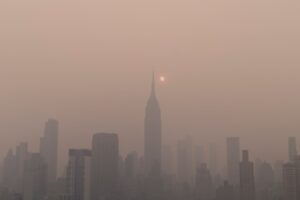
A viral post shared by Steve Milloy claims that poor air quality in cities such as Phoenix and Salt Lake City is mainly caused by meteorological inversions and not pollution sources. The post also claims that pollutants like ozone and particulate matter do not harm human health and that only rare acidic gas events like the 1948 Donora smog disaster could cause health problems. However, scientific evidence from the World Health Organisation and the United States Environmental Protection Agency contradicts these claims. Research conducted over several decades has consistently linked particulate matter and ground-level ozone to respiratory illness, cardiovascular disease, and premature deaths.
Claim Post:
Claim 1: “Poor air quality in places like Phoenix and Salt Lake City is mostly caused by meteorological inversions that trap air in the valleys where these cities are located.”
Fact: Misleading. Inversions trap pollution but do not create it. Temperature inversions occur when a layer of warm air sits above cooler air near the ground, preventing pollutants from dispersing upward. Scientists acknowledge that inversions can worsen smog episodes in valley cities such as Salt Lake City and Phoenix. However, inversions themselves are not the main source of pollution.
According to the EPA and WHO, air pollution primarily comes from emissions released by vehicles, industrial facilities, fossil fuel combustion, construction activities, and wildfires. Meteorological conditions only influence how long those pollutants remain concentrated in the atmosphere. Without these emissions, inversion events would not produce severe air pollution on their own.
Claim 2: “Despite how the air looks, pollutants like ozone and particulate matter do not harm health. EPA has lots of data that establish this.”
Fact: False. EPA and WHO say ozone and particulate matter are harmful to human health. The claim directly conflicts with findings published by both the EPA and WHO. The EPA states that breathing ground-level ozone pollution can inflame airways, reduce lung function, trigger asthma attacks, and increase respiratory complications even at relatively low concentrations.
Scientific evidence on particulate matter is even stronger. Fine particulate matter known as PM2.5 can enter deep into the lungs and bloodstream due to its microscopic size. WHO says exposure to particulate matter is associated with heart disease, stroke, lung cancer, asthma, and premature death. WHO assessment reports that the combined effects of ambient air pollution and household air pollution are associated with 6.7 million premature deaths annually.
Claim 3: “What could possibly cause health problems during inversions is if there were emissions of acidic gases that got concentrated as occurred in October 1948 in Donora, Pennsylvania.”
Fact: False. Scientific studies have linked everyday air pollution exposure to serious health risks. The Donora smog disaster of 1948 remains one of the deadliest air pollution events in US history, but scientific evidence shows that harmful health effects are not limited to rare industrial disasters or highly acidic gas exposure. Researchers have spent decades studying how regular exposure to polluted air affects human health, particularly in urban areas where people are exposed to vehicle emissions, industrial pollution, and fossil fuel combustion on a daily basis.
Multiple epidemiological studies have linked long-term exposure to pollutants such as PM2.5 and ozone with higher risks of respiratory disease, cardiovascular illness, lung cancer, and premature death. A study found consistent associations between long-term particulate matter exposure and increased mortality from cardiovascular and respiratory diseases. The World Health Organisation and the United States Environmental Protection Agency also recognise PM2.5 and ground-level ozone as major public health risks, even at pollution levels commonly observed in cities today.
The viral claims, therefore, misrepresent both atmospheric science and the established medical evidence on air pollution and health.
The Science Behind Ozone, PM2.5, and Human Health Risks
For decades, scientists and public health experts have been studying what polluted air does to the human body. Their findings have remained largely consistent across countries and research institutions. Fine particulate matter, commonly called PM2.5, and ground-level ozone are now widely recognised as two of the most harmful pollutants people breathe in every day, especially in urban areas with heavy traffic, industrial emissions, and fossil fuel use.
PM2.5 particles are so tiny that they can bypass the body’s natural defence system and settle deep inside the lungs. Some particles can even enter the bloodstream. Studies reviewed by the World Health Organisation and the United States Environmental Protection Agency have linked long-term exposure to these pollutants with asthma, heart disease, stroke, lung cancer, breathing difficulties, and premature deaths. Ozone pollution can also inflame the airways and make it harder to breathe, particularly for children, elderly people, and those already living with respiratory illnesses. This is why air quality alerts are issued during high pollution days in many cities around the world.
References:
https://www.britannica.com/science/temperature-inversion
https://www.iqair.com/in-en/newsroom/inversion-leads-air-quality-crisis-salt-lake-city
https://www.epa.gov/ghgemissions/sources-greenhouse-gas-emissions
https://www.epa.gov/ground-level-ozone-pollution/health-effects-ozone-pollution
https://pmc.ncbi.nlm.nih.gov/articles/PMC4740125
https://www.who.int/news-room/fact-sheets/detail/ambient-(outdoor)-air-quality-and-health
https://pmc.ncbi.nlm.nih.gov/articles/PMC5922205
Banner image: Photo by Ahmer Kalam on Unsplash
Sections of this article may have been developed with the assistance of artificial intelligence tools to support research, drafting and language refinement. All information has been reviewed, edited and verified by the author/editor to ensure accuracy, context and editorial integrity. The responsibility for the final content, interpretations and conclusions rests solely with the publisher.