Physical Address
23,24,25 & 26, 2nd Floor, Software Technology Park India, Opp: Garware Stadium,MIDC, Chikalthana, Aurangabad, Maharashtra – 431001 India
Physical Address
23,24,25 & 26, 2nd Floor, Software Technology Park India, Opp: Garware Stadium,MIDC, Chikalthana, Aurangabad, Maharashtra – 431001 India
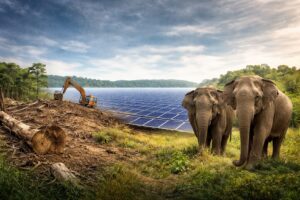
Sri Lanka’s push for clean energy is now at the centre of an unfolding environmental crisis. In Hambantota, more than 1,000 acres of protected forest inside the Elephant Management Reserve have reportedly been cleared, burned and stripped, to make space for large-scale solar parks. Key elephant corridors like Sanakku Gala, Orukemgala, and Kapapu Wewa are being bulldozed. Local activist Sajeewa Chamikara warns that deforestation violates Sri Lanka’s own laws: under the National Environmental Act, any large-scale land conversion requires an Environmental Impact Assessment (EIA) and formal approval. Read here
According to a Supreme Court petition by the Centre for Environmental Justice, these projects have proceeded without the mandated approvals; such breaches are “a direct violation” of the law. Read here
Bypassed Permits and Oversight Failures
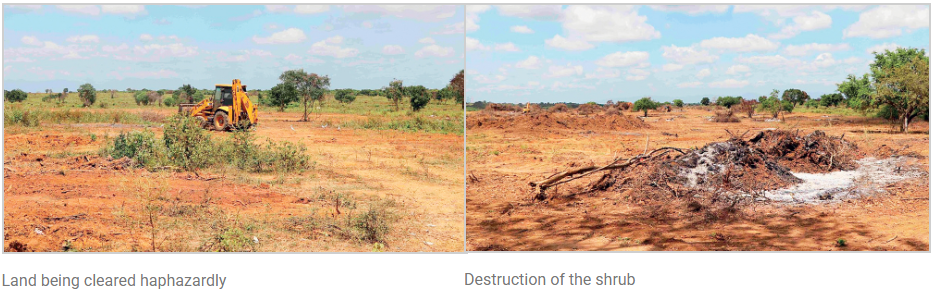
Reports allege that proper permitting was skipped. Sajeewa Chamikara, Advisor – Natural Resource Research and Advocacy at the Movement for Land and Agricultural Reform (MONLAR) notes that companies resumed clearing after paying bribes, without renewed committee approval. Sri Lanka’s regulations (Section 23B of the NEA) clearly require EIA clearance for projects over prescribed capacity. Read here. Yet satellite imagery and on-the-ground reports show forests being razed and even deliberately burned to prepare sites, with no EIA notices visible on site. Observers call this a governance failure: institutions meant to protect these lands have allegedly not enforced the rules.
Further, Chamikara said to The Island that “Nearly 1,000 acres of forest land within the elephant management reserve have been cleared using heavy machinery and, in some instances, by setting fires. This has caused severe and irreversible environmental damage in areas where elephants and other wildlife live.”
He further claimed that the projects had initially been suspended following a decision taken at the District Development Committee meeting held on January 29. However, the projects were later recommenced without the required fresh approval or review by the committee.
Ecological and Social Impacts
The cleared forests were critical elephant habitat and migration corridors. Destroying them has immediate consequences: elephants increasingly wander into villages in search of food, causing a spike in human–elephant conflict. Over 5,000 families have reported crop damage and dangerous encounters as a result.
In the long term, loss of forest undermines climate resilience. The loss of forest also undermines Sri Lanka’s climate goals: mature forests absorb CO₂, so burning or bulldozing them can increase emissions, offsetting gains from renewable energy. There is even concern that large-scale deforestation in the dry zone could alter local rainfall patterns, further harming agriculture. Thus, promoting solar energy while destroying forests “defeats the purpose” of reducing emissions. Read here
Renewable Energy vs. Conservation
Solar advocates argue Sri Lanka needs clean power. But critics point out the irony: Sri Lanka has international conservation on biological diversity commitments as well. Habitat specialists note that solar parks should avoid high-biodiversity zones. As Sameera Weerasinghe of the Udawalawe Elephant Project points out, the planned 150 MW solar park (US$150m) is the country’s largest, yet it sits in a rich elephant habitat. He said to the Daily Mirror “We are not against solar power. However, when there are plenty of alternative locations available, we oppose the use of forest areas rich in biodiversity and heavily populated by wild elephants for this purpose.” In effect, the drive for “green energy” is threatening the country’s wildlife. Clearing over 1,000 acres of elephant habitat for solar panels contradicts Sri Lanka’s conservation commitments and may worsen the human–elephant conflict. Read here
The Way Forward
This conflict highlights a broader tension: How to expand renewable energy without sacrificing biodiversity? Experts urge that solar expansion focus on rooftops and degraded lands, not on forests. Because the Paris Agreement promotes both decarbonisation (read Article 2 and Article 4) and ecosystem protection (read Article 5), not one at the expense of the other. Any renewable energy project that significantly damages forests or wildlife habitats risks undermining climate goals, because cutting emissions while destroying carbon sinks is internally contradictory. Therefore, the authorities must enforce existing laws rigorously: every large project needs public EIA review, and protected corridors must remain intact. The law is clear: environmental protection cannot be bypassed for private interests.
Reference:
Walsapugala case SC FR Application No. 301/2024
Banner Image: AI-generated
Sections of this article may have been developed with the assistance of artificial intelligence tools to support research, drafting, and language refinement. All information has been reviewed, edited, and verified by the author/editor to ensure accuracy, context, and editorial integrity. The responsibility for the final content, interpretations, and conclusions rests solely with the publisher.

Comments are closed.







[…] Elephants vs. Solar Power: How Hambantota’s Green Push Is Fueling Illegal Deforestation and Confli… […]