Physical Address
23,24,25 & 26, 2nd Floor, Software Technology Park India, Opp: Garware Stadium,MIDC, Chikalthana, Aurangabad, Maharashtra – 431001 India
Physical Address
23,24,25 & 26, 2nd Floor, Software Technology Park India, Opp: Garware Stadium,MIDC, Chikalthana, Aurangabad, Maharashtra – 431001 India
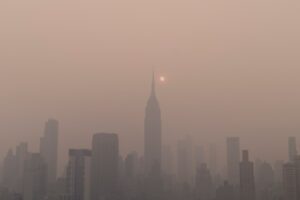
Air pollution continues to be one of the deadliest environmental threats, claiming around nine million lives annually across the world, according to a new assessment by the United Nations Environment Programme. The latest Global Environment Outlook 7 report shows that nearly the entire global population breathes air that fails to meet international safety standards. The findings draw a clear connection between worsening pollution and climate change, indicating that rising temperatures are intensifying the crisis instead of easing it.
The report notes that people in low and middle-income countries remain the most exposed. These regions face long-term pollution from industries, biomass burning and growing urban congestion. At the same time, they have limited resources to monitor and manage air quality, which deepens the health risks faced by millions of families living in polluted environments.
A Growing Health Emergency Around the World
The UN analysis places air pollution among the leading contributors to premature deaths. Fine particulate matter, toxic gases, trace pollutants and even microscopic plastic particles are entering human lungs and bloodstreams at levels that concern scientists. These pollutants are strongly linked to heart disease, respiratory illnesses, lung cancer and several neurological conditions, creating a burden on public health systems that is already difficult to manage.
The impact is not shared equally. More than 90% of the deaths linked to pollution occur in low and middle-income nations. Many of these regions lack clean energy access and rely on fuels that release harmful emissions. Urban residents also face frequent exposure to high pollution from transport corridors and industrial clusters. Together, these conditions form a daily health threat for millions who have limited protection from toxic air.
Climate Change Driving a Vicious Cycle of Poor Air Quality
The report warns that the effects of climate change are feeding into pollution trends. Rising global temperatures are increasing the frequency and scale of wildfires. These fires send vast amounts of smoke and harmful particles into the atmosphere, worsening air quality across continents. Longer periods of drought further dry out landscapes, making them more vulnerable to burning and extending the duration of smoky conditions.
Higher temperatures also influence chemical reactions in the atmosphere. Heat encourages the formation of ground-level ozone, which is a dangerous pollutant linked to breathing difficulties. This means that even regions that do not experience large fires are facing shifts in air quality patterns. Together, these climate-driven changes create a cycle where warming leads to pollution and pollution contributes to warming, drawing the two crises closer together.
Uneven Progress and a Call for Coordinated Action
Some parts of the world have reported improvements in certain pollutants due to stronger regulations and shifts toward cleaner energy. For example, several European and North American countries have recorded reductions in sulphur dioxide and other long-studied pollutants. Despite these gains, the report notes that many megacities, including those in South Asia, the Middle East and parts of Africa, continue to record extremely high concentrations of particulate matter.
The UN stresses that air pollution cannot be viewed in isolation. It is linked to biodiversity loss, soil degradation, economic disruption and rising climate impacts. The agency calls for integrated policies that address pollution control, land management and greenhouse gas emissions at the same time. Without coordinated action, the health and environmental toll will continue to grow in the coming decades.
References:
https://www.unep.org/resources/global-environment-outlook-7
https://wedocs.unep.org/handle/20.500.11822/49014
https://www.epa.gov/ground-level-ozone-pollution/ground-level-ozone-basics
Banner image: Photo byAhmer Kalam onUnsplash

Comments are closed.

F*ckin? amazing things here. I?m very glad to see your post. Thanks a lot and i’m looking forward to contact you. Will you please drop me a mail?
great post to read [url=https://sky-tide.com/]top stock brokers UK[/url]
Поэтапный подход помогает достичь устойчивых результатов и минимизировать вероятность рецидива, обеспечивая безопасность пациента на всех стадиях лечения.
Исследовать вопрос подробнее – http://narkologicheskaya-clinika-v-samare16.ru/narkolog-i-psikhiatr-samara/
нажмите, чтобы подробнее [url=https://krab1.com/]kraken вход tor[/url]
Капельница от запоя — доступная цена в стационаре Балашихи. Стоимость процедуры начинается от 3 500 ?, и вы всегда будете заранее информированы о стоимости услуг.
Узнать больше – [url=https://https://vyvod-iz-zapoya-v-stacionare-balashiha13.ru//]нарколог на дом вывод из запоя балашиха[/url]
best erectile dysfunction pills [url=https://edpillseasybuy.xyz/#]ed medicine[/url] erection pills
Для наглядности представлена таблица с основными направлениями терапии и их эффектами:
Подробнее – [url=https://narkologicheskaya-klinika-v-krasnodare16.ru/]вывод наркологическая клиника краснодар[/url]
Если дома нет возможности обеспечить тишину (ремонт, маленькие дети, гости), можно кратко перейти в «тихий стационар» с отдельным входом; после стабилизации сопровождение возвращается на дом, и маршрут продолжается «зеркально» — с теми же целями и окнами оценки. Такой перенос сохраняет управляемость процесса и снижает тревогу семьи: никто не «начинает сначала», меняется только место, а логика остаётся прежней.
Исследовать вопрос подробнее – [url=https://narkologicheskaya-pomoshh-v-kazani16.ru/]платная наркологическая скорая помощь в казани[/url]
Read Full Article https://rangerfinance.xyz
https://www.speedrun.com/users/melbetcodeofthebest
anonymous https://etherealtrade.rest
see https://hyperliquid-wiki.cv
description https://dexrp.wtf
read this https://defi-money.cc
navigate to this web-site https://defi-money.cc/
https://disqus.com/by/melbet7vipcom1/about/
https://kaikatei.net/
additional reading https://hypperswap.cloud/