Physical Address
23,24,25 & 26, 2nd Floor, Software Technology Park India, Opp: Garware Stadium,MIDC, Chikalthana, Aurangabad, Maharashtra – 431001 India
Physical Address
23,24,25 & 26, 2nd Floor, Software Technology Park India, Opp: Garware Stadium,MIDC, Chikalthana, Aurangabad, Maharashtra – 431001 India
The Nelum Wewa fire claim that 500 Kumbuk trees burned remains disputed. Compare the official inspection with environmentalists’ accounts.
Reports circulating on social media, based on the main headline of the 9th September Daily Mirror newspaper, claimed that a recent fire at the old Eluwakkulam Nelum Wewa in Puttalam had destroyed around 500 kumbuk trees, with some reports suggesting that hundreds of trees were still burning. Climate Fact Checks investigated the claim by contacting officials responsible for the area and reviewing photographs of the affected site.
Claim Post: Facebook
Claim: “The fire at Nelum Wewa destroyed around 500 kumbuk trees.”
Fact: Misleading. Climate Fact Checks contacted the Puttalam Additional District Forest Officer to verify the claim. The officer had inspected the affected area and confirmed that the fire had mainly burned the grassland surrounding the reservoir and affected several large, decaying trees that had remained within the tank area.
According to the officer, many mature trees of different species stood around the reservoir. Apart from branches of a few young trees, the fire had not caused the widespread destruction of trees claimed in reports circulating online.
These findings align with information later reported by Daily Mirror, which also cited the Puttalam Additional District Forest Officer as saying the fire mainly affected surrounding grassland and several large, decaying trees rather than thousands of living kumbuk trees.
The Nelum Wewa area is not under the Forest Department
Climate Fact Checks also asked the Puttalam Additional District Forest Officer about the administrative responsibility for the area where the fire occurred. The officer explained that the Nelum Wewa area in question does not belong to the Forest Department and is under the responsibility of the Irrigation Department.
To independently verify this information and obtain further details about the reservoir and the ongoing work there, Climate Fact Checks contacted Mrs D.S.N. Jayamanna, Director of Irrigation in Puttalam, Irrigation Department. Following her guidance, we contacted Sandaruwan, an Irrigation Department field officer, who further explained the situation at the reservoir.
Fire occurred while reservoir renovation work was underway
According to the Irrigation Department field officer, the fire was man-made, and the circumstances surrounding it are expected to be investigated by the Police. The fire occurred while work was being carried out on the reservoir. The related canal and the bund of the Nelum Wewa reservoir are currently undergoing repairs. The field officer also explained that there have been suggestions to undertake more extensive restoration work, including repairing the entire reservoir and deepening it.
The reservoir had been emptied as part of the ongoing repair process. He further noted that there have been several objections and concerns surrounding the proposed repair work. These details provide important context for understanding why the reservoir currently contains little or no water and why the surrounding area was particularly exposed to fire.
What did the fire actually damage?
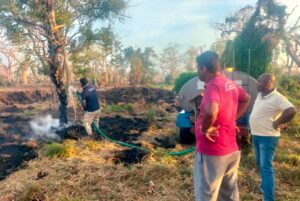
Climate Fact Checks also cross-checked the description of the fire using photographs obtained from reliable sources. The photographs show that the fire had affected substantial areas of grassland around the reservoir. They also show burned vegetation and some trees that had already been standing in the reservoir area.
However, the available photographic evidence does not support the claim that approximately 500 living kumbuk trees were destroyed. This is consistent with the assessment provided by the Puttalam Additional District Forest Officer, who inspected the site.
The distinction is important because the presence of numerous burned trees or branches in photographs does not by itself establish that thousands of mature kumbuk trees were destroyed. Determining the number, species, age and condition of affected trees requires an assessment on the ground.
Was Wilpattu National Park affected?
The fire occurred at the old Eluwakkulam Nelum Wewa, which is located near the boundary of Wilpattu National Park. However, the Forest Conservation Department stated that the fire did not affect Wilpattu National Park.
The Nelum Wewa itself is an important wetland and reservoir ecosystem. The reservoir has a water spread of more than 100 acres and provides water for nearly 700 acres of paddy cultivation. It also provides habitat for local and migratory birds.
Therefore, although the claim that 500 kumbuk trees were destroyed is not supported by the evidence gathered by Climate Fact Checks, the fire should not be dismissed as environmentally insignificant.
What about the cause of the fire?
The Forest Conservation Department has said that an investigation was underway into a suspected deliberate fire, while the Irrigation Department field officer who spoke to Climate Fact Checks also described the fire as man-made. However, responsibility for starting the fire has not yet been established. Therefore, claims identifying a particular person or group as responsible would be premature until the Police investigation is completed.
Verdict: False. The claim that the Nelum Wewa fire destroyed around 500 kumbuk trees is not supported by the evidence available to Climate Fact Checks. Officials who inspected the site said the fire mainly affected surrounding grassland, along with some large, decaying trees and branches of a small number of young trees. Photographs reviewed by Climate Fact Checks are consistent with this assessment.
Copyedited by Vivek Saini.
References
Banner image: Photo by Emma Renly on Unsplash
Sections of this article may have been developed with the assistance of artificial intelligence tools to support research, drafting and language refinement. All information has been reviewed, edited and verified by the author/editor to ensure accuracy, context and editorial integrity. The responsibility for the final content, interpretations and conclusions rests solely with the publisher.