Physical Address
23,24,25 & 26, 2nd Floor, Software Technology Park India, Opp: Garware Stadium,MIDC, Chikalthana, Aurangabad, Maharashtra – 431001 India
Physical Address
23,24,25 & 26, 2nd Floor, Software Technology Park India, Opp: Garware Stadium,MIDC, Chikalthana, Aurangabad, Maharashtra – 431001 India

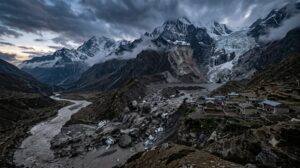
A devastating flash flood in Nepal’s Rasuwa district has exposed a dangerous convergence of climate change, unstable glaciers and seismic activity in the Himalayas. What initially appeared to be a conventional flood is now being investigated as a complex chain of events involving an ice-rock avalanche, temporary river blockage, sudden flooding and unusual seismic signals.
The August 26 disaster has already claimed hundreds of lives, with the death toll reported at 734 and thousands still missing. The destruction spread through the Lhende Khola system, which connects to the Bhote Koshi and Trishuli river networks, raising concerns that the consequences of such high-altitude disasters can travel far beyond the point where they begin.
When an Avalanche Becomes a Flood
Scientists are still trying to establish exactly what triggered the disaster. Dipesh Chapagain, a senior scientist with the United Nations University Institute for Environment and Human Security, said seismic activity could have triggered the avalanche. But another possibility is that the massive avalanche itself generated the seismic signals detected by monitoring stations.
Preliminary observations by the International Centre for Integrated Mountain Development (ICIMOD) detected unusual seismic signals around the time of the disaster. A monitoring station in Jilong, roughly 12 kilometres from the affected area, recorded anomalous activity, while another station at Zhangmu also detected unusual signals. The emerging picture suggests that a section of an evolving glacier may have collapsed, releasing ice and rock into the river system. The debris could have temporarily blocked the river, creating an unstable natural reservoir. When that blockage failed or was overtopped, a powerful surge of water, sediment, and boulders moved downstream. This is what makes Himalayan disasters particularly dangerous: one hazard can rapidly trigger another.
An avalanche can cause a landslide; a landslide can dam a river; the resulting lake can burst; and the flood can then carry enormous quantities of rock and sediment into populated valleys.
A Warming Himalaya Is Changing the Risk
The Nepal disaster has also renewed attention on the growing threat of Glacial Lake Outburst Floods (GLOFs), in which water accumulated behind natural glacial or moraine dams is suddenly released.
According to an ongoing UN-led study examining nearly 500 GLOFs in the Hindu Kush Himalayas, the frequency of these events has increased roughly fivefold since 1950. The region, spread across eight countries, contains more than 64,000 glaciers and over 23,000 glacial lakes. Around 407 of these lakes have been identified as potentially dangerous. Climate change does not necessarily create every individual disaster, but it can make the underlying landscape increasingly unstable. Rising temperatures accelerate glacier melt, increasing the amount of water entering glacial lakes. At the same time, ice and moraine dams can become more vulnerable to collapse.
The UN study found that ice avalanches accounted for about half of observed GLOF triggers, while intense rainfall contributed around a quarter. The concentration of roughly 70 per cent of events during the summer monsoon period further points towards the interaction between warming temperatures and heavy precipitation.
In other words, climate change can load the dice in favour of extreme events, while earthquakes, avalanches, landslides or intense rainfall may provide the final trigger.
Why Nepal’s Warning Matters for India
The disaster is not only a Nepalese concern. Himalayan rivers cross national boundaries, meaning that a sudden release of water and debris at high altitude can have consequences hundreds of kilometres downstream.
A UN-led assessment covering GLOF events from 1835 to 2025 found that India experienced 62 recorded GLOFs, which are fewer than China and Pakistan. However, it suffered the highest number of fatalities, at 6,119. Nepal recorded 58 events during the same period.
The findings raise questions about whether countries downstream of the Himalayas are adequately prepared for a changing hazard landscape. India’s GLOF adaptation measures were assessed as only moderate in the study, with seven measures listed among 62 adaptation actions. The report also categorised international financing for glacier adaptation in India as low.
The warning comes after several major Himalayan disasters, including the 2023 Teesta flash flood in Sikkim and West Bengal and the 2025 Chamoli disaster. Together, they underline a difficult reality: the region is not dealing with isolated floods, landslides or avalanches anymore, but with interconnected hazards that can amplify one another.
The immediate lesson from Nepal is therefore bigger than flood preparedness. Monitoring glaciers, mapping potentially dangerous lakes, strengthening early-warning systems and planning evacuation routes must become part of a single Himalayan risk-management strategy. As temperatures rise and the cryosphere becomes increasingly unstable, disasters once considered rare may become more frequent, or more importantly, more interconnected.
The Himalayas are not simply melting. They are becoming more dynamic. And when one part of this fragile system moves, the consequences can travel much farther than the mountain slope where the disaster begins.
What Is a GLOF? Nepal’s Bhotekoshi Flood Explained
https://papers.ssrn.com/sol3/papers.cfm?abstract_id=5517478
Banner Image: AI-generated
Sections of this article may have been developed with the assistance of artificial intelligence tools to support research, drafting, and language refinement. All information has been reviewed, edited, and verified by the author/editor to ensure accuracy, context, and editorial integrity. The responsibility for the final content, interpretations, and conclusions rests solely with the publisher.