Physical Address
23,24,25 & 26, 2nd Floor, Software Technology Park India, Opp: Garware Stadium,MIDC, Chikalthana, Aurangabad, Maharashtra – 431001 India
Physical Address
23,24,25 & 26, 2nd Floor, Software Technology Park India, Opp: Garware Stadium,MIDC, Chikalthana, Aurangabad, Maharashtra – 431001 India

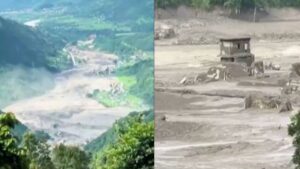
Rasuwa was dry on Wednesday morning. That single detail, reported by district officials before the water arrived, is the reason the flood that tore down the Bhotekoshi at around 9 am is being read as a mountain failure rather than a monsoon one. There was no cloudburst to blame, no swollen catchment, no days of warning rain. Something high in the ice gave way, and a valley that had already been rebuilt once since last July was hit again.
Provisional figures are moving quickly and should be treated as such. Media Outlets first reported eight deaths, with 384 tourists unaccounted for, including 291 foreign nationals from India, Malaysia, the United Kingdom and the United States. Later bulletins from Nepali outlets put the toll at 22 and rising. Nepal’s energy ministry estimated that around 430 MW of generation capacity, roughly one eighth of the country’s installed total, was knocked out. A figure circulating on Indian television, suggesting that about 1,000 people had been swept away, is an early unverified estimate and has not been confirmed by any Nepali authority. Readers should expect these numbers to be revised for several days.
What a GLOF actually is
A glacial lake outburst flood, or GLOF, is the sudden release of water impounded in or beside a glacier. As a glacier retreats, meltwater collects behind the ridge of rock and debris it has bulldozed downslope over centuries. That ridge, called a moraine, was never engineered to hold water. It is loose material, often with buried ice inside it, and it can fail without notice. When it does, a lake that took decades to fill can empty in hours.
There are three broad varieties, and the distinction matters for monitoring. Moraine dammed lakes sit behind those debris ridges and are the classic Himalayan GLOF source. Ice dammed lakes are held back by the glacier itself and drain when the ice floats, cracks or melts through. Supraglacial lakes form as ponds on the dirty surface of a debris covered glacier, merge into larger sheets, and can drain internally through the ice. The third kind is the hardest to watch, because such lakes are often seasonal and may not exist in any national inventory of dangerous lakes.
The trigger is usually external. An ice or rock avalanche drops into the lake and pushes a wave over the dam. Extreme rainfall saturates and weakens the moraine. An earthquake shakes it. Slope collapse from thawing permafrost can do it too. A regional review published in npj Natural Hazards counts more than 388 documented GLOF events across the Himalaya and Karakoram, with avalanches and extreme precipitation the commonest starters. What follows is not an ordinary flood. Peak discharges recorded during Himalayan GLOFs have reached the order of thousands of cubic metres per second, and the flow carries sediment and boulders that do more damage than the water alone.
Climate Fact Checks explained this mechanism in detail when South Lhonak Lake in Sikkim breached in October 2023 (Has Climate Change led to the devastating floods in Sikkim?). The peer reviewed reconstruction published later in Science traced that disaster to a permafrost landslide entering the lake at 5,200 metres, which generated a wave roughly 20 metres high, breached the moraine, drained about 50 million cubic metres of water, and stripped some 270 million cubic metres of sediment along 385 kilometres of the Teesta before reaching Bangladesh.
So was Wednesday a GLOF?
Not confirmed, and possibly not in the strict sense. The preliminary reading from the International Centre for Integrated Mountain Development and from Kathmandu University glaciologist Rijan Bhakta Kayastha is that an ice and rock avalanche on the Nepal side fell into the Lhende Khola, a Bhotekoshi tributary, and blocked it. Water built up behind that temporary barrier and then burst through, sending the surge downstream. Kayastha has also noted that an earthquake occurred on the Tibetan side at roughly the same time, and that link is being examined.
If that assessment holds, the correct label is a landslide dammed or avalanche dammed outburst flood rather than a glacial lake outburst flood. The two sit in the same family of high mountain cascading hazards, they look identical from downstream, and both are worsened by the same warming. They are not, however, the same event type, and they call for different monitoring. A GLOF early warning system watches a known lake. Nothing watches a river reach that a falling serac might block next Tuesday.
This is where a fact checking newsroom has to slow down. Within hours of the surge, the flood was already being described online as a confirmed GLOF, complete with a named lake. Attribution in these events is genuinely slow. After the July 8, 2025 flood in the same valley, Nepal’s Department of Hydrology and Meteorology and ICIMOD took three days to issue even a preliminary satellite based conclusion. The definitive Sikkim study took over a year. Anything asserting a cause on day one is speculation, however confident the phrasing.
The same valley, twice in fourteen months
The July 2025 flood at Rasuwagadhi was eventually traced to a supraglacial lake on the Purepu Glacier in Tibet, sitting at about 5,150 metres and roughly 36 kilometres upstream of the border. Satellite imagery showed it had begun as a small meltwater pond in late 2024 and expanded through the spring of 2025 before draining. It destroyed the Miteri Bridge linking Nepal and China, wrecked the dry port at Timure, and killed at least nine people. Crucially, nobody had been watching that lake, because until a few months earlier it had not existed.
It is part of a run. Two small lakes burst above Tilgaon in Humla district in May 2025 with no rain reported. A GLOF from Thyanbo Lake, an area of only about 0.05 square kilometres, hit Thame village in the Everest region in August 2024. Nepal has recorded 26 GLOF events since the 1970s, and 47 of its glacial lakes are currently classified as potentially dangerous. Against that, the country has functioning early warning systems on exactly two lakes, Imja and Tsho Rolpa. A $36.1 million Green Climate Fund grant approved in 2025 aims to lower water levels at four priority lakes, Thulagi, Lower Barun, Lumding Tsho and Hongu 2, and to extend warning coverage to about 2.3 million people. None of that would have flagged a pond that formed in March and drained in July.
Why India should be reading this closely
The Bhotekoshi joins the Trishuli and eventually the Narayani, which crosses into India as the Gandak and feeds the Ganga basin in Bihar and Uttar Pradesh. Alerts on Wednesday extended down through Rasuwa, Nuwakot, Dhading, Gorkha and Chitwan. Himalayan rivers do not respect borders, and neither do the hazards at their heads.
India’s own inventory is expanding. As Climate Fact Checks reported from the Central Water Commission’s assessment, glacial lakes and water bodies across the Himalayan region grew 10.81 per cent in surface area between 2011 and 2024, while the Indian portion grew 33.7 per cent, from 1,962 hectares to 2,623 hectares. The commission placed 67 Indian lakes in a high risk category after they expanded by more than 40 per cent, spread across Ladakh, Himachal Pradesh, Uttarakhand, Sikkim and Arunachal Pradesh.
The warnings are already live. Tawang district in Arunachal Pradesh has been on alert through 2026 over a possible outburst in the Mago Chu basin, after the Centre for Earth Science and Himalayan Studies flagged instability around the Khangri Glacier and the lake below it. In Uttarakhand, the Dharali flash flood of August 2025 in Uttarkashi produced the same argument in miniature, with a cloudburst explanation competing against a glacial one and neither settled for weeks, as Climate Fact Checks documented at the time (From Cloudburst to Climate Crisis).
The warming underneath all of it
Attribution of any single outburst to climate change is complicated, but the background trend is not. Average GLOF frequency in the Himalayas is now several times what it was before 1950, driven by the formation and growth of lakes and by an increase in the avalanches, landslides and ice collapses that set them off. More than 400 potentially dangerous glacial lakes have been identified across the Hindu Kush Himalaya, many of them in transboundary basins.
A heavy snow year does not reverse this, as Climate Fact Checks set out separately (Why Heavy Snow Isn’t Saving Himalayan Glaciers From Melting). Warmer air also changes what floods look like lower down: our earlier reporting on the September 2024 Kathmandu floods cited a rapid attribution study finding that extreme rainfall of that kind is roughly 70 per cent more likely in today’s climate and about 10 per cent heavier (Rapid Urbanisation and Climate Change Drove Severe Floods in Nepal). Wednesday’s disaster was not a rainfall event, which is precisely the point. The Himalaya is now generating floods that arrive on clear days.
What is missing
Three gaps stand out from this event. Ephemeral supraglacial lakes and avalanche prone slopes are largely absent from national danger lists, which are built around large, stable, well surveyed lakes. Cross border data sharing between China and Nepal remains thin, even though the last two Bhotekoshi surges both originated at or beyond the border. And the infrastructure being built in these valleys, roads, border posts, and run of river hydropower, is designed against historical flood records that the cryosphere has stopped honouring.
For readers following coverage over the coming days, three questions are worth holding on to:
Climate Fact Checks will publish updates as the assessments are published.
References
Rapid Urbanisation and Climate Change Drove Severe Floods in Nepal
Himalayan Glacial Lakes Surge by Over 10% Since 2011, Report Warns of GLOF Threat
Has Climate Change led to the devastating floods in Sikkim?
From Cloudburst to Climate Crisis: Understanding the Uttarkashi Flash Floods
Why Heavy Snow Isn’t Saving Himalayan Glaciers From Melting
https://cwc.gov.in/glacial-lakeswater-bodies-himalayan-region
https://www.science.org/doi/10.1126/science.ads2659
https://www.nature.com/articles/s44304-026-00168-w
https://unu.edu/ehs/commentary/glacial-lake-outburst-floods-growing-climate-threat
Banner Image: Screengrab from BBC @bbcnasrpskom on X
Sections of this article may have been developed with the assistance of artificial intelligence tools to support research, drafting and language refinement. All information has been reviewed, edited and verified by the author/editor to ensure accuracy, context and editorial integrity. The responsibility for the final content, interpretations and conclusions rests solely with the publisher.