Physical Address
23,24,25 & 26, 2nd Floor, Software Technology Park India, Opp: Garware Stadium,MIDC, Chikalthana, Aurangabad, Maharashtra – 431001 India
Physical Address
23,24,25 & 26, 2nd Floor, Software Technology Park India, Opp: Garware Stadium,MIDC, Chikalthana, Aurangabad, Maharashtra – 431001 India

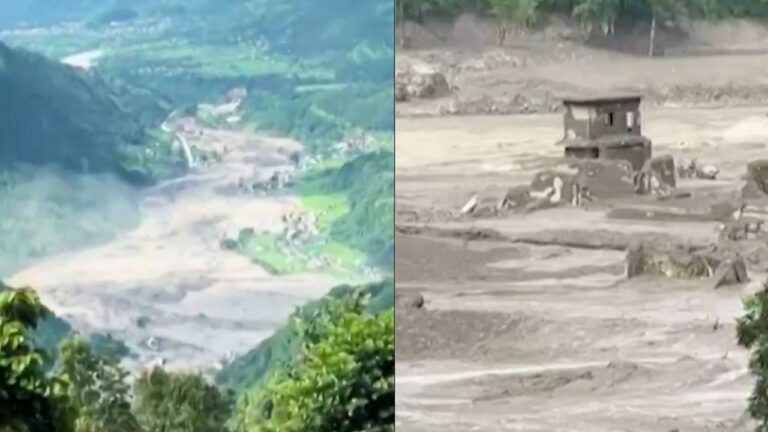
The debris flow reached the valley floor at about half past eight in the morning. The first misattributed video of it was online in time for lunch.
That is the rhythm of a modern disaster. When flash floods and mudslides struck Nepal on 26 August 2026, killing at least 616 people and leaving close to 2,000 missing, dramatic clips began circulating within hours. Some of them were real footage of the event. Several were not, and the fact checkers working through them found something worth pausing on: the fabrications were not all, or even mostly, machine-made.
This guide covers both problems, because a reader scrolling a feed cannot know in advance which one they are looking at. It is a practical guide. It is not about how video models work. It is about what you can do in the thirty seconds before you press forward.
Five kinds of fake, not one
Working through the flood checks published across the Fact Crescendo network this season produces a clear taxonomy. Learning it is more useful than memorising any single tell, because it tells you what to look for first.
Generated by a model
A clip showing an elephant hauling a drowning man to safety spread widely as a scene from Nepal. Fact Crescendo’s Sri Lanka desk found that no news outlet anywhere had reported such a rescue, that the clip had been online since 9 August, well before the Nepal disaster, and that it had earlier circulated as monsoon flooding in Assam. The footage showed physically impossible qualities, and a detection tool confirmed it was AI-generated. Note the sequence: the absence of any news report came first, the date came second, and the detector came last.
Staged for the camera
During the Assam floods, in which 80 people died and more than 2.12 lakh remained affected across eight districts, a video circulated claiming to show the bodies of flood victims. A reverse image search traced it to an Instagram creator who had uploaded it on 3 July 2026, with a laughing emoji. The Assam flood wave began around 19 and 20 July, more than two weeks later, and the account routinely posts staged dramatic videos. No AI involved, and no detection tool would have caught it.
Fiction mistaken for footage
A clip of a woman and a small boy in floodwater was shared as Nepal. Fact Crescendo noticed that the closing seconds looked like a film set, and traced it to a scene from the Indonesian television series Lautan Cinta, uploaded on 3 July 2026 by the family of the child actor in it. The original caption thanked the crew for hours spent in cold water and plugged the show’s broadcast slot.
Real footage, wrong place, wrong year
This is the largest category by a distance. A two-part clip captioned as the first moments of the Nepal disaster turned out to be a mine waste dam failure in Hpakant, Myanmar, from January 2024, spliced to a house collapsing into the Yellowstone River in Montana in June 2022. An excavator being swept away, shared as Nepal, was filmed in Chamoli, Uttarakhand. A landslide clip was an old video from Japan. A man buried chest-deep in debris was an old video from Prayagraj. A Buddha statue apparently surviving the flood was footage from 2024. The same pattern ran through the Assam checks, where a rescue clip was traced to Uttarakhand, a couple carrying a newborn through filthy water was filmed in Prayagraj, and both a flood video and a landslide video were traced to Kerala and to Malappuram in particular. Kerala got the same treatment in reverse, when a viral flood clip there turned out to be from Pakistan. As recently as 31 August, a video shared as flooding in Himachal Pradesh was found to be from the Grand Canyon.
The compilation that is mostly true
This is the largest category by a distance. A two-part clip captioned as the first moments of the Nepal disaster turned out to be a mine waste dam failure in Hpakant, Myanmar, from January 2024, spliced to a house collapsing into the Yellowstone River in Montana in June 2022. An excavator being swept away, shared as Nepal, was filmed in Chamoli, Uttarakhand. A landslide clip was an old video from Japan. A man buried chest-deep in debris was an old video from Prayagraj. A Buddha statue apparently surviving the flood was footage from 2024. The same pattern ran through the Assam checks, where a rescue clip was traced to Uttarakhand, a couple carrying a newborn through filthy water was filmed in Prayagraj, and both a flood video and a landslide video were traced to Kerala and to Malappuram in particular. Kerala got the same treatment in reverse, when a viral flood clip there turned out to be from Pakistan. As recently as 31 August, a video shared as flooding in Himachal Pradesh was found to be from the Grand Canyon.
Compilations work precisely because the genuine material authenticates the borrowed clip. A reader who spot-checks the second or third clip, finds it real, and stops there has been misled by an accurate verification. Every clip in a montage has to be checked on its own.
The lesson from the taxonomy is that the question to ask is not “was this made by AI”. It is “is this what it says it is”. Four of the five categories survive every AI detector ever built, because everything in the frame is physically real, and the fifth one partly does.
The thirty-second look
Watch the clip twice. The second viewing is where synthetic footage falls apart, because the first viewing is the one it was designed for. Five things to look at.
Continuity between frames.
Generated video does not hold a stable world across time. Objects arrive and leave without cause, vehicles right themselves, buildings and trees appear where different ones stood a moment earlier. Pick one fixed point in the frame, ignore the water, and see whether it survives the clip.
Scale and proportion.
Models are unreliable about how big things are relative to one another. Doors, windows, cattle and motorcycles are the useful reference objects, because everyone carries an unconscious sense of their size.
Bodies, and whether they react.
Legs, hands, gait and crowd behaviour remain weak points. Ask a simple question of every person in the shot: is this person responding to what is happening to them? A figure standing calm while the ground gives way is the strongest single tell there is.
Text, signage and logos.
Lettering is where models still fail most reliably. Shop boards, number plates and hoardings come out garbled or half-formed, and brand marks are often smudged or avoided, because generators are built to be cautious about reproducing company logos. A street scene in Assam, Nepal or Kashmir with no legible script anywhere in it deserves a second look.
Watermarks, and the space where one used to be.
Several generators stamp their output in a corner. Those marks are easy to crop or paint out, so also look for blurring, pixelation or discolouration in a corner where a mark would have been. An oddly cropped frame is itself evidence.
One caution about all five. These tells are eroding. During the Hurricane Melissa hoaxes, the unnatural motion, distorted text and missing fingers that used to give the game away are steadily disappearing as the systems improve. Visual inspection is where you start. It is not where you finish.
The two-minute check
This is the sequence Fact Crescendo’s desks actually follow, and it is worth copying because it works on all five categories rather than only on the synthetic ones.
Go to the official channel before you go anywhere else, too. IMD bulletins, NDRF and state disaster management authority updates and district administration handles are slower and duller than your feed, which is exactly the point. Climate Fact Checks verifies reader submissions, and so does Fact Crescendo, which runs desks in Assamese, Bangla, Manipuri, Hindi and nine other Indian languages as well as Sri Lanka, Bangladesh, Myanmar and Afghanistan. You can reach out to Fact Crescendo on their 24×7 WhatsApp tipline number +91 9049044263.
Detection tools, and how far to trust them
Automated detectors are useful and they are not rulings. Notice where they sit in the sequence above: last. In the elephant rescue check, the detector confirmed a conclusion that the absence of news coverage and the date trail had already established. It did not produce the conclusion.
Three rules follow. Never treat a low score as proof that footage is real, since a genuine video filmed in the wrong country will score clean every time. Never rely on a single tool. And let provenance carry the weight, with the detector as the last brick rather than the foundation. Provenance signals embedded in a file by the model provider are more dependable than pixel-level guessing, but they survive only until the video is re-encoded, which social platforms do automatically.
What the fakes cost
The damage is not only to the record. Misattributed footage inflates the perceived scale of an event in some places and flattens it in others, which distorts where volunteers, donations and attention go. It hands officials a ready excuse to dismiss genuine footage that is inconvenient. And it sits on top of real loss. While clips from Myanmar and Montana circulated as Nepal, the actual toll there ran past 600 dead. While a staged video was passed off as Assam flood victims, 80 people had died and more than two lakh were still affected.
There is a second-order cost that worries researchers more. Once people know convincing fakes are cheap, the rational response is to disbelieve everything, including the true footage that a community needs believed. The goal here is not scepticism for its own sake. It is to keep the ability to recognise the real thing.
The checklist
Screenshot this, or keep it where you can find it.
References
Fact Crescendo Sri Lanka, Nepal floods 2026: AI-generated and old footage go viral, 29 August 2026
Fact Crescendo, Staged video goes viral as victims of Assam flood, 31 July 2026
Fact Crescendo, 2024 child rescue video falsely shared linking to recent Nepal flood, 31 August 2026
Fact Crescendo, Video from Kerala going viral as the flood situation in Assam, 5 August 2026
Fact Crescendo, Video of a landslide in Malappuram, Kerala, going viral as Assam, 6 August 2026
Fact Crescendo, Old video from Pakistan goes viral as flood situation in Kerala, 5 August 2026
Fact Crescendo archive of fact checks
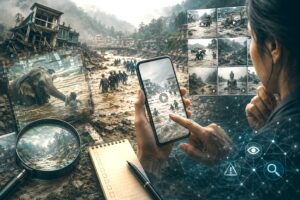
Banner Image: AI Generated
Sections of this article may have been developed with the assistance of artificial intelligence tools to support research, drafting, and language refinement. All information has been reviewed, edited, and verified by the author/editor to ensure accuracy, context, and editorial integrity. The responsibility for the final content, interpretations, and conclusions rests solely with the publisher.