Physical Address
23,24,25 & 26, 2nd Floor, Software Technology Park India, Opp: Garware Stadium,MIDC, Chikalthana, Aurangabad, Maharashtra – 431001 India
Physical Address
23,24,25 & 26, 2nd Floor, Software Technology Park India, Opp: Garware Stadium,MIDC, Chikalthana, Aurangabad, Maharashtra – 431001 India

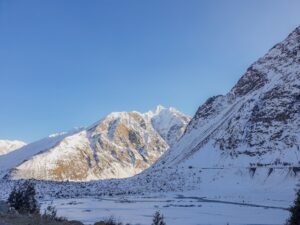
An unusually heavy spell of snowfall in the western Himalaya briefly helped one of the region’s closely monitored glaciers regain some of its lost mass. But scientists say the short-term recovery does not change the larger picture of continued glacier loss across the region. A study of the Chhota Shigri Glacier found that extreme summer snowfall in 2023 helped the glacier record a slightly positive annual mass balance after suffering its most severe annual loss on record the previous year. The researchers say the contrasting results show how short-lived weather extremes can temporarily influence glacier health even as long-term warming continues to drive ice loss.
A year of extreme snowfall briefly slowed glacier melt
Chhota Shigri Glacier, a benchmark site in the western Himalaya, has recorded an average annual mass balance of minus 0.47 metres water equivalent per year between 2002 and 2023, indicating persistent overall ice loss. But conditions varied dramatically between the two years examined in the study.
During the 2021 to 2022 hydrological year, intense spring and summer warming produced the most negative annual mass balance in the glacier’s observational record, at minus 1.71 metres water equivalent. The following year produced a striking contrast. The glacier recorded a slightly positive mass balance of 0.22 metres water equivalent, despite 2023 being the warmest year globally at the time.
The difference was largely associated with an exceptional snowfall event in July 2023. More than 300 millimetres of precipitation fell over three days, during the peak summer melting season. The fresh snow increased the glacier’s surface reflectivity, or albedo, allowing it to absorb less solar radiation and sharply reduce melt.
The snowfall created a temporary shield against heat
Researchers found several indicators supporting the role of the snowfall in suppressing glacier melt. Air temperatures remained close to freezing during the event, while the glacier’s surface albedo increased sharply after the snowfall. Mass gain and reduced ablation were also recorded immediately afterwards.
The difference was especially striking when compared with the previous year. From July 6 to 24, 2023, the glacier gained around 250 millimetres of water equivalent. During the same period in 2022, it had lost roughly 532 millimetres. This shows just how much an unusually heavy snowfall can influence a glacier’s condition, even over a relatively short period.
The researchers also found that the unusually high snowfall in July 2023 was linked to an estimated 0.7-metre increase in the glacier’s annual mass balance. But they point out that this number should not be taken to mean the snowfall directly added 0.7 metres of ice. Instead, it reflects a statistical relationship between the unusual snowfall and the glacier’s overall mass balance.
One snowy summer cannot reverse decades of glacier loss
The study’s central warning is that an unusually snowy year should not be mistaken for evidence that Himalayan glaciers are recovering. Chhota Shigri’s long-term mass balance remains negative, and continued warming is expected to increase melting.
The researchers found that for every 1°C rise in annual temperature, the glacier would need about 80 millimetres of additional summer snowfall to maintain a stable mass balance. With the region expected to warm by 1.5°C to 2°C by the middle of the century, this could mean an additional 50 to 160 millimetres of summer snowfall would be needed to offset the extra ice loss.
However, climate projections suggest that warming in the Himalaya could also change the type of precipitation the region receives, with more precipitation falling as rain rather than snow. This could make it harder for snowfall to compensate for the increased melting caused by rising temperatures.
Extreme weather is making glacier behaviour more unpredictable
The findings also highlight the growing importance of short-duration climate extremes. The study found that the sequence of a severe heatwave in 2022 followed by exceptional snowfall in 2023 produced radically different annual outcomes for the same glacier.
Researchers say such events can temporarily dominate annual glacier mass balance, particularly in high mountain regions where the timing and form of precipitation strongly influence how much snow remains on the surface and how quickly ice begins to melt. They argue that glacier monitoring and modelling therefore need to account not only for long-term temperature trends but also for the timing, intensity and sequence of extreme heat and precipitation events.
The broader implications extend beyond the glacier itself. Himalayan glaciers contribute to downstream water systems that support communities, agriculture and other needs across South Asia. While an exceptional snowfall year can temporarily slow melting, the researchers’ findings indicate that isolated positive years do not overturn the longer-term trajectory of glacier loss under continued warming.
References:
https://www.nature.com/articles/s41598-026-43456-1
https://pmc.ncbi.nlm.nih.gov/articles/PMC13319472
Banner image: Photo by Huzaifa Ginwala on Unsplash
Sections of this article may have been developed with the assistance of artificial intelligence tools to support research, drafting and language refinement. All information has been reviewed, edited and verified by the author/editor to ensure accuracy, context and editorial integrity. The responsibility for the final content, interpretations and conclusions rests solely with the publisher.