Physical Address
23,24,25 & 26, 2nd Floor, Software Technology Park India, Opp: Garware Stadium,MIDC, Chikalthana, Aurangabad, Maharashtra – 431001 India
Physical Address
23,24,25 & 26, 2nd Floor, Software Technology Park India, Opp: Garware Stadium,MIDC, Chikalthana, Aurangabad, Maharashtra – 431001 India

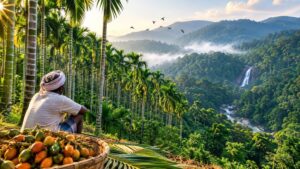
The Western Ghats are often described through numbers: a biodiversity hotspot, the source of major rivers, a landscape spread across several States. But for the people living there, the Ghats are much more personal. They are farms, villages, streams, forests, and livelihoods passed down through generations. That is why the continuing debate over the Kasturirangan report has become so sensitive, particularly among areca growers in Karnataka.
Areca growers have urged the Union and State governments to reject recommendations associated with the Kasturirangan report, fearing that restrictions linked to the proposed Ecologically Sensitive Area could affect agricultural activities and livelihoods. Their concerns reflect a larger challenge that India has repeatedly struggled with: how do we protect ecologically fragile landscapes without making local communities feel that conservation is being imposed at their expense?
The question is not whether the Western Ghats need protection. They unquestionably do. The harder question is what that protection should look like.
A landscape where ecology and livelihoods overlap
The Kasturirangan report emerged from the long-running debate over how much of the Western Ghats should receive additional environmental protection. The earlier Gadgil Committee had proposed a much wider and more stringent conservation framework. The Kasturirangan panel took a different approach, identifying relatively undisturbed natural landscapes for protection while attempting to keep areas with greater human habitation and agricultural activity outside the proposed ecologically sensitive zone. On paper, that distinction may appear straightforward. On the ground, it is far more complicated.
The Western Ghats are not an untouched wilderness separated neatly from human settlements. People have cultivated land, grown plantations, and built communities across the landscape for decades. Areca cultivation, in particular, is an important source of income for many farmers in Karnataka’s coastal and Malnad regions. Any policy that creates uncertainty around agricultural land can therefore trigger genuine anxiety.
For a farmer, an environmental notification is not merely a document. It can raise questions about what can be built, what activities may be permitted, and what the future of the family’s land will look like.
Those concerns deserve to be heard.
But there is another reality that cannot be ignored. The ecological services provided by the Western Ghats are themselves essential to agriculture and human settlements. Forests regulate water flows, protect soil, support biodiversity, and help maintain local climatic conditions. When slopes are destabilised, streams are damaged, or natural vegetation is cleared excessively, the resulting environmental costs eventually reach farms and communities.
The choice should not be between protecting every inch of the Western Ghats as if people do not exist, or opening fragile landscapes to unrestricted development because communities live there. Both extremes can create problems.
A better approach would distinguish between activities that sustain livelihoods and those that permanently damage ecological systems. Farming practices that maintain vegetation, protect soil, and conserve water should not be treated in the same way as quarrying, mining, or poorly planned construction. Communities that conserve forests and water sources should have incentives to continue doing so.
The government also needs to communicate clearly. People should know exactly which activities would be restricted, which would remain permitted, and what support or compensation mechanisms would be available. Uncertainty is often what turns environmental regulation into a source of conflict.
There is also an opportunity to make conservation more participatory. Farmers, local governments, scientists, and environmental groups can work together to identify vulnerable slopes, important water sources, and high-biodiversity areas while allowing sustainable agriculture to continue. Agroforestry, native tree planting, soil conservation, rainwater harvesting and climate-resilient farming could become part of the solution rather than afterthoughts.
The Western Ghats are already facing a changing climate, making this balance even more urgent. Extreme rainfall, landslides, prolonged dry spells and shifting agricultural conditions are reminders that ecological degradation has consequences beyond forests.
Ultimately, protecting the Western Ghats should not mean protecting a landscape from its people. It should mean protecting the landscape with its people. The concerns raised by areca growers should therefore not be dismissed as resistance to environmental protection. At the same time, conservation cannot be abandoned whenever it becomes politically difficult. The real task is to build rules that protect ecological limits while giving communities a secure and dignified future. Healthy Western Ghats and healthy rural livelihoods are not opposing goals. In the long run, they depend on each other.
References:
Banner Image: AI-generated
Sections of this article may have been developed with the assistance of artificial intelligence tools to support research, drafting, and language refinement. All information has been reviewed, edited, and verified by the author/editor to ensure accuracy, context, and editorial integrity. The responsibility for the final content, interpretations, and conclusions rests solely with the publisher.