Physical Address
23,24,25 & 26, 2nd Floor, Software Technology Park India, Opp: Garware Stadium,MIDC, Chikalthana, Aurangabad, Maharashtra – 431001 India
Physical Address
23,24,25 & 26, 2nd Floor, Software Technology Park India, Opp: Garware Stadium,MIDC, Chikalthana, Aurangabad, Maharashtra – 431001 India


Inspired by Nature. For Climate. For Our Future.
Every year, governments, businesses, scientists, and communities come together to discuss climate action. New policies are drafted, international negotiations are held, sustainability targets are announced, and innovative technologies are developed to address one of humanity’s greatest challenges.
Yet even after decades of climate conferences, carbon reduction pledges, and environmental regulations, our world continues to grapple with rising temperatures, extreme weather events, biodiversity loss, and increasing pressure on natural resources.
Boardrooms, parliaments, laboratories, and international forums have largely shaped humanity’s response to climate change. We often seek solutions through data, economics, regulations, and technology. These tools are essential and will continue to play a critical role. However, in our search for answers, we sometimes overlook the greatest sustainability expert the world has ever known: nature itself. As we celebrate World Environment Day 2026 under the theme “Inspired by Nature. For Climate. For Our Future,” it is worth asking an unusual but thought-provoking question: What if nature itself wrote our climate action plan?
Nature’s First Principle: Long-Term Balance Over Short-Term Gains
If nature were to draft a climate action plan, its first guiding principle would likely be balance. Nature has thrived for billions of years not because it maximizes short-term gains, but because it maintains equilibrium. Forests do not consume more resources than they can regenerate. Rivers follow natural cycles of replenishment. Ecosystems evolve gradually, ensuring that the needs of one species do not permanently undermine the survival of others.
Human systems, however, often operate differently. Economic decisions are frequently influenced by quarterly results, annual growth targets, and immediate returns. Infrastructure projects are planned for decades, but environmental costs are often considered only after visible damage occurs. We extract resources faster than ecosystems can recover, and consume materials faster than nature can replenish them.
Nature would likely challenge this approach. Instead of asking, “How much can we take today?” nature would ask, “How much can be sustained tomorrow?”
This shift in perspective may seem simple, but it lies at the heart of many environmental challenges. Climate change itself is a consequence of accumulating impacts over time. The greenhouse gases emitted decades ago continue to influence today’s climate. Similarly, deforestation, habitat degradation, and unsustainable consumption create consequences that extend far beyond a single generation.
Nature’s climate action plan would therefore prioritize resilience over rapid expansion and regeneration over extraction. It would encourage investments that strengthen ecosystems, restore degraded landscapes, and preserve natural capital for future generations.
In many ways, sustainability is not about limiting development; it is about ensuring that development can continue indefinitely. Nature understands this principle instinctively. The challenge for humanity is to embrace it consciously.
Nature’s Second Principle: Diversity Creates Strength
A walk through a healthy forest offers an important lesson about resilience.
No two trees are exactly alike. Different plants occupy different layers of the ecosystem. Birds, insects, fungi, and microorganisms perform distinct but interconnected roles. This diversity is not accidental, as it is the reason ecosystems can adapt to disturbances, recover from shocks, and continue functioning over time.
Nature would likely make diversity a central pillar of its climate action plan. Too often, climate discussions focus on finding a single breakthrough solution. Whether it is renewable energy, carbon capture, electric mobility, or hydrogen technology, there is a tendency to seek a single solution to a complex problem. Nature teaches a different lesson. Complex challenges require diverse solutions.
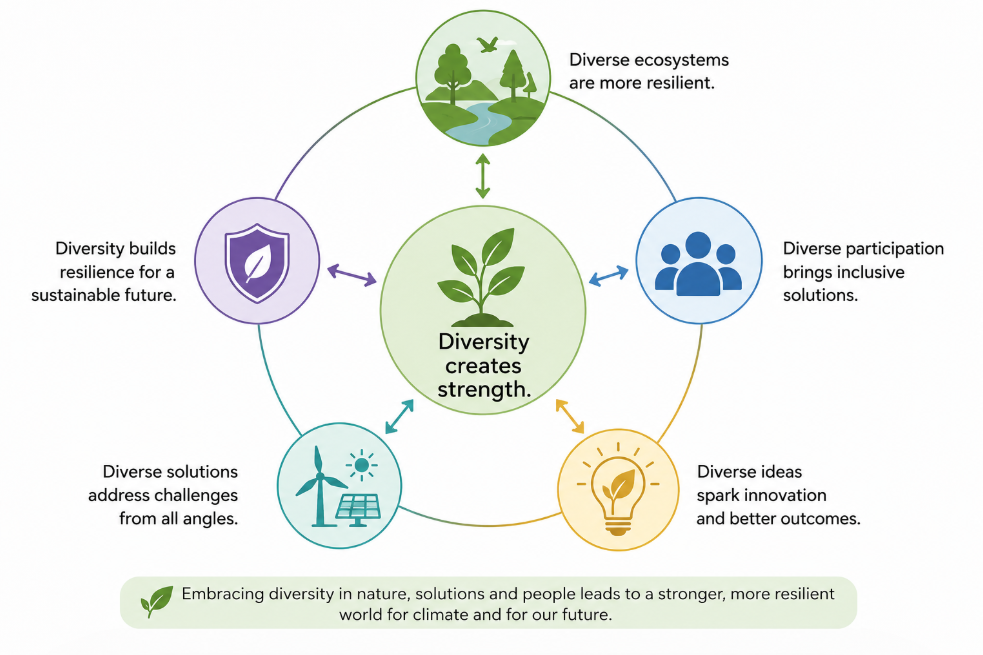
For governments, this means creating policies that support a broad portfolio of climate actions rather than relying on a single intervention. For industries, it means integrating energy efficiency, renewable energy, circular economy practices, resource conservation, and innovation simultaneously. For cities, it means combining green infrastructure, sustainable transport, urban forests, and resilient water systems.
The same principle applies to individuals. There is no single action that can eliminate one’s environmental footprint. However, a combination of conscious choices aims at reducing waste, conserving energy, supporting sustainable products, planting trees, and adopting responsible consumption habits that can collectively create a meaningful impact. Nature also demonstrates the value of biodiversity itself. Healthy ecosystems absorb carbon, regulate water cycles, protect soil fertility, and support countless forms of life. Conserving biodiversity is therefore not separate from climate action; it is climate action. If nature were writing the plan, protecting ecosystems would not be treated as an optional environmental activity. It would be viewed as a fundamental investment in climate resilience and human well-being.
Nature’s Third Principle: Everything Is Connected
Perhaps the most profound lesson nature would offer is the understanding that everything is connected.
A forest does not function as a collection of individual trees. It functions as a living network. Water cycles connect oceans, clouds, rivers, and groundwater. Pollinators support agriculture. Wetlands protect communities from floods. Coral reefs support fisheries. Every component influences countless others. Nature recognizes no departmental boundaries. Climate change, however, is often addressed in fragmented ways. Energy, water, waste, biodiversity, agriculture, and urban development are frequently managed as separate sectors. Yet the environmental challenges we face are deeply interconnected. Nature would encourage us to think in systems rather than silos.
For governments, this means aligning climate policies with biodiversity conservation, water security, and sustainable development goals. For businesses, it means recognizing that environmental performance is not limited to emissions alone but includes responsible resource use, waste management, and ecosystem stewardship throughout the value chain. For cities, it means designing infrastructure that works with nature rather than against it. Urban forests, wetlands, green roofs, and permeable landscapes can simultaneously address heat stress, flooding, and air quality challenges. And for individuals, it means understanding that daily choices are linked to global outcomes. The food we eat, the products we buy, the energy we consume, and the waste we generate all contribute to broader environmental systems. Nature would also emphasize cooperation. In ecosystems, survival often depends on relationships. Trees share nutrients through underground networks. Species evolve together and support one another in unexpected ways. Competition exists, but so collaborates.
Climate action requires the same mindset. Governments, industries, researchers, communities, and citizens must work together because no single stakeholder can solve the climate challenge alone.
Reading Nature’s Blueprint for the Future
If nature were to write our climate action plan, it would probably not be a lengthy document filled with technical jargon, complex metrics, or policy frameworks. Its message would be remarkably simple. Maintain balance. Value diversity. Recognize connections. These principles have guided Earth’s natural systems for millions of years. They have enabled ecosystems to adapt, recover, and thrive despite constant change.
The solutions to climate change will undoubtedly require innovation, investment, science, and policy. But they will also require the wisdom to think beyond short-term interests, to appreciate interconnected systems, and to work in harmony with the natural world. Perhaps the most important realization is that nature has already written a successful sustainability blueprint. Every forest, river, wetland, and ecosystem reflects principles that have stood the test of time.
The question is not whether nature has the answers. The question is whether we are willing to listen.
References:
https://www.worldenvironmentday.global
https://www.sciencedirect.com/science/article/pii/S2772411524000673
https://pmc.ncbi.nlm.nih.gov/articles/PMC12135966
https://pmc.ncbi.nlm.nih.gov/articles/PMC10521359
https://www.sciencedirect.com/science/article/pii/S2405844024166686
https://www.sciencedirect.com/science/article/pii/S2772427125000361
Diagram: AI-generated.
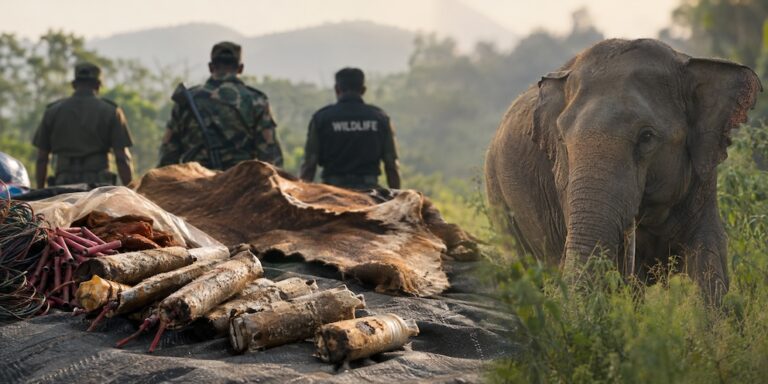
Banner Image: AI-Generated
Sections of this article may have been developed with the assistance of artificial intelligence tools to support research, drafting, and language refinement. All information has been reviewed, edited, and verified by the author/editor to ensure accuracy, context, and editorial integrity. The responsibility for the final content, interpretations, and conclusions rests solely with the publisher.