Physical Address
23,24,25 & 26, 2nd Floor, Software Technology Park India, Opp: Garware Stadium,MIDC, Chikalthana, Aurangabad, Maharashtra – 431001 India
Physical Address
23,24,25 & 26, 2nd Floor, Software Technology Park India, Opp: Garware Stadium,MIDC, Chikalthana, Aurangabad, Maharashtra – 431001 India

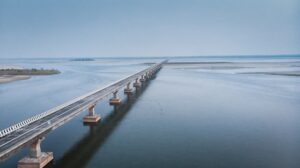
At sunrise along the Ganga, rituals unfold with quiet devotion, offerings placed gently on the water, prayers whispered into the current. Across India, rivers are not just physical systems; they are sacred lifelines, shaping culture, memory, and survival. Yet beneath this reverence lies a contradiction. Even as rivers are worshipped, they are being steadily stripped of sand; the very material that helps stabilize their form and flow. In an era of intensifying climate extremes, this extraction is not just an ecological concern; it is quietly reshaping how rivers erode, incise, and respond to hydrological stress.
India’s Construction Boom and the Sand Rush
India’s rapid urbanisation has turned sand into one of the most heavily extracted natural resources in the country. From highways to housing, nearly every major form of infrastructure depends on aggregates. The United Nations Environment Programme has warned that sand, gravel, and crushed rock together account for the largest volume of solid materials extracted worldwide, creating growing ecological pressure on rivers and other sediment systems.
India does have a regulatory framework on paper. The Sustainable Sand Mining Management Guidelines, 2016 and the Enforcement & Monitoring Guidelines for Sand Mining, 2020 were issued to bring extraction closer to ecological limits, improve replenishment-based planning, and strengthen monitoring and compliance. But enforcement remains uneven, and illegal mining continues across multiple states, often targeting river stretches that are already geomorphically vulnerable.
What Happens When Sand Disappears
Sand is not just a building material. It is fundamental to how river systems function. River sediment helps shape channel geometry, buffer erosive forces, maintain habitat structure, and influence exchanges between rivers and groundwater. When sand is removed faster than it can be naturally replenished, this balance begins to fail.
Scientific reviews show that excessive river sand mining can deepen and simplify channels, lower riverbeds, destabilise banks, alter sediment transport, damage aquatic and riparian habitats, and create long-lasting geomorphological change. These impacts are not isolated to the extraction point; they can propagate upstream and downstream, affecting infrastructure, floodplains, and water availability.
Climate Change Meets Altered Rivers
This matters even more in a warming climate. The IPCC has assessed that heavy precipitation is increasing across much of Asia, and that additional warming raises the intensity and frequency of heavy rainfall events. For South Asia, this means more frequent hydrological stress on river systems already under pressure.
Under more natural conditions, rivers can store, sort, and redistribute sediment and water across bars, banks, side channels, and floodplains. But when in-channel sand extraction significantly alters river morphology, that buffering capacity may weaken. The result is not a single uniform flood outcome everywhere, but a river system that is often more unstable, more incision-prone, and less resilient under extreme rainfall.
India-specific research reinforces this concern. Work on the Raidak-II River in eastern India found that intense sand and gravel mining has altered channel form and morphometric characteristics, while a 2026 study of the same river system linked prolonged mining to changes in sediment dynamics, channel behaviour, and ecological balance. Together, these findings suggest that persistent extraction can make river systems more vulnerable to hydrological extremes.
Recent Warnings and Policy Responses
Recent developments across India show growing concern, though responses remain fragmented. Courts and enforcement agencies are stepping in more visibly, often in response not only to environmental damage but also to law-and-order concerns surrounding illegal extraction. In April 2026, the Supreme Court raised serious concerns about illegal sand mining and called for stronger state action, including the use of preventive detention against organised operators in especially severe cases. Around the same time, the Madras High Court directed action against officials who failed to stop illegal sand mining, citing damage to agricultural land and groundwater.
At the ground level, enforcement drives continue to reveal the scale of the problem. In Odisha’s Ganjam district, authorities recently seized multiple vehicles involved in illegal sand transport. In Maharashtra’s Nagpur division, officials reported 2,478 actions linked to illegal excavation and transport of minor minerals between April 2025 and March 2026, including 587 criminal cases, 158 arrests, and penalties totaling ₹55.39 crore.
These developments also point to a darker dimension: violence and administrative risk. In the Chambal sanctuary matter, the Supreme Court stressed the need for stronger surveillance and enforcement. Recent reporting from Odisha has also highlighted attacks on officials during anti-mining action.
At the same time, governments continue to struggle with the development dilemma.
Restrictions on extraction can cause shortages, but weak regulation invites ecological damage, revenue loss, and criminal capture of supply chains. Recent amendments to Maharashtra’s sand-mining policy were explicitly framed around strengthening monitoring and curbing illegal activity while keeping lawful extraction administratively workable.
Erosion, Ecology, and Everyday Risk
The impacts of sand mining extend well beyond floods. Removing sediment destabilises banks and adjacent land, increasing erosion risks for farms, settlements, roads, and bridges. It also damages aquatic ecosystems by simplifying habitat, increasing turbidity, and disrupting spawning and feeding environments.
Groundwater systems can also be affected. Riverbed sediments often help regulate surface-water and groundwater interaction. Where excessive extraction lowers bed levels and alters hydraulic relationships, water tables and local recharge dynamics can also shift, especially in already stressed basins. Reviews of river sand mining impacts increasingly identify groundwater stress as one of the downstream consequences of unregulated extraction.
The human risks are immediate as well as long-term. Illegal or poorly regulated mining often leaves behind unstable pits, hazardous crossings, damaged embankments, and unsafe river-edge conditions. Even where such risks are underreported, court interventions suggest that sand extraction is not only an environmental issue but a public-safety and governance issue too.
The Development Dilemma
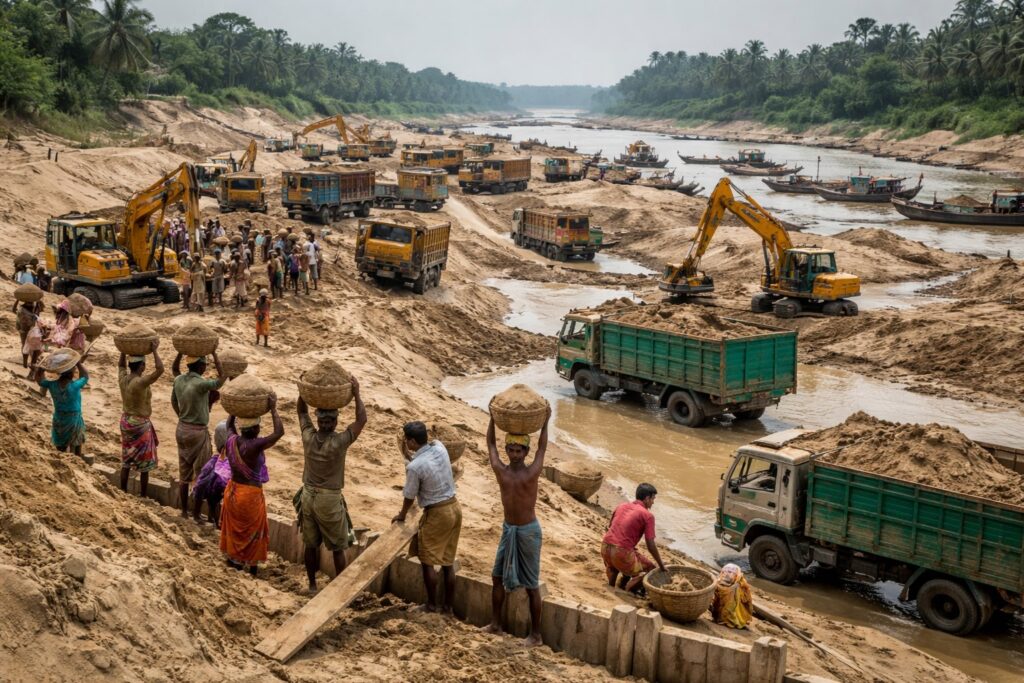
India’s dependence on river sand presents a difficult trade-off. Construction demand remains enormous, and abrupt restrictions often push prices upward or shift supply into informal and illegal channels. But allowing extraction to run ahead of replenishment deepens the very environmental risks that make river basins more fragile over time.
This is why sand mining cannot be treated only as a mining issue. It is also a river-management issue, a flood-risk issue, a groundwater issue, and increasingly a climate-resilience issue. UNEP has argued for more integrated governance of sand resources, and Indian guidelines themselves emphasise planning based on replenishment, monitoring, and scientific assessment rather than pure demand.
Rethinking Rivers in a Climate-Stressed India
A more coherent approach is increasingly necessary. Sustainable sand mining has to be aligned with ecological limits and sediment budgets, not simply construction pressure. Monitoring needs to become more credible, using field verification, digital tracking, and stronger local enforcement. Alternatives such as manufactured sand can reduce pressure on rivers, but only if quality, supply chains, and regulatory support improve at scale, as reflected in India’s Enforcement & Monitoring Guidelines for Sand Mining, 2020.
Most importantly, climate resilience planning must take river health seriously. Flood management, infrastructure design, watershed planning, and urban expansion all depend on assumptions about how rivers behave. When those rivers have already been altered by uncontrolled extraction, the underlying risk picture changes. The IPCC’s assessment of intensifying heavy rainfall risk makes that interaction harder to ignore.
A Faultline Beneath the Surface
India’s rivers are already under pressure from pollution, deforestation, encroachment, and climate change. Sand mining adds another, often less visible, layer of stress. Its effects may accumulate gradually, but they become most visible when rivers are pushed to extremes.
As climate risks intensify, the question is no longer whether sand mining contributes to environmental instability. The evidence increasingly shows that it does. The more urgent question is whether it will be recognised as a central part of India’s climate and river-governance challenge.
For a country that reveres its rivers, the paradox remains stark. We continue to draw from them; material, meaning, and life, without fully reckoning with what is being taken away.
References
The Times of India (17 April 2026). “Crackdown on illegal mining nets Rs55.39cr penalty: Bidari.”
TeamLease RegTech. Note on Maharashtra sand-mining policy amendments.
Banner Image: Photo by Akhil Verma on Unsplash
Insert: AI-Generated
Sections of this article may have been developed with the assistance of artificial intelligence tools to support research, drafting and language refinement. All information has been reviewed, edited and verified by the author/editor to ensure accuracy, context and editorial integrity. The responsibility for the final content, interpretations and conclusions rests solely with the publisher.