Physical Address
23,24,25 & 26, 2nd Floor, Software Technology Park India, Opp: Garware Stadium,MIDC, Chikalthana, Aurangabad, Maharashtra – 431001 India
Physical Address
23,24,25 & 26, 2nd Floor, Software Technology Park India, Opp: Garware Stadium,MIDC, Chikalthana, Aurangabad, Maharashtra – 431001 India

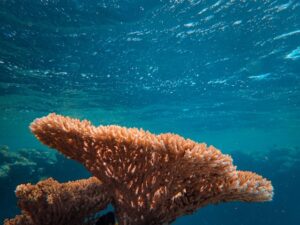
South Asia has emerged as one of the few regions in the world where coral reefs show signs of recovery. But this regional improvement masks a far more worrying picture for Sri Lanka.
The latest Status of Coral Reefs of the World: 2025 report by the Global Coral Reef Monitoring Network (GCRMN) shows that hard coral cover across South Asia increased over the assessment period, even as the subregion containing Sri Lanka experienced a decline.
The report, the most comprehensive global assessment of coral reefs ever undertaken by the GCRMN, analysed more than 21 million observations drawn from 87,299 surveys across 36,886 reef sites. Spanning several decades, the data offer an unusually detailed picture of how coral reefs have changed under the combined pressures of climate change and human activity.
At first glance, South Asia appears to be a success story: average hard coral cover rose from 30.1% during 1997–2009 to 35.0% during 2020–2024, an absolute increase of 4.9 percentage points, or a relative increase of 16.2%. South Asia is one of only two GCRMN regions, alongside the Western Indian Ocean, where the latest assessment identifies a statistically significant increase in hard coral cover.
But this regional figure demands considerable caution when applied to Sri Lanka.
Regional recovery does not mean Sri Lankan reefs are recovering
The GCRMN divides South Asia into four subregions: Chagos, Maldives, the West and South Indian Shelf, and the Bay of Bengal. Sri Lankan reefs are included primarily within the West and South Indian Shelf, together with coral reefs along the western and southern coasts of India.
This is one of the most important details in the report.
While South Asia as a whole recorded a 16.2% relative increase in hard coral cover, the West and South Indian Shelf recorded a decline in hard coral cover between 2003 and 2024. The GCRMN notes that the positive regional trend is largely driven by the Chagos and Maldives subregions, which together account for about 83% of South Asia’s total coral reef area.
In other words, the headline that South Asian reefs are recovering should not be interpreted as evidence that Sri Lanka’s reefs are following the same trajectory.
The report suggests that oceanic reef systems such as Chagos and the Maldives may have experienced greater recovery capacity than continental-shelf reef systems exposed to heavier human pressures. The West and South Indian Shelf also contains the largest concentration of people living close to coral reefs in South Asia, increasing exposure to coastal development and other human pressures.
This distinction is particularly important for Sri Lanka, where coral reefs occur alongside heavily populated coastal areas and are exposed to multiple land- and sea-based pressures.
Sri Lanka sits within a declining subregion
The report does not provide a separate national hard-coral-cover trend for Sri Lanka. Instead, Sri Lankan reefs are assessed as part of the wider West and South Indian Shelf subregion. Therefore, the decline identified by the GCRMN should not be presented as a precise percentage decline for Sri Lanka alone.
Nevertheless, the subregional trend is highly relevant because Sri Lanka forms an important part of this reef system.
The report shows that hard coral cover in this subregion underwent a series of sharp declines. From 2003 onwards, the decline occurred in several steps, including an 11.5-percentage-point reduction during 2003–2005, a further 10.2-percentage-point decline during 2009–2010, and a much larger 17.9-percentage-point decline during 2015–2016.
These periods correspond closely with major disturbances.
The first decline coincided with the 2004 Sumatran-Andaman earthquake and tsunami, while the later declines corresponded with global coral bleaching events. The report also records that the 2015–2016 bleaching event caused an approximately 50% relative decline in mean hard coral cover in the Gulf of Mannar.
Sri Lanka’s reefs were also among those affected by the 2004 tsunami. The GCRMN describes the tsunami’s impacts on Sri Lankan coral reefs as spatially heterogeneous but notes that some of the most significant effects within South Asia were recorded in Sri Lanka.
The climate threat is becoming more severe
Perhaps the most significant message for Sri Lanka is not simply the historical decline in coral cover, but the increasingly hostile thermal environment in which the country’s reefs now have to survive.
Across South Asian coral reefs, average sea-surface temperature increased by 0.79°C between 1985 and 2025, equivalent to approximately 0.20°C per decade. Major heat-stress episodes occurred in 1998, 2010, 2016, 2020 and 2024. Four of these events coincided with the four recognised global coral bleaching events.
The global picture is even more alarming. Across the world’s coral reefs, sea-surface temperatures increased by approximately 0.81°C between 1985 and 2025. The GCRMN identifies increasingly frequent and intense marine heatwaves as the primary driver of the global decline in coral cover.
The fourth global coral bleaching event, which began in 2023 and continued into 2025, was the most extensive and intense bleaching event recorded. However, its full ecological consequences are not yet reflected in the GCRMN’s coral-cover estimates, because the underlying ecological dataset analysed in the report extends only through 2024.
This is particularly important when considering Sri Lanka’s current situation. The latest published coral-cover figures should not automatically be interpreted as representing the full damage caused by the most recent bleaching event.
The recovery story has an important warning
One of the most encouraging findings of the report is that coral reefs can recover.
Following the third global bleaching event, global average hard coral cover increased by approximately 6% between 2017 and 2019. This demonstrated that reefs retain the capacity to regain coral cover after major disturbances when they are given enough time to recover.
The South Asian experience provides further evidence of this resilience.But there is a fundamental problem: the recovery periods are becoming shorter.
Before 2010, major global bleaching events were separated by approximately a decade. Since 2010, major disturbances have occurred every four to six years in many regions. The GCRMN warns that increasingly frequent disturbances could prevent reefs from recovering before the next major heatwave or bleaching event arrives.
This creates a potentially dangerous cycle for Sri Lanka: a reef may survive one bleaching event and begin rebuilding its coral communities, only to experience another severe thermal disturbance before recovery is complete.
Climate change is not the only problem
Although ocean warming is now the dominant global threat, the GCRMN stresses that local pressures can determine how well individual reefs withstand and recover from climate-related disturbances.Across South Asia, coral reefs are affected by coastal development, eutrophication, pollution and unsustainable fishing. Land-based pollution, particularly wastewater, is identified as an important but still understudied threat.These pressures matter because a coral reef already weakened by poor water quality, sedimentation, excessive nutrients or fishing pressure may have less capacity to withstand thermal stress.
For Sri Lanka, this means that climate adaptation of coral reefs cannot be separated from coastal management.Reducing untreated wastewater entering coastal waters, controlling sedimentation, improving coastal development practices, preventing destructive fishing and strengthening reef management could all help reefs withstand future heat stress.
But the GCRMN is equally clear that local management cannot replace global climate action. Reducing local pressures can increase resilience, but it cannot compensate indefinitely for continued ocean warming.
A major gap: Sri Lanka and South Asia still need better monitoring
Another issue receiving less attention in discussions of the report is the quality and distribution of the monitoring data.
The South Asia assessment is based on 2,825 surveys from 15 datasets covering 636 monitoring sites between 1997 and 2024. However, 90% of the surveys were conducted after 2005. The monitoring effort is also unevenly distributed across the region.The GCRMN warns that several reef systems in the West and South Indian Shelf remain poorly represented.
This has direct implications for Sri Lanka. A lack of consistent long-term monitoring can make it difficult to determine exactly how individual Sri Lankan reefs are changing, which reefs are recovering, which are deteriorating and which may be acting as refuges for coral populations.
The problem is therefore not simply that reefs are declining. It is also that there are still significant gaps in our ability to track those changes.
The report’s authors call for expanded monitoring, particularly in vulnerable and understudied regions, together with standardised methods, improved data access and a broader range of indicators beyond hard coral cover.
Not all Sri Lankan reefs are equally degraded
The broader evidence from Sri Lanka also suggests that the country’s coral reefs cannot be described with a single national figure.
Recent research has found substantial differences between nearshore and offshore reefs around Colombo. Offshore sites such as Gingiripita and Pitagala have recorded considerably higher hard coral cover and reef biodiversity, while a nearshore sandstone reef at Palagala recorded only 2.3% hard coral cover and poorer water quality associated with land-based pollution, turbidity and untreated sewage.
This variation reinforces an important lesson from the GCRMN report: global and regional averages can conceal major differences between individual reef systems.Some Sri Lankan reefs may be severely degraded, while others retain relatively high coral cover and potentially important populations capable of supporting recovery elsewhere.
What Sri Lanka can learn from the global assessment
The GCRMN report does not suggest that coral reefs have reached an irreversible point of collapse. Instead, it presents a more nuanced message: recovery remains possible, but the opportunity for recovery is becoming narrower.
South Asia’s overall improvement provides evidence that coral reefs can recover when conditions allow. But Sri Lanka’s position within a declining subregion demonstrates that recovery is not automatic.
The country’s reefs face a combination of rising sea temperatures, increasingly frequent bleaching events and local pressures such as pollution, sedimentation, coastal development and unsustainable fishing. These threats can reinforce one another, leaving reefs less able to recover between disturbances.
The GCRMN therefore points towards a two-level response. First, global greenhouse-gas emissions must be reduced to slow ocean warming. Second, local pressures must be reduced so that individual reefs have the greatest possible chance of surviving and recovering from unavoidable climate-related disturbances.
For Sri Lanka, that means treating coral reefs not simply as tourist attractions or marine habitats, but as critical components of coastal resilience, fisheries, biodiversity and the wider economy.The apparent recovery of South Asian coral reefs should therefore be seen neither as a reason for complacency nor as evidence that Sri Lanka’s reefs are recovering.
Instead, it offers a more hopeful but urgent message: coral reefs can recover-but only if they are given the time, space and conditions to do so.For Sri Lanka, ensuring those conditions may depend on decisions taken both beneath the waves and far and beyond the coastline.
References
Banner Image: Representative Image, Photo by Francesco Ungaro on Unsplash
Sections of this article may have been developed with the assistance of artificial intelligence tools to support research, drafting and language refinement. All information has been reviewed, edited and verified by the author/editor to ensure accuracy, context and editorial integrity. The responsibility for the final content, interpretations and conclusions rests solely with the publisher.