Physical Address
23,24,25 & 26, 2nd Floor, Software Technology Park India, Opp: Garware Stadium,MIDC, Chikalthana, Aurangabad, Maharashtra – 431001 India
Physical Address
23,24,25 & 26, 2nd Floor, Software Technology Park India, Opp: Garware Stadium,MIDC, Chikalthana, Aurangabad, Maharashtra – 431001 India

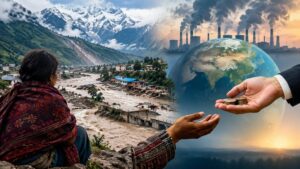
Nepal’s latest demand for climate compensation has brought a familiar climate debate into sharper focus: who should pay when countries that have contributed little to global warming suffer some of its most devastating consequences?
Following the catastrophic flash floods that struck Nepal on August 26, the country has called for climate compensation from major greenhouse-gas emitters, particularly the United States, China and India. Nepal’s Foreign Minister Shisir Khanal has described the demand not as charity or conventional foreign aid, but as a question of justice, responsibility and compensation.
The disaster has left more than a thousand people dead and thousands missing, while villages, roads and hydropower infrastructure have been severely damaged. The floods followed an ice-and-rock collapse in the Himalayan region, highlighting how quickly changes in the fragile mountain environment can translate into a human catastrophe downstream.
A Small Emitter Facing a Huge Climate Bill
Nepal’s argument rests on a striking imbalance. The country contributes only a tiny fraction of global greenhouse-gas emissions, yet its geography places it directly in the path of climate-related risks. Its mountains, glaciers and river valleys make it particularly vulnerable to changes in temperature and extreme weather.
The Hindu Kush Himalayas are warming rapidly, and the retreat of glaciers is increasing concerns about glacial lakes, landslides, floods and other hazards. For a country whose economy and communities are closely connected to its mountain environment, these changes are not distant projections. They are increasingly becoming an economic and humanitarian reality.
The recent disaster has also exposed the vulnerability of Nepal’s hydropower ambitions. Hydropower is central to the country’s economic strategy, and damage to generating facilities has threatened both electricity production and exports. The floods reportedly damaged around 10% of Nepal’s installed generation capacity, forcing the country to reconsider how infrastructure should be planned in an era of increasing climate uncertainty.
The economic consequences could be enormous. Estimates of reconstruction and recovery costs have run into several billion dollars, a burden that is particularly difficult for a developing economy to absorb. This is where Nepal’s climate justice argument gains force. Its message is simple: countries that have historically produced far greater quantities of greenhouse gases should contribute more towards helping vulnerable nations deal with the damage.
From Climate Aid to Climate Responsibility
Nepal’s demand also reflects a larger shift in international climate politics. For years, developing countries have argued that climate finance should not be viewed simply as assistance from wealthy nations to poorer ones. The issue is increasingly framed around loss and damage, the costs of climate impacts that cannot simply be prevented through adaptation.
The establishment of the international Loss and Damage Fund was an important step in this direction. However, the scale of available finance remains far smaller than the potential costs of major disasters. Nepal’s experience illustrates the gap between the financial mechanisms created internationally and the enormous bills that vulnerable countries can suddenly face. There is, however, a difficult question at the heart of Nepal’s demand: can responsibility for global warming be translated into legal liability for a particular disaster?
That is far more complicated than establishing that climate change is making extreme events more likely. A compensation claim against individual countries would have to address questions of causation, historical emissions, international law and the contribution of particular emitters to a specific event. The Paris Agreement’s negotiating framework also deliberately avoided creating a straightforward basis for liability or compensation. For this reason, Nepal’s initiative may currently be more powerful as a diplomatic and political argument than as a straightforward legal claim.
India, meanwhile, has long maintained that climate responsibilities must reflect historical emissions, differences in development and countries’ respective capacities to act. New Delhi has also emphasised the principle of common but differentiated responsibilities. India has expressed solidarity with Nepal following the disaster and described climate change as a shared global challenge. Nepal’s demand nevertheless raises an uncomfortable question for all major emitters: if climate change crosses borders, should responsibility also cross borders?
The answer will not be easy, and compensation mechanisms cannot undo the lives lost or communities destroyed by a disaster. But Nepal has succeeded in putting the question firmly on the international agenda. Its appeal is ultimately about more than one flood or one country. It is about whether the global climate system can develop a fairer way of sharing the enormous costs of a crisis that some countries helped create, while others are being forced to pay a much higher price.
References:
https://www.sciencedirect.com/science/article/abs/pii/S0012825226000607
https://www.unep.org/news-and-stories/story/what-you-need-know-about-cop27-loss-and-damage-fund
Banner Image: AI Generated
Sections of this article may have been developed with the assistance of artificial intelligence tools to support research, drafting, and language refinement. All information has been reviewed, edited, and verified by the author/editor to ensure accuracy, context, and editorial integrity. The responsibility for the final content, interpretations, and conclusions rests solely with the publisher.