Physical Address
23,24,25 & 26, 2nd Floor, Software Technology Park India, Opp: Garware Stadium,MIDC, Chikalthana, Aurangabad, Maharashtra – 431001 India
Physical Address
23,24,25 & 26, 2nd Floor, Software Technology Park India, Opp: Garware Stadium,MIDC, Chikalthana, Aurangabad, Maharashtra – 431001 India

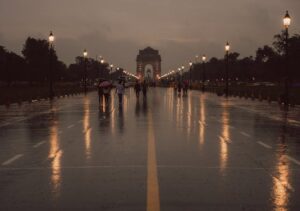
Urbanization’s influence on temperature is widely recognized: cities are warmer than rural areas due to the urban heat island (UHI) effect. Less acknowledged, however, is its counterpart—the urban precipitation anomaly—where cities often experience increased rainfall compared to surrounding regions. This phenomenon arises from multiple factors linked to urban growth and infrastructure.
What is Urban Precipitation Anomaly?
Urban Precipitation Anomaly refers to the shift in rainfall patterns caused by city landscapes. Urban environments, with their dense infrastructure, asphalt roads, and limited vegetation, modify local atmospheric dynamics. Heat-retaining surfaces in cities create urban heat islands that warm the air above, prompting it to rise and enhance convection, which can result in more frequent or intense rainfall. Furthermore, urban pollution introduces aerosols into the atmosphere, which act as cloud condensation nuclei and alter cloud and rainfall behaviour. The layout of a city—such as the height and distribution of buildings or the presence of green areas—also plays a critical role in influencing precipitation.
Understanding Urban Heat Islands and Their Role in Rainfall
Climate Scientist and CFC’s in-house expert Dr Partha Das explains, “The urban areas are hotter than the surrounding rural areas both in day and night and in all seasons mainly due to the formation of local heat islands. Anthropogenic urban surfaces and materials that go into making urban areas such as roads, buildings, roofs, parking lots etc. absorb and emit more heat than natural areas like water bodies, forests, parks etc. that are found more in suburban and rural areas than in urban spaces. This is why and how confined spaces with hotter environs are created within cities and other urban agglomerations. The surface and air temperatures recede as one moves from the centre of a city towards the suburbs and rural landscapes. It is evident that the overall rise in atmospheric temperatures due to global warming and consequent climatic changes also contribute to formation and retention of urban heat islands increasing its severity of heat stresses for urban populations. Thus, the UHI phenomenon is evidence of how urbanization can affect local climate by increasing temperatures.”
Key Factors Driving Urban Precipitation Anomalies
Environmental and urbanization factors such as topography, temperature, population density, aerosols, and the urban heat island effect contribute significantly to precipitation anomalies. Cities situated in lowlands or valleys may receive less rainfall, whereas those on flat plains or highlands often experience increased precipitation. Urban areas with large populations tend to exhibit stronger rainfall anomalies, especially where aerosol concentrations and surface heating drive convective rainfall patterns.
“It is only through recent research that scientists have come to realise that urbanization can also impact local precipitation by modifying temperatures, wind flows, and evapotranspiration. This is an interesting development and shows how human induced modifications can interact with natural systems to change climatic characteristics both locally and regionally. Latest scientific observations have indicated that rainfall in urban areas is increasing compared to the adjacent rural areas and heats islands have play an important role in enhancing rainfall intensity and frequency,” Dr Das added.
Among megacities, those with populations exceeding one million, urban centres generally receive more rainfall, although extreme precipitation is often more intense in nearby downwind rural areas. This highlights the complex interplay between urbanization, wind flow, and localized temperature changes.
Triggers of Enhanced Rainfall
Associate Professor at Cotton University, Assam, Dr Rahul Mahanta shared insights with CFC on the factors that enhance precipitation due to rapid urbanization:
“A. Urban Heat Island (UHI): Cities trap more heat than rural areas due to concrete structures, asphalt, and reduced vegetation. This warming effect increases convective activity, which can intensify rainfall.
B. Aerosol and Pollution Levels: Urban areas typically have higher concentrations of aerosols, which can influence cloud formation and precipitation patterns by acting as cloud condensation nuclei.
C. Increased Surface Runoff: Concrete surfaces prevent rainwater infiltration, leading to quicker accumulation of surface water, exacerbating the impact of intense rainfall.
D. Changing Atmospheric Circulation: Urban structures can alter wind patterns and moisture transport, possibly triggering convective systems that lead to heavy downpours in localized areas.”
Indian Cities and the Reality of Urban Precipitation Anomaly
In India, signs of urban precipitation anomalies are increasingly evident. Mumbai’s rapid urbanization has intensified localized convection, contributing to events like the catastrophic 2005 floods. Delhi experiences irregular and intense rain spells driven by heat island effects and pollution. Bengaluru, once known for its mild weather, now witnesses more violent storms, attributed to uncontrolled urban expansion and the loss of natural water bodies. Chennai, particularly vulnerable during the Northeast Monsoon, saw dramatic floods in 2015, worsened by the city’s shrinking green cover. Kolkata has also seen increased rainfall intensity during both pre-monsoon and monsoon periods, a trend tied to dense urban development.
Urban Vulnerability in a Warming World
Dr Das says, “In the rapidly urbanizing world of today, the urban population, as estimated by the UN, is around 55% which is expected to increase to about 68% by the year 2050. Most of the urbanization will occur in developing countries like India, China and Nigeria. These three countries together will account for 35% of the projected growth of the world’s urban population between 2018 and 2050. The rise in urban population is projected to be 416 million for India, 255 million for China and 189 million for Nigeria. The developing countries like India are already highly vulnerable to adverse impacts of climate change. Unplanned and unhealthy urbanization has put the populations in towns and cities at more risk. Urban flooding has emerged as a common catastrophe for many cities across the globe, which are generated mainly through extreme rainfall, collapse of flood defense and drainage failure. If the findings from the contemporary research are taken into consideration, it does not augur well for those cities that are already found to be vulnerable to climate change and consequent hydrometeorological disasters like extreme rains, hailstorms and flash floods.”
Reflecting on India’s experience, Dr Das added, “Coming to the Indian context, we remember the cataclysmic urban flash flooding experience in cities like Ahmedabad (2001, 2020, 2022), Chennai (2004, 2015, 2021), Mumbai (2005, 2017), Surat (2006), Kolkata (2007), Jamshedpur (2008), Delhi (2009, 2023) and Guwahati (2010), Hyderabad (2020 and 2021), Bengaluru (2017, 2022), Nagpur (2023). Although there were a number of factors that had interacted to led to these disasters, in most cases, the triggering element was extreme rainfall.”
Strategies to Mitigate Urban Precipitation Anomalies
Addressing urban precipitation anomalies requires cities to adopt climate-sensitive infrastructure and planning. Expanding green spaces like urban forests, parks, and green roofs helps cool environments and absorb excess rain. Restoring lakes, ponds, and wetlands supports natural water retention and flood mitigation. Using permeable surfaces enables water to seep into the ground, while smart urban planning—including well-spaced buildings and airflow corridors—reduces the heat island effect. Reducing pollution levels is also key, as fewer aerosols encourage more natural cloud and rain processes. Additionally, improving drainage systems and promoting rainwater harvesting can strengthen a city’s ability to handle sudden, heavy rainfall.
Global Case Studies: Cities Leading the Way
Globally, several cities have demonstrated how nature-based and engineered solutions can manage urban rainfall effectively. Singapore’s “ABC Waters Programme” integrates rain gardens and green roofs into city design to absorb water and prevent floods. Copenhagen implemented a Cloudburst Management Plan following devastating floods in 2011, redesigning public spaces to temporarily store stormwater. Tokyo’s G-Cans Project redirects stormwater through vast underground tunnels, while Rotterdam’s water plazas double as recreational spaces and temporary water storage. New York’s Green Infrastructure Plan uses rooftop vegetation and rain gardens to manage stormwater and mitigate the urban heat island effect.
India’s Efforts Toward Resilient Urban Futures
India is taking steps in a similar direction. Many cities now promote green infrastructure to reduce heat and surface runoff. Rainwater harvesting is mandatory in cities like Chennai, Bengaluru, and Delhi. Urban lake rejuvenation projects are underway in Pune and Hyderabad, while the Smart Cities Mission pushes for climate-resilient planning and better drainage systems. The National Mission on Sustainable Habitat supports sustainable urban development, including heat island mitigation. Efforts are also being made to develop early warning systems and urban flood forecasting models. Although enforcement remains a challenge in rapidly urbanizing areas, these initiatives reflect India’s growing recognition of the need to build resilient, climate-smart cities.
References:
https://www.pub.gov.sg/Resources/Publications/ABC-Waters
https://www.nyc.gov/site/dep/water/green-infrastructure.page
https://mohua.gov.in/upload/uploadfiles/files/NMSH-2021.pdf
Banner Image: Photo by Pramod Tiwari: https://www.pexels.com/photo/people-walking-on-the-street-during-night-time-13759774/

Comments are closed.







kamagra gel: kamagra gel – Kamagra oral jelly pas cher