Physical Address
23,24,25 & 26, 2nd Floor, Software Technology Park India, Opp: Garware Stadium,MIDC, Chikalthana, Aurangabad, Maharashtra – 431001 India
Physical Address
23,24,25 & 26, 2nd Floor, Software Technology Park India, Opp: Garware Stadium,MIDC, Chikalthana, Aurangabad, Maharashtra – 431001 India

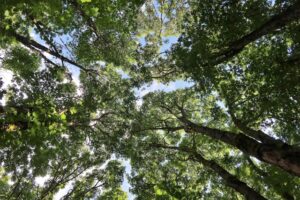
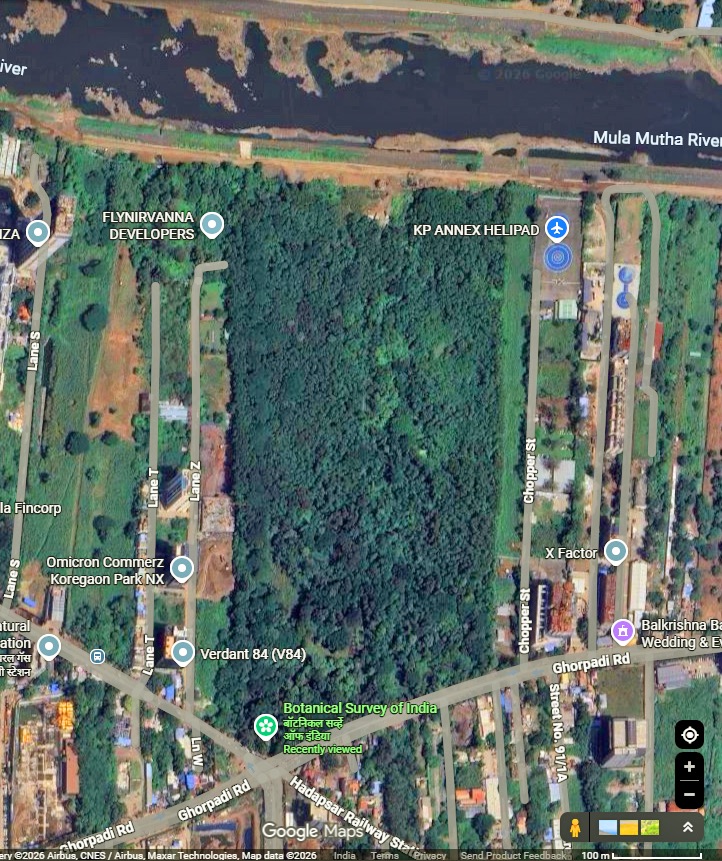
The proposal reads like a small administrative item: a road, a public notice, a window for objections closing on 9 June. What it would actually do is remove close to 1,500 mature trees from the campus of the Botanical Survey of India (BSI) at Mundhwa in Pune, a 44-acre garden that has served for decades as a living plant archive and one of the last large green lungs along the Mula-Mutha river. The felling is tied to road construction under the city’s River Front Development project, referred to by some residents as a DP Road alignment, and the Pune Municipal Corporation (PMC) has invited public objections before a final decision.
The figure under dispute is itself telling. Activists and the PMC notice cite roughly 1,488 to 1,500 trees, including riparian and heritage specimens, many of them old enough to anchor an entire local microclimate. The BSI Mundhwa campus, part of the survey’s Western Regional Centre, is not an ornamental park. It is a scientific collection that houses hundreds of plant species and serves as a reference garden for botanists, which is part of why the proposal has drawn objections framed less as nimbyism and more as the destruction of public ecological infrastructure.
A city already running short of green
The climate argument against the felling does not rest on sentiment. It rests on Pune’s own numbers. Campaigners point out that the city’s green cover has declined to roughly 5 to 6 percent of its surface area, far below the 33 percent that urban planners and climate-resilience frameworks treat as a healthy benchmark. A botanical garden of mature canopy is not a like-for-like swap with saplings planted elsewhere; the cooling, shade, water retention and habitat value of a 40-year-old tree cannot be replanted on a project timeline.
That gap matters most in summer. Mature canopy is one of the cheapest and most reliable defences a tropical city has against extreme heat, and Pune has been warming and paving in tandem. Stripping a dense, old-growth cluster on the riverbank removes exactly the cover that moderates daytime temperatures and protects the people least able to afford air conditioning. Every large tree felled in a heat-stressed city is a withdrawal from a public cooling system that took decades to build.
The flood-risk contradiction
The sharpest point in the objections is also the most quantitative. Residents have cited MERI data (from the Maharashtra Engineering Research Institute) indicating that rainfall-driven flood values in Pune could triple. If that projection holds, the riverbank trees now marked for removal are not obstacles to development; they are part of the city’s flood defence.
Riparian trees along the Mula-Mutha do real hydrological work. Their roots bind the bank against erosion, while the vegetated buffer slows and absorbs stormwater that would otherwise rush into an already stressed channel. Clearing that buffer to build a road inside a flood-prone river corridor, in a city whose own engineering data warns of tripling flood values, turns a local tree dispute into a climate-governance story: the development meant to manage the river may erode one of the river’s natural safeguards.
Process questions the PMC has not answered
Beyond ecology, the objections target how the decision was reached. Campaigners argue that Pune currently lacks a properly constituted Tree Authority, which under the Maharashtra (Urban Areas) Protection and Preservation of Trees Act, 1975 must have a minimum number of members, including non-official experts. A felling clearance of this scale, the argument runs, cannot be valid if the statutory body meant to scrutinise it is not lawfully in place.
They have also flagged that the tree officer did not impose protective conditions available under the Act even where the department’s own expert committee had reportedly recommended caution, and that the public notice withheld basic detail: the age, species, girth and GPS location of the trees slated for removal. Petitioners point further to directives from the Supreme Court’s Central Empowered Committee restricting riverside felling without prior approval and expert assessment, raising the question of whether the proposal clears that bar at all.
The credibility problem is compounded by Pune’s recent record on compensation. A separate controversy this week alleged that GPS coordinates for the PMC’s compensatory plantations pointed to locations as far afield as Africa, reviving doubts about whether the trees promised in lieu of those felled are ever planted or survive. When the standard mitigation, plant more than you cut, is itself under a cloud, the assurance that 1,500 felled trees will be replaced rings hollow.
A core issue beneath the noise
The campaign has folded in a range of surrounding grievances, from builder-driven felling elsewhere in the city to allegations of conflict of interest against civic officials. A fact-checker’s caution applies: claims about specific officials, about past projects, and about who benefits should be weighed separately from the core, verifiable issue. That core is not in serious dispute. A large stand of mature, partly riparian trees in a scientific garden is proposed for felling, on a flood-prone riverbank, in a city with single-digit green cover and official data warning that floods may worsen threefold.
What residents are saying
A scan of public posts on X captures the texture of the opposition, which runs from raw alarm to careful, cross-partisan dissent. The dominant note is a fear that Pune is being converted into an unliveable concrete jungle. One resident asked whether the city had simply resolved to turn Pune into a desert; another framed the felling as the loss of a natural green belt in the name of a development that leaves the city less habitable, not more. A third said they would take leave from work and sit on a dharna if it came to that, describing mature trees as essential infrastructure rather than obstacles to it.
Much of the energy is a demand for action beyond statements. Residents have pressed elected representatives to file a public interest litigation rather than post about the issue, and one journalist, writing in a personal capacity, called for a non-political agitation for the trees framed around children’s futures, while others told public figures bluntly that posting on X is not enough with the deadline days away.
Notably, the resistance is not confined to government critics. A self-described supporter of the current state administration said he could not understand why the road must run through the botanical garden when other locations exist in Pune, a sign that the issue has crossed political lines. A nature-focused account tied the Mundhwa case to earlier builder-driven felling in Hinjewadi, arguing that the compensatory plantation promised on paper rarely materialised on the ground. A separate, more contentious strand is openly partisan, trading hypocrisy charges and conflict-of-interest allegations across political camps; those claims are unverified and noted below with caution.
The deadline, and the larger pattern
Pune is not unique. Indian cities have repeatedly fast-tracked tree felling for roads, metros and memorials, often overnight and ahead of public scrutiny, and courts have at times had to step in to halt clearances. The Mundhwa proposal fits that pattern, but it also sharpens it, because the trees in question sit inside a national botanical institution and on the very riverbank the development is meant to manage.
The objection window closes on 9 June 2026. Whether the PMC pauses to reckon with its own flood projections, its own green-cover deficit and its own contested compensation record, or proceeds on schedule, the Mundhwa garden has become a test of a simple climate-era question: when a city’s data tells it that mature trees and intact riverbanks are infrastructure, can it still treat them as something to be cleared for a road?
References
https://www.mypunepulse.com/pune-citizens-raise-objections-to-proposed-felling-of-1488-trees-at-bsi-mundhwa/ https://punesamvad.wordpress.com/2026/06/03/object-to-%e2%89%881500-tree-felling-at-botanical-garden-mundhwa/
https://bsi.gov.in/rc-page/en?rcu=134%2C95
https://www.pmc.gov.in/en/d/tree
Banner Image: Representative. Photo by Chris Linnett on Unsplash
Sections of this article may have been developed with the assistance of artificial intelligence tools to support research, drafting and language refinement. All information has been reviewed, edited and verified by the author/editor to ensure accuracy, context and editorial integrity. The responsibility for the final content, interpretations and conclusions rests solely with the publisher.