Physical Address
23,24,25 & 26, 2nd Floor, Software Technology Park India, Opp: Garware Stadium,MIDC, Chikalthana, Aurangabad, Maharashtra – 431001 India
Physical Address
23,24,25 & 26, 2nd Floor, Software Technology Park India, Opp: Garware Stadium,MIDC, Chikalthana, Aurangabad, Maharashtra – 431001 India

A year after Cyclone Ditwah killed more than 600 people, Sri Lankan survivors still wait for land and repairs. What science says about climate change's role.
The storm struck on 28 November 2025. Twelve months later, families are still waiting for land, water tanks are still broken, and scientists are still working out how much climate change added to the rain.
In Gampola, a town in Sri Lanka’s central hills, people now judge the weather by a single number. When rainfall goes above 100 millimetres, residents say, the area starts to flood again. That fear is one of the quieter legacies of Cyclone Ditwah, which hit the island a year ago this week.
Ditwah struck Sri Lanka’s east coast on 28 November 2025 and set off the worst floods and landslides the country had seen in decades. Official figures now put the death toll at 646, with 173 people still missing. About 2.2 million people across all 25 districts were affected.
Homes lost, and a long wait for land
Around 6,200 homes were destroyed and about 114,000 were partly damaged. Kandy district was the worst hit. In the village of Hadabima, a mudslide buried part of the settlement. A dozen houses there have since been declared unsafe, and their owners receive rent support until they find somewhere else to live.
The government is offering families up to 5 million rupees (about $15,000) to buy a plot of land, one of its largest disaster relief payments. But survivors say getting the money is hard, and many have little or no savings to fall back on. Officials say people in high-risk areas have been asked to leave. Many families reply that the land is their home and their livelihood, and that moving to another village is not simple.
This tension has deep roots. In January, CFC reported that cleared forests, eroded soils and building on steep slopes helped turn Ditwah’s rain into more than 1,200 severe landslides, 363 of them in Kandy district alone. Moving people off dangerous slopes is the safer choice on paper. In practice, it asks families to give up land, work and community, and it only works if the support that comes with it is real and reaches them.
What the cyclone cost
Putting one figure on the damage is hard, because different studies measure different things. The World Bank estimates the damage at about $4.1 billion. The government’s Post Disaster Needs Assessment put direct damage at about LKR 618 billion (around $2 billion) and estimated that recovery and reconstruction would need about LKR 1,022 billion (around $3.4 billion) over three years. Whichever number is used, the bill arrived just as Sri Lanka was climbing out of its 2022 economic crisis.
Broken tanks and a polluted coast
The cyclone also damaged much of the island’s water system. The Irrigation Department recorded 1,020 irrigation systems affected, from tanks and canals to bunds. In August, CFC found that tanks in the eastern part of Wilpattu National Park had run dry because structures damaged by Ditwah had not been repaired. Wildlife officers were trucking in about 26,000 litres of water a day so that deer and elephants had something to drink.
The coast was hit too. After the storm, the Marine Environment Protection Authority reported pollution along about 200 nautical miles of coastline as rivers flushed mud, plant debris and waste into the sea. CFC noted at the time that Sri Lanka had little baseline data to measure the harm to reefs and fisheries.
How much did climate change add?
Ditwah was not a strong storm by wind speed. Its winds peaked at about 75 km/h, far weaker than some earlier cyclones that hit the island. What made it deadly was the rain.
A rapid study by the World Weather Attribution group found that the heavy rain over Sri Lanka from 24 to 28 November 2025 was about a once-in-30-years event in today’s climate, which is about 1.3°C warmer than before industrialisation. Rainfall records showed such downpours had become 28% to 160% heavier. The scientists could not put an exact figure on climate change’s share, because the climate models they tested did not match the observed rainfall trend well. They estimated that La Niña and a negative Indian Ocean Dipole, two natural climate patterns, added roughly 5% to 13% to the rain.
Basic physics points the same way. Warmer air holds about 7% more moisture for every 1°C of warming, so storms have more water to drop. CFC explained this link in January in Cyclone Ditwah Was No Natural Disaster.
New research is still arriving. Researchers from Japan’s Tohoku University presented an attribution study of Ditwah at a scientific meeting in May 2026. The study found climate change made the heavy rain stronger and spread it over a wider area.
Warnings that did not reach people
Forecasting was not the main failure. The Meteorology Department issued a red alert before landfall, yet many families in the worst-hit areas said they never received a timely warning. The WWA study also listed insufficient early warning, lack of insurance, deforestation and urban growth among the factors that made the disaster worse.
Rebuilding is a chance to close these gaps: repairing tanks before the next dry season, keeping homes off the most dangerous slopes while properly supporting those who move, and making sure alerts reach people in time and in their own language.
What to watch
Sri Lanka is now in another northeast monsoon season. Survivors in Kandy and Gampola say each heavy shower brings back the fear of last November. One year on, the real question is not whether another storm like Ditwah will come, but whether the island will be better prepared when it does.
References
http://www.dmc.gov.lk/images/pdfs/PDNA_Executive%20Summary_Final_Published_on_%2021_May.pdf
https://srilanka.un.org/en/308868-cyclone-ditwah-situation-report-23-january-2026
https://www.yahoo.com/news/world/articles/sri-lanka-cyclone-survivors-struggle-020706342.html
Degraded Land, Deadly Storm: How Soil Erosion Worsened Cyclone Ditwah’s Impact
Eastern Wilpattu Runs Dry as Post-Ditwah Tank Repairs Lag
From Sea Foam to Sediment Tsunami: How Cyclone Ditwah Reshaped Sri Lanka’s Coasts
Cyclone Ditwah Was No Natural Disaster: How Climate Change Supercharged Sri Lanka’s Floods
https://confit.atlas.jp/guide/event/jpgu2026/subject/AAS03-16/date
https://thesun.my/news/sri-lanka-cyclone-survivors-struggle-to-rebuild-lives-one-year-on
From Red Alert to Ruin: How System Failures Turned Ditwah into Sri Lanka’s Worst Storm in Decades
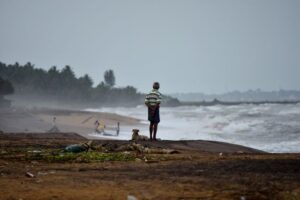
Banner Image: Representative Image. Photo by Janaka Sampath: https://www.pexels.com/photo/man-and-his-dog-standing-on-beach-during-storm-8493343/
Sections of this article may have been developed with the assistance of artificial intelligence tools to support research, drafting and language refinement. All information has been reviewed, edited and verified by the author/editor to ensure accuracy, context and editorial integrity. The responsibility for the final content, interpretations and conclusions rests solely with the publisher.