Physical Address
23,24,25 & 26, 2nd Floor, Software Technology Park India, Opp: Garware Stadium,MIDC, Chikalthana, Aurangabad, Maharashtra – 431001 India
Physical Address
23,24,25 & 26, 2nd Floor, Software Technology Park India, Opp: Garware Stadium,MIDC, Chikalthana, Aurangabad, Maharashtra – 431001 India

Massive Pacific swells have put California's coast on high alert. See where flooding and erosion risks are highest, why El Niño matters and what's next.
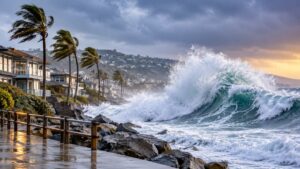
California’s coastline is facing an unusually powerful spell of ocean activity, with massive waves, dangerous surf and coastal flooding putting communities on alert. Successive weather systems moving across the Pacific have generated powerful swells, sending towering waves crashing against beaches, seawalls and piers, while authorities have urged residents and visitors to stay away from exposed coastal areas.
The scale of the waves has drawn particular attention. Offshore buoys recorded wave heights exceeding 30 feet (9 metres) recently. A buoy off Monterey recorded a wave height of 34.1 feet, potentially the highest reading at that location in three decades. The measurements highlight the intensity of the ocean conditions and the growing risks for communities along California’s Pacific shoreline.
The powerful surf has already disrupted coastal activities. Several beaches and piers were closed over the preceding weekend as large waves battered the shoreline. In Pacifica, waves surged over seawalls, offering a dramatic illustration of how exposed coastal infrastructure can be when powerful swells reach land.
Powerful Pacific storms bring more than just giant waves
The unusual wave activity is linked to successive areas of low pressure developing over the Pacific Ocean. These weather systems have generated strong swells that travel across the ocean before reaching the California coast, where they break with considerable force.
The National Weather Service issued warnings across several coastal regions, with expected wave heights generally ranging between 10 and 18 feet. Some exposed stretches of the coastline, particularly beaches in San Luis Obispo County and the central coast of Santa Barbara County, were forecast to experience waves reaching 18–22 feet.
However, the impact of these systems extends well beyond the shoreline. Heavy rainfall, strong winds and snowfall in mountainous areas have accompanied the unsettled weather across the western United States.
San Francisco experienced record-breaking rainfall during the week, while heavy downpours in Sacramento reportedly left around 32,000 electricity customers without power. The weather systems have also brought snowfall to higher elevations, including areas around Donner Pass in the northern Sierra Nevada mountains. The combination of heavy precipitation, strong winds and powerful coastal surf has created multiple weather-related challenges across the region.
The situation has been particularly concerning for communities situated close to the ocean. Large breaking waves can overtop seawalls, damage coastal infrastructure, erode beaches and increase the risk of flooding in low-lying areas. They can also generate dangerous rip currents, which can pull swimmers away from the shore, even when the water appears relatively calm.
The threat is not limited to people entering the water. Unexpectedly large waves can reach further inland than anticipated, catching beachgoers, fishermen and people watching the surf off guard. Coastal authorities have therefore urged the public to maintain a safe distance from the shoreline during periods of hazardous surf. San Diego has already witnessed the consequences of the powerful ocean conditions.
King tides could intensify coastal flooding ahead of Thanksgiving
Even as communities deal with the impact of large waves, another coastal threat is emerging: exceptionally high tides expected during the Thanksgiving holiday period.
From November 23 to 26, several parts of California are expected to experience unusually high king tides. The situation is being intensified by a combination of astronomical and oceanic conditions, including November’s Beaver Moon and an El Niño-related ocean phenomenon known as a Kelvin wave. King tides are exceptionally high natural tides that occur when the gravitational pull of the Sun and Moon combines to produce a greater-than-usual rise in ocean levels. Their effects can become more pronounced around full and new moons.
This time, the concern is that these naturally elevated tides will coincide with already unsettled coastal conditions and powerful ocean swells. The resulting combination could increase the likelihood of coastal flooding, beach erosion and water entering low-lying neighbourhoods.
Coastal flood advisories are expected from areas north of Los Angeles down to San Diego, while coastal flood warnings covered the San Francisco Bay Area and San Pablo Bay. Some locations were expected to experience exceptionally high water levels exceeding nine feet. Authorities in San Diego have begun preparing for the anticipated conditions. Municipal teams are reinforcing protective sand barriers along beaches, clearing storm drains and monitoring flood-prone locations. Residents have also been advised to avoid flooded roads, stay away from vulnerable coastal cliffs and keep clear of areas exposed to sudden water surges.
The timing is particularly significant as the approaching Thanksgiving holiday is one of the busiest travel periods in the United States, potentially bringing more visitors to coastal destinations. While large waves and high tides are natural ocean phenomena, their combined effects can create serious risks for coastal populations. Repeated episodes of powerful surf can gradually weaken shorelines, accelerate erosion and place additional pressure on infrastructure already exposed to the elements. California’s latest spell of extreme coastal conditions is a reminder that the risks associated with severe weather are not confined to storms and rainfall. The ocean itself can become a major source of disruption, particularly when powerful swells, unusually high tides and heavy precipitation occur together. For communities living along the Pacific coast, preparedness and timely warnings will be crucial in limiting damage and keeping people safe.
References:
https://forecast.weather.gov/wwamap/wwatxtget.php?cwa=LOX&wwa=coastal%20flood%20warning
Banner Image: AI generated
Sections of this article may have been developed with the assistance of artificial intelligence tools to support research, drafting, and language refinement. All information has been reviewed, edited, and verified by the author/editor to ensure accuracy, context, and editorial integrity. The responsibility for the final content, interpretations, and conclusions rests solely with the publisher.