Physical Address
23,24,25 & 26, 2nd Floor, Software Technology Park India, Opp: Garware Stadium,MIDC, Chikalthana, Aurangabad, Maharashtra – 431001 India
Physical Address
23,24,25 & 26, 2nd Floor, Software Technology Park India, Opp: Garware Stadium,MIDC, Chikalthana, Aurangabad, Maharashtra – 431001 India

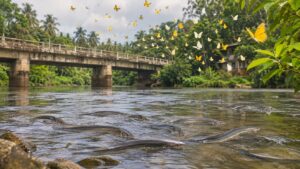
Viral eels at Kalladi Bridge and butterfly swarms over Colombo were called omens. Both are rain-driven seasonal events. Here’s the science.
Two viral sightings in Sri Lanka this month were shared as signs that a catastrophe was coming. Both are seasonal events driven by rain that has already fallen. Here is what the animals are actually doing, and why the omen story is so hard to shake.
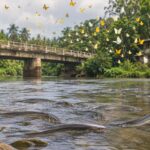
In the same week that forecasters were warning Sri Lanka of heavy rain, flash floods and landslides from a system building over the Bay of Bengal, two stretches of the island’s wildlife went viral for the wrong reasons. In Batticaloa, night footage of dozens of long, dark bodies thrashing at the surface of the lagoon under Kalladi Bridge was shared as a swarm of snakes and a sign that something terrible was about to happen. In Colombo, Galle and Ratnapura, clouds of yellow and white butterflies drifting in one direction set off a parallel round of speculation about cyclones and calamity.
Fact Crescendo Sri Lanka has checked both the eels and the butterflies. Neither event predicts anything. What they share is more interesting than any omen: each is a normal response to the island’s inter-monsoon rains, and each arrived at a moment when people were primed to read nature as a warning.
What was really under Kalladi Bridge
The first posts appeared on 13 November, beginning with a Facebook Reel captioned in Tamil, roughly, “snakes under Kalladi Bridge, don’t know what’s going to happen”. Within a day the clip had moved across Tamil and Sinhala pages, gathering hashtags such as #natural_disaster and “effect of climate change”, along with an unsupported claim that the same thing had been seen a month before the 2004 tsunami. Even the person filming the original video switched mid-clip from calling the animals snakes to calling them fish, according to Fact Crescendo’s fact check.
They are freshwater eels. Sri Lanka has two species, Anguilla bicolor bicolor and Anguilla nebulosa nebulosa, and residents, a local journalist and naturalist Yesitha Rodrigo all identified the animals in the video as eels. Rodrigo told Fact Crescendo that their size and look suggest mature “silver” eels preparing for the most important journey of their lives. Eels appear in Batticaloa’s estuaries every year, at several spots; Kalladi simply has enough foot traffic and fishing activity for someone to film them.
Why eels gather when the rain comes
Eels live their lives backwards compared with salmon. They are born at sea, drift towards the coast as transparent larvae, and climb inland as young eels, sometimes remarkably far: researchers have watched juveniles scaling reservoir walls in Sri Lanka’s North Central Province, at least 100 km from the sea. Adults can spend decades in rivers, tanks and lagoons. Then, once in their lives, they turn around and head for the ocean to spawn, after which they die.
Before that final run, their bodies change. The skin turns silvery, the eyes grow larger, the gut shrinks and they stop feeding. Timing matters, because swimming hundreds of kilometres without eating is expensive. Riding high water is the cheapest way out, and studies of migrating eels in Europe have recorded large numbers moving during peak river discharge after heavy rain. October and November are Sri Lanka’s second inter-monsoon season, when depression-driven rain is common, so a lagoon outlet full of restless silver eels in mid-November is exactly what the biology predicts.
In other words, the eels were responding to rain that had already fallen and water that was already flowing. That is the opposite of a forecast.
What the butterflies are doing
The butterfly swarms were reported from early November and drew wide attention in Colombo, including around Independence Square and Marine Drive. The main species is the Lemon Emigrant (Catopsilia pomona), with smaller numbers of the Common Albatross and the endemic Ceylon Lesser Albatross, according to the Sunday Times.
The trigger, butterfly specialists say, again starts with rain. Inter-monsoon and monsoon showers push host plants such as Cassia species into a flush of new leaves, eggs hatch in large numbers, and the resulting population boom spreads out in search of fresh plants on which to lay eggs and less competition for food. Wind shapes where they go. Newswire and Fact Crescendo both describe this as a seasonal movement tied to rain, vegetation and breeding.
Scientists are still working out the details, which is part of why the event invites rumour. A 2024 study in the journal Taprobanica, led by Prof. Kapila Dissanayake of Sabaragamuwa University, tracked Albatross butterflies from 60 locations in March and April 2023 and found most heading northwest, possibly from Kumana National Park in the southeast towards Wilpattu, roughly 280 km away, at an average of about 11 km per hour. This year, Dissanayake has described what is happening as a “mass movement” rather than a confirmed migration, because its direction and extent have not yet been mapped, and Lakshman Kumara of the Butterfly Conservation Research Group has noted that flight directions differ from previous years. Sri Lanka is also a crossing point for other species: the Crimson Rose has been recorded flying across the sea from Dhanushkodi in India to Mannar.
The old belief that butterflies travel on pilgrimage to Sri Pada (Adam’s Peak) has a natural root too. Large swarms near the peak used to coincide with the pilgrimage season, and many butterflies “hill-top”, gathering on high ground to find mates. But tracking data shows most migrants are not heading for Sri Pada at all.
Can animals sense disasters coming?
Animals do react to weather. Insects respond to shifts in pressure, temperature and wind, and fish respond to rising water. A swarm of butterflies or a run of eels can therefore coincide with a spell of bad weather, because the same rain-bearing systems drive both. What no study has shown is that these movements give advance warning of a cyclone, flood, earthquake or tsunami beyond what weather instruments already measure.
The best-tested version of the idea comes from Japan, where oarfish washing ashore have long been treated as earthquake omens. A 2019 study by researchers at Tokai University compared 336 deep-sea fish sightings with 221 earthquakes between 1928 and 2011 and found just one case that could plausibly be linked; no deep-sea fish appeared before any magnitude 7 earthquake in the record. Fact Crescendo also notes that the US Geological Survey has found no reproducible link between animal behaviour and earthquakes.
The problem with treating these sightings as warnings is not only that they are wrong. It is that they compete with the warnings that work. Sri Lanka’s Department of Meteorology and Disaster Management Centre issue forecasts, landslide alerts and evacuation orders based on measurements. A viral clip that frightens people for no reason can, over time, make real alerts easier to dismiss.
Why the omen story spreads
Context does a lot of the work. These posts appeared two weeks before the first anniversary of Cyclone Ditwah, which made landfall on 28 November 2025, and in a country where the 2004 tsunami still shapes how unusual events are read. The Kalladi clip also carried the hashtag #Singingfish, a nod to Batticaloa’s famous lagoon legend, which shows how readily local folklore attaches itself to anything strange in the water. CFC has written before about how genuine climate anxiety creates fertile ground for doomsday claims, and how the science of real extreme rainfall in Colombo is more useful than rumour.
There is also a simple visibility effect. Eels migrate every year, but most years nobody films them at a busy bridge. Butterflies move every year, but a dense swarm across a city road during a tense week becomes a story. Something that happens annually feels unprecedented when it is seen for the first time.
What is worth worrying about
If these sightings carry a real message, it is about the animals, not about disasters. Sri Lanka’s eels depend on open rivers to complete their journey, and a growing network of dams, weirs and mini-hydro barriers is cutting those routes, with fish passages often proposed but rarely built. Butterfly specialists cited by Fact Crescendo warn that irregular rainfall linked to climate change can trigger hatching when host plants are scarce, and that invasive plants such as Lantana are crowding out the native shrubs that emigrant butterflies need.
For anyone who sees a swarm or a strange gathering of animals this season, the most useful response is not to share it as a warning but to report it. The Butterfly Conservation Research Group is asking the public to send the date, place, flight direction and photos of butterfly movements so that scientists can map them. For weather, the only reliable warnings remain the official ones.
References
Snakes Under Kalladi Bridge Warning of a Disaster? No, They Are Migrating Eels
Butterfly Swarms Across Sri Lanka? Experts Explain the Natural Monsoon Migration
Cyclone threat: Sri Lanka warned of heavy rains, floods from November 15
Behind Sri Lanka’s ‘fish rain’ lies a web of migrations now blocked by rising dams
Researchers puzzle over sea-crossing migration of crimson rose butterflies
https://www.eurekalert.org/news-releases/549711
Climate Anxiety Is Real. These Viral Doomsday Claims Aren’t
Banner Image: AI Generated
Sections of this article may have been developed with the assistance of artificial intelligence tools to support research, drafting, and language refinement. All information has been reviewed, edited, and verified by the author/editor to ensure accuracy, context, and editorial integrity. The responsibility for the final content, interpretations, and conclusions rests solely with the publisher.