Physical Address
23,24,25 & 26, 2nd Floor, Software Technology Park India, Opp: Garware Stadium,MIDC, Chikalthana, Aurangabad, Maharashtra – 431001 India
Physical Address
23,24,25 & 26, 2nd Floor, Software Technology Park India, Opp: Garware Stadium,MIDC, Chikalthana, Aurangabad, Maharashtra – 431001 India
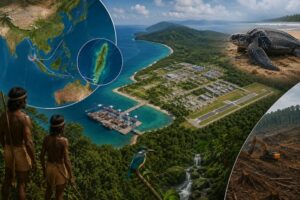
Great Nicobar stands at the intersection of four powerful forces: national security, economic development, biodiversity conservation, and indigenous rights, all making it one of the most complex development debates in contemporary India.
Positioned near the strategically vital Strait of Malacca, the island located at the southernmost tip of India’s Andaman and Nicobar archipelago is central to India’s plans to strengthen its maritime presence, enhance trade connectivity, and reinforce national security in the Indo-Pacific region.
Why Great Nicobar is Ecologically Unique
Great Nicobar is far more than a strategically located island; it is one of India’s most valuable ecological treasures. The island forms part of the UNESCO-recognized Great Nicobar Biosphere Reserve and remains among the country’s least disturbed natural landscapes. Nearly 95% of its area is still covered by dense primary tropical rainforest, making it one of the last extensive tracts of relatively untouched rainforest under Indian jurisdiction. This landscape supports an interconnected network of ecosystems, including tropical evergreen forests, mangrove habitats, seagrass meadows, coral reefs, freshwater streams, and coastal wetlands.
The island is also a biodiversity hotspot, hosting numerous endemic species found nowhere else in the world. Among its most notable wildlife are the endangered leatherback sea turtle, the Nicobar megapode, the Nicobar long-tailed macaque, saltwater crocodiles, and the giant coconut crab. Of particular significance is Galathea Bay on the island’s southeastern coast, which serves as one of the most important nesting grounds for leatherback turtles in the Indian Ocean region and is considered among the species’ most significant nesting sites globally. Given the rarity and ecological importance of these habitats and species, conservationists argue that any large-scale development on the island requires exceptionally careful planning and robust environmental safeguards to prevent irreversible ecological damage.
A Strategic Gateway in the Indo-Pacific
Great Nicobar’s geographical location gives it immense strategic importance. Situated close to one of the world’s busiest maritime trade routes, the island offers India a unique opportunity to improve its monitoring and influence over critical shipping lanes. As global trade and geopolitical competition increasingly shift towards the Indo-Pacific, policymakers view the island as a crucial asset for safeguarding India’s economic and security interests.
The proposed Great Nicobar Infrastructure Project includes the development of an international container transshipment terminal at Galathea Bay, a greenfield international airport, power generation facilities, and a modern township. Together, these components are expected to transform the island into a major hub for trade, logistics, and connectivity. Supporters of the project argue that the infrastructure will reduce India’s dependence on foreign transshipment ports, strengthen supply chains, and improve the country’s maritime capabilities. The island’s proximity to important sea routes such as the Malacca, Sunda, and Lombok Straits further enhances its value in India’s long-term strategic planning. In an era when economic and maritime security are increasingly interconnected, proponents view the project as an investment in national resilience and regional influence.
Beyond its economic benefits, the project is also viewed as a means of reinforcing India’s presence in the Indian Ocean Region. With growing strategic competition among major powers, the ability to monitor and respond to developments in surrounding waters is becoming increasingly important. Great Nicobar offers India a natural vantage point from which to strengthen its role as a key maritime power in the region.
Environmental Clearances and the Ongoing Debate
The Great Nicobar project received environmental clearance in 2022, subject to several conditions aimed at minimizing ecological impacts. However, the decision remains contentious as the project requires the diversion of nearly 130 sq km of forest land, much of it comprising ecologically significant rainforest. The denotification of part of the Galathea Bay Wildlife Sanctuary before the port proposal moved forward has further fuelled concerns among conservationists. Critics argue that compensatory afforestation elsewhere cannot truly replace ancient island ecosystems with unique biodiversity and ecological functions. Supporters, however, maintain that India’s strategic and economic priorities necessitate carefully managed trade-offs and that strict environmental safeguards can help reduce adverse impacts. The controversy highlights the broader challenge of balancing national development goals with long-term ecological conservation.
Ecological Concerns and the Challenge of Sustainable Development
While the strategic case for development is compelling, Great Nicobar is also one of India’s most ecologically sensitive regions. The island remains largely covered by dense tropical forests and supports a wide variety of ecosystems, including mangroves, coral reefs, and coastal habitats. It is home to numerous endemic species and serves as one of the world’s most important nesting grounds for the endangered leatherback sea turtle.
Environmental experts have raised concerns about the scale of the proposed construction. The development requires the diversion of large forest areas and the removal of a significant number of trees. Critics fear that habitat loss, increased human activity, and infrastructure expansion could disrupt fragile ecosystems that have evolved over centuries. The potential impact on wildlife, biodiversity, and coastal environments has become a central issue in the debate surrounding the project.
The Shompen Question: Development and Indigenous Rights
Beyond environmental concerns, the project has also drawn attention to its potential impact on the Shompen community, one of India’s most isolated indigenous groups. Classified as a Particularly Vulnerable Tribal Group (PVTG), the Shompens are estimated to number only around 200–300 individuals and follow a largely semi-nomadic, hunter-gatherer lifestyle. Their livelihoods, food systems, cultural practices, and traditional knowledge are closely intertwined with the island’s forests, on which they have depended for generations. Having historically maintained limited contact with the outside world, the community is considered particularly vulnerable to social disruption and the introduction of diseases that can accompany increased human interaction and infrastructure development.
Supporters of the Great Nicobar project argue that the primary Shompen habitats lie away from the main development sites and that safeguards have been incorporated to protect tribal interests.
Where National Ambitions Meet Environmental Responsibility
Great Nicobar is not merely an infrastructure project; it is a test of India’s ability to reconcile strategic ambition with ecological stewardship. The island’s rainforests, marine ecosystems, and indigenous communities represent assets whose value cannot be measured solely in economic terms. Equally, its location near one of the world’s most critical maritime corridors presents opportunities that policymakers consider strategically indispensable. The true measure of success will therefore not be whether ports, airports, and townships are built, but whether India can demonstrate that large-scale development in ecologically fragile regions can proceed without irreversibly compromising biodiversity, indigenous rights, and environmental resilience.
References:
https://www.pib.gov.in/PressReleasePage.aspx?PRID=2257174®=48&lang=2
https://www.abc.net.au/news/2026-06-05/what-is-indias-great-nicobar-island-project/106726126
https://www.pib.gov.in/PressReleasePage.aspx?PRID=2257323®=1&lang=1
https://tribal.nic.in/DivisionsFiles/SwLPVTGs.pdf
Banner Image: AI-generated
Sections of this article may have been developed with the assistance of artificial intelligence tools to support research, drafting, and language refinement. All information has been reviewed, edited, and verified by the author/editor to ensure accuracy, context, and editorial integrity. The responsibility for the final content, interpretations, and conclusions rests solely with the publisher.