Physical Address
23,24,25 & 26, 2nd Floor, Software Technology Park India, Opp: Garware Stadium,MIDC, Chikalthana, Aurangabad, Maharashtra – 431001 India
Physical Address
23,24,25 & 26, 2nd Floor, Software Technology Park India, Opp: Garware Stadium,MIDC, Chikalthana, Aurangabad, Maharashtra – 431001 India

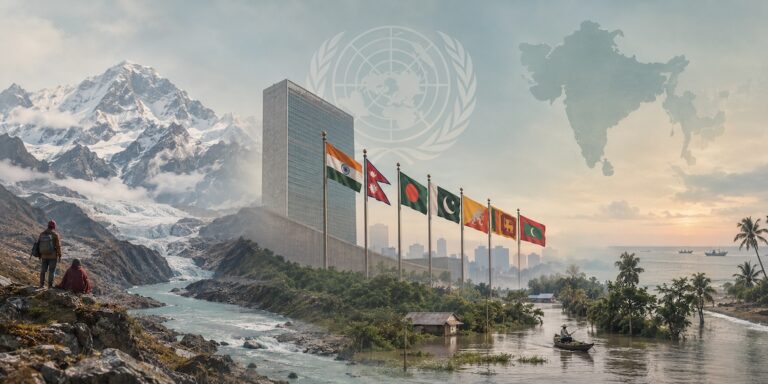
A single line in the 2026 Environmental Performance Index has handed Sri Lanka its most quotable environmental result in years: first place in South Asia for climate change mitigation. The score behind that headline, 48.71 out of 100, deserves a closer reading before it hardens into a talking point.
The 2026 EPI, published in July by the Yale Center for Environmental Law & Policy and the Center for Integrated Earth System Information at Columbia University, ranks 177 countries on 47 indicators grouped into 12 issue categories and three policy objectives: Environmental Health, Ecosystem Vitality and Climate Change.
What the index actually found
In the Climate Change Mitigation category, Sri Lanka scores 48.71 and ranks 41st globally, ahead of every other South Asian country. Its score has risen by 17.73 points over the roughly ten-year window the index reports. Bhutan follows the region at 56th with 45.40, then Afghanistan (87th), Bangladesh (120th), Pakistan (123rd), India (130th), Nepal (138th) and Maldives (169th).
One point of housekeeping is worth making early. In the 2026 edition, the Climate Change policy objective contains only one issue category, which is Climate Change Mitigation. Sri Lanka’s policy objective score and its category score are therefore the same figure, 48.71 at 41st place. They are one result reported twice, not two separate achievements.
The country’s overall standing is a different matter. Sri Lanka’s overall EPI score is 39.58, placing it 94th of 177 countries and second in South Asia behind Bhutan, which sits 52nd. Over the decade measured, that overall score improved by 5.68 points.
What the mitigation category measures
The category is not a measure of how much a country emits. It is built from nine indicators, most of them based on trends rather than levels: emission trends for carbon dioxide, methane, nitrous oxide, fluorinated gases and black carbon; net carbon flux from land-use change; projected total greenhouse gas emissions in 2050, now expressed as a share of current emissions; and greenhouse gas emission trends adjusted for population and for economic output.
A country can therefore place well by moving in the right direction from a modest starting point, without ever having been a significant emitter. That is broadly Sri Lanka’s situation, and it is the correct frame for reading 41st place.
Where Sri Lanka performs strongly
The country leads South Asia on six of the nine mitigation indicators. Its carbon dioxide emission trend scores 52.30, ranking 50th globally and first regionally, an improvement of 27.81 points over the decade. Its nitrous oxide emission trend scores 61.53 at 43rd globally and first regionally, with a gain of 49.50 points, the largest single-indicator improvement in its climate profile.
Sri Lanka does best where emissions are weighed against the size of its population and economy. It ranks 22nd globally and first regionally on greenhouse gas emission trends adjusted per capita, with a score of 48.83, and 30th globally and first regionally on the same trend adjusted per unit of GDP, with 59.10. On projected 2050 emissions it ranks 55th globally and first regionally with 36.74. Its black carbon emission trend, scoring 57.18, tops the region despite a middling global rank of 88th.
Where it does not
Methane is the visible weak point among the gases. Sri Lanka’s methane emission trend scores 43.90, ranking 94th globally and fifth of eight in South Asia. Methane is a short-lived but potent greenhouse gas tied closely to paddy cultivation, livestock and waste management, all of which are central to the Sri Lankan economy.
Fluorinated gases score 8.29 at 114th globally, and here a widely repeated framing needs correcting: the EPI records a fall of 31.28 points on this indicator over the decade, not an improvement. The figure also deserves caution for a second reason. Sri Lanka, Bangladesh and Afghanistan carry identical F-gas scores and identical decade changes, a pattern consistent with modelled or regionally imputed values rather than country-specific measurement.
The weakest component of the climate profile is net carbon flux from land-use change, where Sri Lanka scores 23.10 and ranks 116th globally and sixth of eight regionally. This is the part of the mitigation picture that reflects forests, wetlands and the terrestrial carbon balance, and it is moving far more slowly than the emissions indicators.
Why a strong climate score does not lift the overall ranking
The gap between 41st on climate and 94th overall is partly a matter of arithmetic. The 2026 methodology assigns 45 percent of the overall score to Ecosystem Vitality, 30 percent to Climate Change and 25 percent to Environmental Health, weights chosen to balance the statistical spread of each objective rather than to rank their importance. Sri Lanka scores 37.75 on Ecosystem Vitality (121st) and 31.93 on Environmental Health (127th), and those two carry seventy percent of the weight between them.
Within Environmental Health, the sharpest weakness is Water Resources, where Sri Lanka scores 1.11 and ranks 164th. That category consists of a single indicator, wastewater treatment, so the two figures often reported side by side are again one finding rather than two.
The country also has genuine strengths outside climate. It ranks ninth globally and first regionally in Agriculture with 76.60, and records the maximum score of 100 on phosphorus surplus, a top rank it shares with other countries at the ceiling, including Afghanistan. That said, the EPI’s own methodology notes that missing values in the Agriculture and Water Resources categories are filled using statistical models, regional averages or other assumptions, and it explicitly urges caution when comparing countries on exactly these categories.
What the numbers cannot settle
Because the mitigation indicators reward direction of travel, they are sensitive to circumstances that have nothing to do with climate policy. The decade the index covers includes Sri Lanka’s 2022 economic crisis, with fuel shortages, import restrictions and sharply reduced industrial and transport activity. Emissions that fall during a contraction are not the same as emissions reduced by design, and a trend-based index does not distinguish between the two. Separating the structural gains from the circumstantial ones requires national energy and emissions data, not the EPI alone.
Two further cautions apply. Most metrics in the 2026 edition draw on data through 2024, as the Yale School of the Environment has noted, so very recent policy shifts will not yet register. And the EPI team states plainly that methodological changes between editions make scores and ranks non-comparable across versions, which means Sri Lanka’s 2026 result should not be set against its 2024 or 2022 figures.
Scale is worth keeping in view as well. Estonia leads the mitigation category with 90.58, driven by a steep decade-long fall in power sector emissions, followed by the Netherlands (74.13), Luxembourg (73.67), France (73.50) and Germany (73.04). Sri Lanka’s 48.71 sits within a hundredth of a point of Barbados at 40th, an indication of how tightly packed the table is in that stretch and how little separates neighbouring ranks.
What follows for policy
Read as a diagnostic rather than a verdict, the indicator table points at specific places. Methane sends attention to paddy water management, livestock and municipal waste. The F-gas result points to refrigerant handling, servicing standards and the phase-down commitments under the Kigali Amendment. The land-use carbon flux score points to forest cover, degraded land restoration and wetland protection, areas where mitigation is usually discussed in conservation terms rather than emissions terms.
The overall score adds one more priority that has little to do with climate at all. Wastewater treatment is the single largest gap in Sri Lanka’s environmental profile, and it is the kind of infrastructure deficit that no amount of progress on emissions will offset. As the Columbia Climate School observed in its assessment of the 2026 results, few countries anywhere are on track for net zero by 2050, and progress has slowed across pollution control and natural resource management more broadly.
A regional leader, on one measure
Sri Lanka is a regional leader in climate change mitigation and it is not a global one. Both statements are supported by the same table. The more useful reading of 41st place is not as a prize but as a baseline: a set of numbers detailed enough to show which parts of the country’s emissions profile are moving, which are stalled, and which rest on data too thin to carry the weight of a headline.
References
https://epi.yale.edu/indicator/2026/EPI
https://epi.yale.edu/indicator/2026/CCH
https://epi.yale.edu/region/2026/southern-asia
https://epi.yale.edu/2026-methodology
https://environment.yale.edu/news/article/2026-epi-climate-bright-spots-slow-progress-globally
New Environmental Performance Index Highlights Sustainability Gains and the Challenges Ahead
Banner Image: Photo by Christoph Theisinger on Unsplash
Sections of this article may have been developed with the assistance of artificial intelligence tools to support research, drafting and language refinement. All information has been reviewed, edited and verified by the author/editor to ensure accuracy, context and editorial integrity. The responsibility for the final content, interpretations and conclusions rests solely with the publisher.