Physical Address
23,24,25 & 26, 2nd Floor, Software Technology Park India, Opp: Garware Stadium,MIDC, Chikalthana, Aurangabad, Maharashtra – 431001 India
Physical Address
23,24,25 & 26, 2nd Floor, Software Technology Park India, Opp: Garware Stadium,MIDC, Chikalthana, Aurangabad, Maharashtra – 431001 India

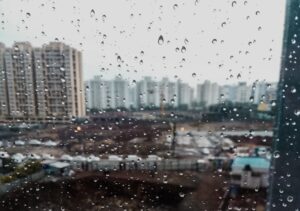
Air pollution in India is usually discussed as a public health emergency, and it is one. But pollution particles do more than damage lungs. They also change how much sunlight reaches the ground, how fast the land heats up, and, through that, how strongly the monsoon draws moisture in from the sea. That makes air quality a rainfall question as well as a health question, and it makes it a question that does not stop at national borders.
A study published recently in Environmental Research: Climate puts numbers to that idea for the first time at this scale. Ankit Bhandekar and colleagues at the University of Reading, working with a large international team, ran ten climate models through three different pollution cleanup scenarios and compared each against a high pollution baseline. The results suggest that India’s monsoon rainfall is shaped not only by what India does about its own emissions, but by what China and the rest of East Asia decide to do about theirs.
What the models show
The mechanism is straightforward enough. Aerosol particles reflect and absorb sunlight before it reaches the surface. Less sunlight means cooler land, and a cooler landmass weakens the temperature contrast between land and sea that pulls monsoon winds inland. Remove the particles and the process runs the other way: the land warms, the contrast sharpens, and the circulation that carries ocean moisture over the subcontinent strengthens. Earlier work has already documented how aerosol build-up can suppress rainfall within a monsoon season and lengthen break spells.
When the models cleaned up South Asian emissions alone, all-India monsoon rainfall rose by about 0.19 mm per day across the season. When pollution was cut worldwide, the gain was larger, roughly 0.28 mm per day. In both cases the biggest increases showed up over the northern Bay of Bengal, the Western Ghats and the Indo-Gangetic Plain, which are already the wettest parts of the monsoon system. Cleaner air, in other words, mostly deepened a pattern that was there anyway.
The complication sits in the East Asian scenario. Cutting pollution over China and its neighbours warms that region’s surface by up to 1 degree Celsius and adds about 0.20 mm of rain a day there during the summer monsoon. Good news locally. But the strengthened circulation over East Asia pulls moisture toward itself, and some of that moisture would otherwise have fed the Indian monsoon. The models project rainfall declines of between 0.2 and 0.6 mm per day over parts of west-central and eastern India as a result.
There is a second, separate effect in the pre-monsoon months. Dark, sunlight-absorbing particles such as black carbon collect over the Himalayan foothills and heat the air above them, a process known as the elevated heat pump. Removing those particles cools the mid-level air by up to 0.4 degrees Celsius in the models, which weakens the rising motion that helps set the monsoon up. Unlike the East Asian effect, this one is largely local to South Asia.
Why this matters for policy
Greenhouse gases mix evenly through the atmosphere, so a tonne of carbon dioxide emitted in Gujarat and a tonne emitted in Guangdong do broadly the same thing to the global climate. Aerosols do not behave that way. They are short-lived, they stay close to where they were emitted, and their effects are uneven across space. That is precisely why one country’s clean air programme can register as a rainfall change in a neighbouring country, and why the accounting is so much harder.
Bhandekar has framed the finding as an argument for coordination rather than for slower cleanup, noting that clean air remains beneficial almost everywhere it happens, and that India and China stand a better chance of avoiding unintended tradeoffs if their air quality plans are aligned instead of designed in isolation. Air pollution kills millions of people across Asia every year, and nothing in this study argues for slowing that response down. What it argues is that the timing and sequencing of cleanup across the region has consequences nobody is currently negotiating over.
India has no forum in which air quality policy is discussed with China as a shared climate variable. The National Clean Air Programme is a domestic instrument. India’s Nationally Determined Contribution treats emissions, not aerosols. Monsoon forecasting at the seasonal scale does not, as far as the public record shows, incorporate scenarios for what happens to rainfall if East Asian emissions fall faster than South Asian ones. On the evidence of this paper, that is a gap worth closing.
How to read the numbers
Three cautions belong with any coverage of this study.
First, these are model projections, not observations. The study uses plausible future emission pathways drawn from the Shared Socioeconomic Pathways, and it compares scenarios against each other rather than measuring anything that has already happened. The projected divergence between high and low aerosol emission futures by 2050 is large, which is exactly why the exercise is useful, but it is still a projection.
Second, the figures are daily averages across a whole season and a whole country, which makes them look smaller than they are. A shift of 0.2 mm per day sustained through a four-month monsoon adds up to roughly 24 mm of seasonal rainfall, and the regional distribution matters far more than the national average. What such a change does to a rainfed farm in Vidarbha or a reservoir in Telangana depends on where and when the rain arrives, not on the all-India mean.
Third, aerosols are one influence among several. The monsoon is also being reshaped by warming itself, including changes in the low-pressure systems that deliver most extreme monsoon rainfall. Aerosol effects and greenhouse warming pull in different directions in places, and separating them is part of what makes monsoon projection difficult.
The useful takeaway is not that cleaner air is bad for India. It is that the monsoon has become a shared regional asset shaped by decisions taken well beyond India’s borders, and that treating air quality purely as a domestic file leaves a real climate risk unmanaged.
References
https://iopscience.iop.org/article/10.1088/2752-5295/ae7fad
Monsoons in South Asia affected by improved air quality
https://www.nature.com/articles/s41598-017-17599-1
Banner Image: Photo by Bhupendra Singh on Unsplash