Physical Address
23,24,25 & 26, 2nd Floor, Software Technology Park India, Opp: Garware Stadium,MIDC, Chikalthana, Aurangabad, Maharashtra – 431001 India
Physical Address
23,24,25 & 26, 2nd Floor, Software Technology Park India, Opp: Garware Stadium,MIDC, Chikalthana, Aurangabad, Maharashtra – 431001 India

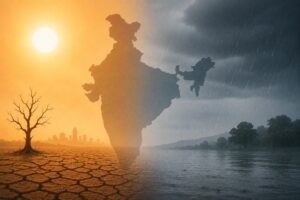
India is witnessing a startling preview of what climate change looks like in real time: cities gasping through brutal heatwaves, hospitals preparing for heat-linked illnesses, farmers scrambling to save crops from both scorching temperatures and flooding rains, and meteorologists racing to update outdated warning systems that no longer reflect the scale of the crisis.
Over the week, the country is experiencing an extraordinary convergence of weather extremes that would once have been treated as isolated seasonal events. Instead, they are now unfolding simultaneously.
In Delhi, the warning has become especially severe. The India Meteorological Department has issued a yellow alert for heatwave conditions on Tuesday and Wednesday, warning that temperatures could touch 45°C in isolated parts of the capital. Areas such as Safdarjung, Ayanagar and the Ridge have already recorded dangerously high temperatures, while officials have warned that hot, dry northwesterly winds replacing cooler easterlies could intensify conditions further. Residents have been advised to avoid stepping outdoors during peak afternoon hours as the city braces for what forecasters described as two days of “brutal heat.”
The heat is not limited to the capital.
Across Rajasthan, Uttar Pradesh, Madhya Pradesh, Vidarbha, Chhattisgarh, Gujarat and Maharashtra, the India Meteorological Department’s heatwave guidance has warned of prolonged heatwave to severe heatwave conditions. In Vidarbha, the crisis has already intensified dramatically. Amravati and Wardha recorded 46°C, making them among the hottest places in India over the weekend, while Akola touched 45.4°C. Seven cities in the region featured among the country’s 10 hottest locations. Reports of worsening heat conditions have raised concerns about public health risks across the region.
Even as large parts of north and central India bake under dangerous temperatures, other regions are preparing for the opposite extreme. The southwest monsoon is expected to reach Kerala around May 26, according to IMD, with a margin of error of four days. Conditions are already favourable for its advance over the Andaman Sea and parts of the Bay of Bengal. Meanwhile, parts of Assam and Meghalaya are already dealing with intense rainfall. B P Ghat in Assam recorded 27 cm of rain in just 24 hours, while heavy rainfall warnings remain in place across much of northeast India through May 21. Heavy rainfall alerts have also been issued for parts of Tamil Nadu, Karnataka and Kerala.
The simultaneous extremes reveal something far bigger than seasonal volatility. Scientists have increasingly warned that climate change is intensifying sharp swings between weather extremes.
A rethink of outdated weather definitions
India’s weather agency is now confronting an uncomfortable reality: the country’s official definition of a heatwave may no longer be adequate for a rapidly warming world. Current heatwave declarations are based largely on temperature thresholds. Under existing rules, a heatwave is declared when temperatures reach at least 40°C in plains, 37°C in coastal regions and 30°C in hilly areas, along with departures from normal temperatures. But this model increasingly misses dangerous heat conditions.
Officials recently said the criteria may soon be revised because states such as Kerala frequently face dangerous heat stress caused by high humidity, even when temperatures do not meet traditional thresholds. That matters because humidity significantly affects how the human body cools itself. When humidity rises, sweat evaporates more slowly, making it harder for the body to regulate temperature. This significantly increases the risk of dehydration, heat exhaustion and heatstroke.
Night-time heat is another growing concern. Historically, cooler nights provided relief after extreme daytime temperatures. But rising minimum temperatures are making recovery harder, especially in densely populated urban areas where concrete traps heat and homes often lack cooling systems.
The latest IMD bulletin warned of warm night conditions in parts of Madhya Pradesh and Vidarbha. Climate scientists say this shift reflects a broader warming trend. Reportedly, climate change has tripled the likelihood of severe heat events in India. That means what was once considered an extreme event is becoming increasingly common.
For millions of outdoor workers, that shift carries devastating consequences. Construction workers, farmers, sanitation workers, delivery personnel and street vendors often have little choice but to remain outdoors during the hottest parts of the day. Many lack access to cooling centres, healthcare support or workplace protections that could reduce exposure.
Health emergency unfolding in hospitals and homes
Extreme heat is often framed as a weather story, but doctors increasingly say it should be treated as a public health emergency. The World Health Organization recently warned that climate change is rapidly becoming a health crisis, worsening heat-related illness, respiratory disease, infectious disease outbreaks and food insecurity. A separate group of public health experts has also urged the WHO to formally declare climate change a global public health emergency.
In India, heat-related deaths are often underreported because fatalities are frequently attributed to organ failure, cardiac arrest or pre-existing illnesses rather than direct heat exposure. But doctors say the broader health consequences are becoming increasingly visible. Extreme heat can aggravate cardiovascular disease, worsen respiratory illnesses, trigger kidney stress, create pregnancy complications and intensify dehydration-related illnesses. It can also place enormous mental strain on people who must continue working or living in unsafe conditions. The elderly, infants, pregnant women and people with chronic illnesses remain particularly vulnerable. The IMD has explicitly warned of “high health concern” for vulnerable populations and advised people to avoid prolonged exposure to sunlight, stay hydrated and consume fluids such as buttermilk, lemon water and oral rehydration solutions.
Urban areas face another challenge: infrastructure built for a cooler climate. Many Indian cities continue to lose tree cover while expanding concrete roads, flyovers and dense housing developments that intensify the urban heat island effect. Low-income neighbourhoods often face the highest risks because homes may have poor ventilation, unreliable electricity and limited access to cooling systems. For many households, air conditioning remains unaffordable.
Farmers are battling drought and flooding at the same time
Few sectors illustrate India’s climate instability more clearly than agriculture.
In heat-hit states such as Rajasthan, Gujarat and Maharashtra, farmers have been advised to irrigate crops frequently, use shade protection and take preventive steps to protect orchards and standing crops from heat damage. Fruit crops, vegetables and newly planted saplings are especially vulnerable during prolonged high temperatures.
At the same time, farmers in Assam, Meghalaya and other parts of northeast India are dealing with the opposite problem. Authorities have urged them to drain excess water from agricultural fields as heavy rainfall threatens crops and rural infrastructure. Heavy rainfall also increases the risk of landslides, transport disruptions, waterlogging and localized flooding.
Fishermen have been warned against venturing into parts of the Bay of Bengal and Arabian Sea due to dangerous marine conditions linked to rough weather systems.
These simultaneous crises are becoming more common as climate systems grow increasingly unstable. Warmer oceans, changing rainfall patterns and rising global temperatures are intensifying both heatwaves and extreme precipitation. India’s decision to revise how heatwaves are measured may improve warning systems. But experts say better definitions alone will not solve a crisis that is already reshaping public health, labour systems, agriculture and urban life.
This is no longer about surviving one unusually harsh summer. It is about learning how to live in a country where multiple climate disasters can unfold at once and where extreme weather is increasingly becoming the norm rather than the exception.
References:
https://mausam.imd.gov.in/responsive/heatwave_guidance.php
https://archive.org/details/monsoon-neweather-15-05-2026
Banner Image: AI-Generated
Sections of this article may have been developed with the assistance of artificial intelligence tools to support research, drafting and language refinement. All information has been reviewed, edited and verified by the author/editor to ensure accuracy, context and editorial integrity. The responsibility for the final content, interpretations and conclusions rests solely with the publisher.