Physical Address
23,24,25 & 26, 2nd Floor, Software Technology Park India, Opp: Garware Stadium,MIDC, Chikalthana, Aurangabad, Maharashtra – 431001 India
Physical Address
23,24,25 & 26, 2nd Floor, Software Technology Park India, Opp: Garware Stadium,MIDC, Chikalthana, Aurangabad, Maharashtra – 431001 India


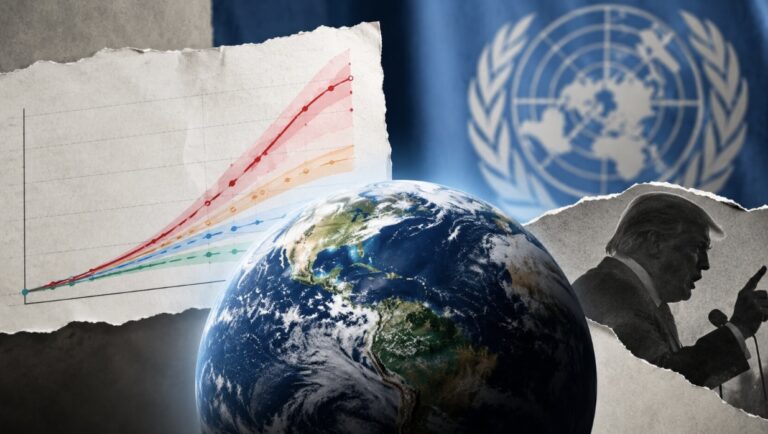
A viral tweet claims global temperatures have been “in free fall” for the past two years, dropping by 0.6 °C since April 2024. It goes on to suggest that if this trend continues, we could be in an “ice age” within five years, and even argues the UN should respond by calling for more CO2 emissions.
Claim Post:
Claim 1: “Global temperature: 2 years in free fall. Since April 2024 (15 months), the global temperature has plummeted by an astonishing 0.6 °C.”
Fact: False and not supported by any credible dataset. Surface temperature records used as the global benchmark do not show such a sharp drop over the past two years. According to Berkeley Earth and the EU’s Copernicus Climate Change Service, April 2025 was the second-warmest April on record, just slightly cooler than April 2024. The months following, from May to July 2025, ranked among the hottest ever recorded globally.
When scientists calculate global average temperature, they rely on extensive datasets covering land, ocean, and satellite observations, rather than selectively using data from short time spans or specific regions. A claim of a sudden 0.6 °C fall within such a short period is inconsistent with the observed long-term warming trend and contradicts the consensus from multiple independent climate monitoring agencies.
The framing of this claim also disregards the physical reality of how global temperatures change. Short-term fluctuations do occur due to natural variability. Still, the kind of sustained cooling suggested here would require a massive and prolonged shift in Earth’s energy balance, something that has not happened in the modern observational era. Instead, the scientific record shows that global heat content in the atmosphere and oceans continues to rise, driven primarily by human-induced greenhouse gas emissions.
Claim 2: “At this rate, we would be in the next ice age in just 5 years (–3°C).”
Fact: Scientifically baseless. There is no mechanism or evidence to support a global temperature drop of 3 °C within five years. Climate shifts of that magnitude over such a short timeframe are unprecedented in recorded human history. The Earth’s climate system, influenced by ocean circulation, atmospheric composition, and energy from the sun, does not experience rapid, multi-degree cooling without a massive external forcing, such as a significant asteroid impact or a supervolcanic eruption. Neither has occurred in recent years, and scientific agencies project none.
The idea of an “ice age” within five years is also contradicted by the World Meteorological Organisation’s latest report. According to its 2025–2029 forecast, the annually averaged global mean near-surface temperature in each of those years is expected to be between 1.2°C and 1.9°C warmer than the 1850-1900 average. The WMO estimates there is an 80% chance that at least one year in this period will be hotter than 2024, currently the warmest year on record, and an 86% chance that at least one year will exceed 1.5°C above pre-industrial levels.
The report also notes a 70% probability that the five-year average warming for 2025-2029 will be above the 1.5°C threshold, up from 47% in last year’s assessment for 2024-2028, and just 32% two years ago for 2023-2027. These projections highlight the ongoing warming trend and leave no room for the kind of rapid cooling imagined in the viral claim.
Claim 3: “The UN should be concerned and ask us to increase our CO2 emissions.”
Fact: This claim runs directly counter to global scientific consensus and United Nations policy. The United Nations and its lead climate science body, the IPCC, have consistently emphasised that CO₂ emissions must be reduced, never increased, to mitigate global warming.
Countries worldwide are being urged to act fast. According to the European Union’s Copernicus Climate Change Service (C3S), July 2025 ranked as Earth’s third-hottest July on record, with a global surface temperature 0.45 °C above the 1991–2020 average, and 1.25 °C above pre-industrial levels (1850–1900). Moreover, the 12-month span from August 2024 to July 2025 averaged 1.53 °C above pre-industrial levels, surpassing the Paris Agreement’s 1.5 °C target, even if only temporarily.
Scientists warn that unless greenhouse gas emissions are significantly reduced, these extreme conditions will only intensify and become even more frequent. The UN and global science bodies clearly advocate for reducing CO₂ emissions, not increasing them. Warnings from scientists and agencies underline that continued emissions will escalate warming and climate extremes, fueling more heatwaves, heavier rainfall, stronger storms, and accelerating sea-level rise. This advice isn’t ideological, it’s grounded in peer-reviewed research and real-time observations of climate impacts.
Why Short-Term Variability Gets Misused in Climate Narratives
Claims like these often hinge on cherry-picked timeframes or misinterpretation of data, creating the illusion of dramatic shifts that do not reflect long-term trends. Natural variability, driven by phenomena like El Niño, volcanic aerosols, or short-term ocean-atmosphere interactions, can cause temporary rises or dips in global temperature. However, over the decades, the warming signal from greenhouse gases far outweighs these fluctuations.
The “free fall” narrative takes advantage of this natural variability, portraying it as evidence against climate change. In reality, all credible climate monitoring agencies, from NASA to Copernicus, show the same overarching trend: a steadily warming planet. Extreme heat events, melting glaciers, and ocean heat content records continue to align with the predictions of climate science, not with a scenario of rapid cooling.
References:
Third-Warmest July Puts End to Record Global Heat Streak
Banner image:
Photo by Натали Хмельницкая on Unsplash