Physical Address
23,24,25 & 26, 2nd Floor, Software Technology Park India, Opp: Garware Stadium,MIDC, Chikalthana, Aurangabad, Maharashtra – 431001 India
Physical Address
23,24,25 & 26, 2nd Floor, Software Technology Park India, Opp: Garware Stadium,MIDC, Chikalthana, Aurangabad, Maharashtra – 431001 India

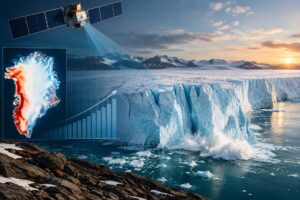
A claim circulating on X says that Greenland’s ice loss is “decelerating” and suggests that satellite observations show a slowdown rather than an acceleration. Another part of the post argues that there is no risk of a runaway collapse or tipping point for the Greenland Ice Sheet.
The picture from climate science is more complicated than a simple “accelerating” or “decelerating” label. Greenland’s ice loss varies considerably from year to year, but the longer-term evidence clearly shows substantial mass loss, with the average rate increasing between the 2000s and the 2010s.
Claim: Greenland’s ice loss is decelerating
Fact: Misleading.
Greenland does experience years when ice loss slows. That is an important part of the story because weather patterns, snowfall, surface melting and glacier flow can cause large year-to-year fluctuations. But a temporary or short-term slowdown cannot be used to establish that the long-term trend has reversed.
The Intergovernmental Panel on Climate Change (IPCC) assessed satellite observations and found that Greenland lost an estimated 4,890 gigatonnes (Gt) of ice between 1992 and 2020. That was equivalent to about 13.5 mm of global mean sea-level rise. More importantly, the IPCC found that the average annual rate of loss increased substantially over successive decades. Greenland lost about 175 Gt per year between 2000 and 2009, compared with approximately 243 Gt per year between 2010 and 2019. That represents an increase of roughly 39 per cent in the average annual loss rate.
The IPCC therefore concluded with high confidence that Greenland’s mass loss has increased substantially since the beginning of the 21st century. It also noted that annual mass changes have been consistently negative since the early 2000s. This does not mean Greenland loses exactly the same amount of ice every year. It does not. Individual years can be much higher or lower than the long-term average. In fact, the IPCC noted that 2017 and 2018 were relatively moderate years for Greenland, while 2019 saw an exceptionally large annual mass loss of about 532 Gt. So, pointing to a period of slower loss is not enough to demonstrate a long-term deceleration.
Claim: Satellite data show decelerating ice loss rather than accelerating loss
Fact: Misleading.
Satellite observations are central to the evidence showing that Greenland has been losing mass at an increasing rate over recent decades. The IPCC assessment incorporated measurements from satellite-based programmes, including the Ice Sheet Mass Balance Intercomparison Exercise, along with observations from the GRACE and GRACE Follow-On satellite missions. The cumulative satellite record shows substantial net ice loss from Greenland since 1992.
There is, however, a kernel of truth that may help explain how this claim arises. Research has found periods in which Greenland’s annual ice loss slowed. For example, Greenland’s total ice-loss rate slowed to about 222 Gt per year during 2013–2017, partly because atmospheric circulation produced cooler conditions and ocean temperatures fell near the terminus of Jakobshavn Isbræ. But a slowdown during several years is different from evidence that the overall ice sheet has entered a sustained recovery or that its long-term loss rate is declining. The IPCC’s broader assessment points in the opposite direction: the Greenland Ice Sheet was close to mass balance in the 1990s, but mass loss increased thereafter.
The distinction is important. Ice loss can fluctuate without the underlying long-term trend disappearing.
A useful analogy is a company’s annual expenses: spending might fall for two years while the average expenditure over the following decade is still substantially higher than it was previously. Looking at only the short period can produce a very different impression from examining the longer record.
Claim: There is no runaway collapse or tipping-point risk for Greenland
Fact: False as stated.
The claim also oversimplifies what scientists mean by a tipping point. The IPCC does not predict that Greenland is suddenly going to disappear in the near future. Nor does it assign a precise date when the entire ice sheet will collapse. But that is very different from saying there is no risk of irreversible ice loss.
The IPCC states that continued warming can lead to long-term and effectively irreversible loss of parts or eventually much of the Greenland Ice Sheet. Its assessment explains that ice sheets respond extremely slowly and that some changes, once established, can take centuries to millennia to reverse. One mechanism is particularly important. As Greenland’s surface melts and its elevation decreases, more of the ice can be exposed to warmer air. This can create a feedback in which melting lowers the ice surface, which then makes further melting easier. Scientists also do not necessarily describe Greenland’s future as a single dramatic “cliff” in which the entire ice sheet suddenly collapses. Research assessed by the IPCC indicates that the relationship between sustained warming and eventual ice-sheet volume can be gradual rather than governed by one simple temperature threshold.
Nevertheless, once enough ice is lost, the ice sheet may not return to its present size even if temperatures later decline. The IPCC’s Sixth Assessment Report says that the likelihood and impacts of abrupt or irreversible changes increase as global warming increases. Its Synthesis Report also assesses that at sustained warming levels between 2°C and 3°C, the Greenland and West Antarctic ice sheets could be lost almost completely and irreversibly over multiple millennia, contributing several metres of sea-level rise. That timescale matters. A “tipping point” does not necessarily mean an ice sheet vanishes within years or decades. Ice-sheet tipping processes can initiate changes that unfold over centuries to millennia.
The bottom line
Greenland is not experiencing a perfectly smooth, year-by-year acceleration in ice loss. There are substantial natural fluctuations, and some individual periods have recorded slower losses. But the longer satellite record shows that Greenland has undergone significant mass loss, with the average annual loss increasing from the 2000s to the 2010s. And while scientists do not predict an imminent sudden collapse, the risk of long-term, potentially irreversible ice-sheet loss is real and rises with continued warming. It takes short-term variability and uncertainty around the timing and nature of ice-sheet tipping behaviour and presents them as evidence that Greenland’s long-term ice loss is slowing and that irreversible loss poses no meaningful risk. The available IPCC assessment does not support either conclusion.
References:
https://x.com/Electroversenet/status/2107486039568764948?s=20
https://www.ipcc.ch/site/assets/uploads/2018/02/WG1AR5_Chapter13_FINAL.pdf
https://www.ipcc.ch/report/ar6/wg1/downloads/report/IPCC_AR6_WGI_Chapter09.pdf
https://www.ipcc.ch/report/ar6/wg1/chapter/chapter-2
https://www.sciencedirect.com/science/article/pii/S1569843226002025
Banner Image: AI generated
Sections of this article may have been developed with the assistance of artificial intelligence tools to support research, drafting, and language refinement. All information has been reviewed, edited, and verified by the author/editor to ensure accuracy, context, and editorial integrity. The responsibility for the final content, interpretations, and conclusions rests solely with the publisher.