Physical Address
23,24,25 & 26, 2nd Floor, Software Technology Park India, Opp: Garware Stadium,MIDC, Chikalthana, Aurangabad, Maharashtra – 431001 India
Physical Address
23,24,25 & 26, 2nd Floor, Software Technology Park India, Opp: Garware Stadium,MIDC, Chikalthana, Aurangabad, Maharashtra – 431001 India

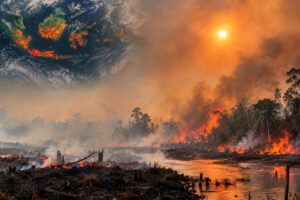
Indonesia is facing its most severe wildfire season in a decade, with more than a million wildfire hotspots detected across the country as unusually dry conditions fuel the spread of fires.
Data from wildfire monitoring platform Nusantara Atlas showed that Indonesia recorded 1,061,746 wildfire hotspots by October 14, 2026. The figure has already crossed the 885,037 hotspots recorded during 2019, which was previously considered the country’s worst fire year in the comparison. The scale of the fires is also evident from the area burned. Nearly 895,657 hectares of land had been affected by fires by August this year, according to Nusantara Atlas. While the figure remains below the 2.63 million hectares burned during the whole of 2019, the fire season is still ongoing.
The worsening situation comes as Indonesia experiences the influence of a powerful Super El Niño event. The climate phenomenon, which originates from unusually warm waters in the tropical Pacific, can alter rainfall patterns across large parts of the world. In Indonesia, one of its major consequences is often a prolonged period of drier-than-normal weather.
El Niño creates the conditions, but people can start the fires
The relationship between El Niño and Indonesia’s fires is not as simple as climate conditions directly causing wildfires. Dry weather removes moisture from vegetation, forests and peatlands, turning them into highly flammable material. Under such conditions, fires that might otherwise remain small can spread rapidly and become much harder to contain.
Human activity remains an important part of the problem. Slash-and-burn practices used for land clearing have been identified as one of the factors contributing to the current fires. Although such burning is prohibited in Indonesia, enforcing the restrictions over large and often remote areas remains difficult. This distinction matters because El Niño does not itself ignite a forest. Instead, it can create the dry landscape in which human-started fires are more likely to escape control and grow. Indonesia’s vulnerability is particularly serious because large areas of its forests and peatlands can burn for extended periods. Once peat dries out, fire can move through organic material beneath the surface, making suppression more difficult and allowing smoke emissions to persist.
The combination of human ignition sources and extreme dryness therefore creates a dangerous cycle: fires become easier to start, spread faster and require greater resources to control.
Smoke crosses borders, raising health concerns
The consequences are no longer limited to Indonesia. Smoke from the fires has spread into residential areas and neighbouring countries, including Malaysia and Singapore. The haze contains a mixture of gases and fine airborne particles that can deteriorate air quality and pose risks to public health. Satellite and aerosol monitoring also shows substantial concentrations of airborne particles over fire-affected parts of Indonesia, with smoke moving towards the Indian Ocean. There is uncertainty over how far the haze will eventually travel, including whether some of it could cross the Bay of Bengal and reach India. For communities living close to the fires, the immediate concern is exposure to polluted air. Prolonged wildfire smoke can aggravate respiratory conditions and increase health risks, particularly for children, older people and those with existing illnesses.
The regional nature of the haze also makes Indonesia’s fire crisis more than a domestic environmental problem. Smoke does not stop at national borders, meaning neighbouring countries can experience the consequences of fires over which they have little direct control. The coming weeks could prove crucial. With dry conditions associated with the Super El Niño continuing to influence the region, authorities face the difficult task of containing existing fires while preventing new outbreaks. Indonesia’s experience this year also highlights a broader climate challenge. Extreme climate conditions can magnify the consequences of existing environmental pressures. Where land-clearing fires already occur, prolonged drought can turn local incidents into large-scale disasters.
The record number of hotspots is therefore not simply a measure of how many fires are burning. It is a warning about how climate variability, land-use practices and weak fire prevention can combine to produce a crisis that affects forests, communities and even countries beyond Indonesia’s borders.
https://atmosphere.copernicus.eu/smoke-transport-arctic-and-intense-seasonal-fires-indonesia
Banner Image: AI generated
Sections of this article may have been developed with the assistance of artificial intelligence tools to support research, drafting, and language refinement. All information has been reviewed, edited, and verified by the author/editor to ensure accuracy, context, and editorial integrity. The responsibility for the final content, interpretations, and conclusions rests solely with the publisher.