Physical Address
23,24,25 & 26, 2nd Floor, Software Technology Park India, Opp: Garware Stadium,MIDC, Chikalthana, Aurangabad, Maharashtra – 431001 India
Physical Address
23,24,25 & 26, 2nd Floor, Software Technology Park India, Opp: Garware Stadium,MIDC, Chikalthana, Aurangabad, Maharashtra – 431001 India

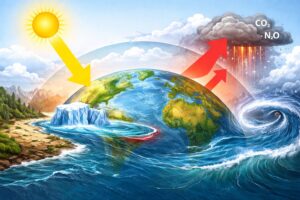
Earth’s climate system works on a delicate balance of energy. Every second, the planet receives energy from the Sun and releases some of it back into space. For thousands of years, this balance kept global temperatures relatively stable. Today, however, scientists warn that this equilibrium is being disrupted. The concept at the centre of this disruption is known as Earth’s energy imbalance, and it is one of the clearest indicators of how human activity is reshaping the climate.
What is Earth’s Energy Imbalance?
Earth’s energy imbalance refers to the difference between the energy the planet receives from the Sun and the energy it radiates back into space. When both are equal, the climate remains stable. But when incoming energy exceeds outgoing heat, the planet begins to warm.
At present, Earth is experiencing a positive energy imbalance, meaning it is gaining more energy than it is losing. This excess energy does not simply disappear it accumulates within the Earth system, driving long-term climate change.
This imbalance is largely the result of human activities. The burning of fossil fuels, deforestation, and industrial processes release greenhouse gases such as carbon dioxide and methane into the atmosphere. These gases act like a blanket, trapping heat and preventing it from escaping into space efficiently. As a result, more energy remains within the system, gradually raising global temperatures.
Where Does the Excess Heat Go?
One of the most important and often misunderstood aspects of Earth’s energy imbalance is where the extra heat actually ends up. Contrary to what many might assume, the atmosphere absorbs only a small fraction of this energy.
The vast majority, over 90%, is stored in the oceans. Because water has a high capacity to absorb heat, oceans act as a massive buffer, slowing down the rate at which atmospheric temperatures rise. However, this buffering effect does not eliminate the problem; it merely delays its full impact.
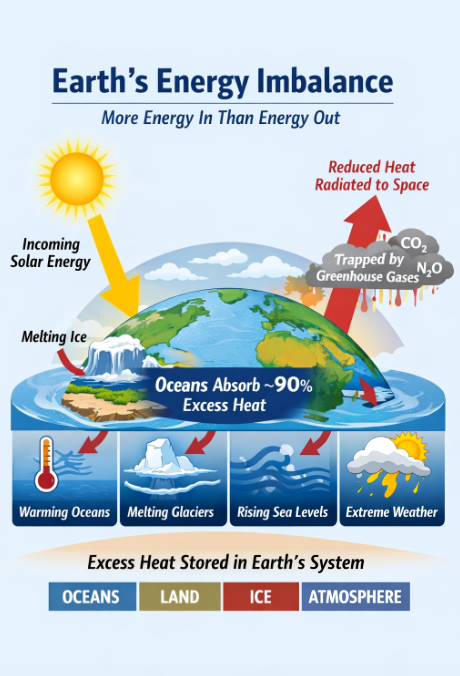
The remaining energy contributes to:
Rising ocean heat content has already led to serious consequences, including marine heatwaves, coral bleaching, and sea-level rise caused by thermal expansion. In essence, the oceans are silently absorbing the bulk of the planet’s excess heat, masking the true scale of warming that would otherwise be more immediately visible.
Why the Imbalance is Increasing
The growing energy imbalance is not a static phenomenon it is accelerating. Several interconnected factors are driving this trend.
First, greenhouse gas concentrations continue to rise, strengthening the heat-trapping effect of the atmosphere. This reduces the amount of energy that can escape back into space.
Second, the loss of reflective surfaces such as ice and snow is amplifying warming. Ice reflects a significant portion of sunlight back into space, but as it melts, darker surfaces like oceans and land absorb more heat. This creates a feedback loop that further increases energy absorption.
Third, changes in clouds and atmospheric particles can influence how much solar radiation is reflected or absorbed. While these processes are complex, they can enhance the overall imbalance.
Natural climate variability, such as periodic warming events in the Pacific Ocean, can temporarily intensify the imbalance. However, these are short-term fluctuations layered on top of a long-term human-driven trend.
What It Means for Our Future
Earth’s energy imbalance is more than just a scientific concept it is a warning signal about the future of the planet. As long as this imbalance persists, warming will continue. Even if greenhouse gas emissions were reduced immediately, the excess energy already stored, especially in the oceans, would keep influencing the climate for decades.
The consequences are wide-ranging. A warmer planet means more frequent and intense extreme weather events, including heatwaves, heavy rainfall, droughts, and stronger storms. Rising ocean temperatures contribute to sea-level rise, threatening coastal communities and ecosystems.
Perhaps most importantly, the energy imbalance reveals that climate change is not just about surface temperature increases. It reflects a deeper shift in the Earth’s entire energy system. Surface warming is only one visible outcome of a much larger accumulation of heat.
Stabilising the climate requires restoring balance, ensuring that the energy entering Earth is once again equal to the energy leaving it. Achieving this will depend on rapidly reducing greenhouse gas emissions, transitioning to cleaner energy sources, and protecting natural systems that help regulate the climate.
In simple terms, Earth is currently gaining more heat than it can release. Until that imbalance is corrected, the effects of climate change will continue to intensify.
References:
https://wmo.int/news/media-centre/earths-climate-swings-increasingly-out-of-balance
https://www.researchgate.net/publication/51933604_Earth’s_Energy_Imbalance_and_Implications
https://unric.org/en/global-warming-90-of-emissions-heat-absorbed-by-the-ocean
https://science.nasa.gov/climate-change/effects/
https://www.epa.gov/climatechange-science/basics-climate-change
Diagram & Banner Image: AI Generated
Sections of this article may have been developed with the assistance of artificial intelligence tools to support research, drafting, and language refinement. All information has been reviewed, edited, and verified by the author/editor to ensure accuracy, context, and editorial integrity. The responsibility for the final content, interpretations, and conclusions rests solely with the publisher.