Physical Address
23,24,25 & 26, 2nd Floor, Software Technology Park India, Opp: Garware Stadium,MIDC, Chikalthana, Aurangabad, Maharashtra – 431001 India
Physical Address
23,24,25 & 26, 2nd Floor, Software Technology Park India, Opp: Garware Stadium,MIDC, Chikalthana, Aurangabad, Maharashtra – 431001 India


A morning cup of coffee has become noticeably more expensive across cafés and supermarket shelves. While inflation, supply chain disruptions, and higher labour costs all play a role, another powerful force is increasingly driving food prices: climate change. Economists now use the term climate inflation to describe the rising cost of goods and services caused by climate-related events and long-term environmental changes.
Coffee has emerged as one of the clearest examples of this phenomenon. Once considered a relatively stable agricultural commodity, coffee is now facing repeated climate shocks that are reducing yields, disrupting supply chains, and increasing prices worldwide. The story of coffee offers an important glimpse into how climate change could reshape the future of food.
What Is Climate Inflation?
Climate inflation refers to the increase in prices that results directly or indirectly from climate change. Unlike conventional inflation, which is driven by economic factors such as demand, monetary policy, or rising production costs, climate inflation originates from environmental disruptions.
Extreme weather events include droughts, floods, heatwaves, wildfires, and unseasonal rainfall that can damage crops, reduce agricultural productivity, and interrupt transportation networks. As supplies shrink while demand remains steady or grows, prices inevitably rise. Climate inflation extends beyond agriculture. It affects energy, insurance, construction, water resources, and public health. However, food prices often provide the most immediate and visible evidence because consumers experience them almost daily. Coffee perfectly illustrates this growing challenge.
Why Coffee Is Becoming More Expensive
Over the past few years, coffee prices have risen sharply in many parts of the world. Consumers have noticed higher prices for packaged coffee, café beverages, and specialty blends. Although several factors contribute to these increases, climate change has become one of the most significant drivers.
Coffee is grown within a narrow climatic zone known as the “Coffee Belt,” stretching across tropical regions in Latin America, Africa, and Asia. Coffee plants require specific combinations of temperature, rainfall, and altitude. Even small deviations from these conditions can reduce yields and affect bean quality.
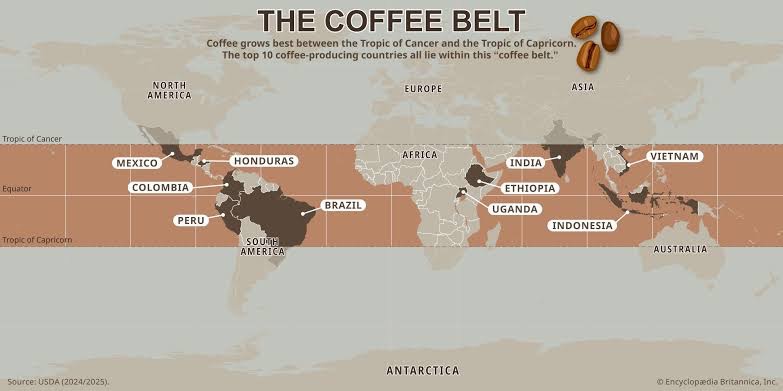
Image source: Britannica
The world’s two dominant coffee varieties are Arabica, prized for its flavour, and Robusta, known for its resilience and commonly used in instant coffee. They are both experiencing increasing climate-related stress. When harvests decline, exporters have less coffee to sell. Roasters face higher procurement costs, which eventually translate into more expensive coffee for consumers.
How Climate Change Is Disrupting Coffee Production
Climate change affects coffee production through several interconnected pathways.
Rising Temperatures
Coffee plants thrive within relatively narrow temperature ranges. As average temperatures rise, many traditional coffee-growing regions become less suitable for cultivation. Excessive heat stresses plants, reduces flowering, limits bean development, and lowers overall productivity. Farmers are increasingly forced to move plantations to higher elevations where cooler temperatures remain suitable. However, mountainous land is limited, making adaptation increasingly difficult.
Unpredictable Rainfall
Coffee production depends on well-timed rainfall patterns. Changes in precipitation include delayed rainy seasons, prolonged droughts, or intense downpours that disrupt flowering and fruit development. Heavy rainfall can also damage blossoms, increase soil erosion, and delay harvesting, reducing both yield and quality.
More Frequent Droughts
Extended droughts have become more common in several major coffee-producing countries. Water shortages reduce plant growth, shrink bean size, and lower harvest volumes. Brazil, which is the world’s largest coffee producer, has experienced repeated droughts that significantly affected coffee output, contributing to price volatility in global markets.
Extreme Weather Events
Climate change is increasing the frequency and intensity of extreme weather events. Frosts, storms, floods, and heatwaves can destroy coffee plantations within days. For example, unexpected frost events in Brazil have severely damaged millions of coffee trees, while hurricanes and flooding have disrupted production in Central America.
Expansion of Pests and Diseases
Warmer temperatures also favour the spread of pests and diseases. One of the most damaging is coffee leaf rust, a fungal disease that attacks leaves, weakens plants, and drastically reduces yields. Similarly, the coffee berry borer is a tiny beetle that feeds on coffee beans and is expanding into new regions as temperatures become more favourable.
To understand how climate change is affecting coffee on the ground, CFC India spoke with Sr. M. Govindappa, Divisional Head, Plant Physiology, Coffee Board of India. According to him: “The impact of climate change on coffee cultivation has become increasingly evident over the past decade, and it’s something both farmers and researchers have been observing closely. A growing body of scientific literature now documents these changes. Among the biggest concerns is the rise in heavy and erratic rainfall, which disrupts the coffee crop at critical stages of growth. Intense downpours can damage flowers and developing fruits, reduce yields, and affect bean quality.”
“Since coffee is highly sensitive to changes in temperature and rainfall patterns, even small shifts in weather can have significant consequences for production, livelihoods, and ultimately the price consumers pay”, he added.
What Coffee’s Price Spike Tells Us About the Future of Food
Coffee is not the only crop under pressure. Cocoa, wheat, rice, maize, tea, and several fruits are experiencing similar climate-related risks. However, coffee serves as an especially visible indicator because it is traded globally, consumed daily, and highly sensitive to climatic conditions.
Its rising prices offer several important lessons about the future of food production.
First, food security is increasingly linked to climate resilience. Protecting agricultural production now requires investments in climate-smart farming practices, drought-resistant crop varieties, improved irrigation systems, and better weather forecasting.
Second, supply chains must become more resilient. Diversifying sourcing regions, improving storage infrastructure, and reducing transportation vulnerabilities can help limit disruptions caused by climate extremes.
Third, consumers may need to adjust expectations. Foods once considered affordable and consistently available may become more expensive or seasonal as climate impacts intensify.
Finally, climate adaptation is becoming an economic necessity rather than solely an environmental priority. Governments, businesses, researchers, and farmers must work together to reduce emissions while strengthening agricultural resilience against unavoidable climate impacts.
The Bottom Line
The rising cost of coffee is more than a temporary market fluctuation: it is a powerful illustration of climate inflation in action. From prolonged droughts and rising temperatures to unpredictable rainfall and expanding crop diseases, climate change is reshaping one of the world’s most beloved beverages.
Understanding climate inflation through the lens of coffee helps us recognise that climate change is no longer a distant environmental issue. It is increasingly becoming an everyday economic reality that influences household budgets, global food security, and the future affordability of the foods and beverages we often take for granted.
References:
https://pmc.ncbi.nlm.nih.gov/articles/PMC9824350
https://www.sciencedirect.com/science/article/pii/S1059056025000097
https://www.britannica.com/topic/coffee-production
https://www.worldbank.org/en/topic/climate-smart-agriculture
https://www.sciencedirect.com/science/article/pii/S2666188825010202
https://www.ipcc.ch/srccl/chapter/chapter-5
Photo: Coffee Belt image source Britannica
Banner Image: AI generated
Sections of this article may have been developed with the assistance of artificial intelligence tools to support research, drafting and language refinement. All information has been reviewed, edited and verified by the author/editor to ensure accuracy, context and editorial integrity. The responsibility for the final content, interpretations and conclusions rests solely with the publisher.