Physical Address
23,24,25 & 26, 2nd Floor, Software Technology Park India, Opp: Garware Stadium,MIDC, Chikalthana, Aurangabad, Maharashtra – 431001 India
Physical Address
23,24,25 & 26, 2nd Floor, Software Technology Park India, Opp: Garware Stadium,MIDC, Chikalthana, Aurangabad, Maharashtra – 431001 India

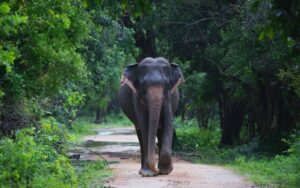
Protecting elephant corridors is more than drawing boundaries on a map. Sri Lanka must ensure that these ancient movement routes remain functional, connected and free from the pressures that drive elephants into human settlements.
For generations, Sri Lanka’s wild elephants have moved across landscapes that existed long before modern roads, villages, farms and development projects. They have followed familiar routes between forests, grasslands, water sources and feeding grounds, often returning to the same areas season after season.Today, many of those traditional routes have become fragmented.
A road may cut across an old movement path. A settlement may occupy part of an elephant’s range. Cultivation may replace natural vegetation. An irrigation scheme, industrial development or other infrastructure project may divide a landscape that once functioned as a continuous habitat.The elephant, however, does not necessarily understand these changes.This is one of the fundamental realities behind Sri Lanka’s human-elephant conflict: the landscape has changed much faster than the ecological behaviour of elephants.
Against this background, the government’s recent efforts to formally recognise and restore elephant movement corridors are significant. Three corridors- Koholankala, Hadapanagala and Watahira Kanda- have been gazetted as part of measures aimed at reducing human-elephant conflict. The corridors are located primarily in the Hambantota and Monaragala areas.
But an important question remains:
Can a gazette notification by itself make an elephant corridor work?
The answer is no.A corridor must exist not merely on paper, but on the ground.
What exactly is an elephant corridor?
The word “corridor” can create the misleading impression of a narrow passageway, almost like a road reserved for elephants.In conservation science, the concept is much broader.
An elephant corridor is an area of habitat that enables elephants to move between different parts of their wider range. It may connect forests, protected areas, feeding grounds, water sources or seasonal habitats.The objective is not to force elephants through an artificially constructed route. Rather, it is to retain or restore the landscape through which elephants naturally move.This distinction is crucial.
Elephants require large areas to survive. Their movements are influenced by the availability of food, water, shelter and seasonal resources. Consequently, protecting only isolated national parks cannot necessarily provide everything an elephant population needs.
A functioning corridor allows animals to move between important areas while reducing the likelihood that they will have to cross heavily populated or intensively cultivated landscapes.The most effective corridor, therefore, is not necessarily the shortest one.It is the route that remains sufficiently safe, attractive and ecologically suitable for elephants.
Ancient routes rather than newly invented highways
One of the most important points often missed in public discussions is that many elephant corridors are not new inventions of conservation planners.They are routes that elephants have used for generations.The traditional wildlife paths are identified as “mankada”- paths used by wild animals- and explains how knowledge of these routes can persist within elephant societies.Elephants possess remarkable spatial memory. Older females in particular play an important role in guiding herds towards familiar feeding and watering areas. Young elephants learn routes through repeated movement with older members of their social groups.
Consequently, when a traditional route becomes blocked, elephants may not simply abandon it permanently.They may attempt to find another way.And that alternative route may lead directly through a village, home garden, plantation or cultivated field.This is where an ecological problem becomes a human tragedy.
When development blocks an elephant’s route
Imagine a landscape that once contained a continuous stretch of forest and scrub.An elephant could move from one feeding area to another without encountering people.Then the landscape changes.A road is constructed. Houses appear. Cultivation expands. A fence is erected. A wetland is drained. A new development occupies another portion of habitat.Individually, each intervention may appear relatively small.Collectively, however, they can transform the entire landscape.The elephant’s traditional route becomes fragmented.The animal still needs food and water, but the safe route has disappeared.This is why human-elephant conflict cannot be understood simply as a problem of “elephants entering villages.”
In many cases, the more important question is:
Why has the landscape become one in which elephants and people are forced to occupy the same space?
Sri Lanka continues to experience one of the world’s most serious human-elephant conflicts. Recent reporting and conservation sources document substantial losses of both elephants and people, demonstrating that conventional responses have not resolved the underlying problem.
Three corridors- and an important distinction
The recent government initiative involving Koholankala, Hadapanagala and Watahira Kanda deserves attention, but it should not be interpreted as the creation of completely new pathways for elephants. The Handapanagala and Watahira Kanda landscapes have long been associated with elephant movements linking important protected areas in Sri Lanka. The current intervention is therefore better understood, at least in part, as an effort to restore and formally protect ecological connections that have been progressively disrupted.Government statements have also identified a proposed elephant migration route extending from Handapanagala towards the Menik Ganga and Yala National Park.
This distinction matters because it changes how the problem should be approached.If a corridor is newly “created”, the question might be where people should build it.If an ancient movement route is being restored, the question becomes:
What happened to the route in the first place, and what must be removed or managed to make it functional again?
The second question is far more complicated.
Gazetting is only the beginning
Legal recognition is important.Without a legal framework, authorities can face serious difficulties when attempting to prevent development or encroachment in ecologically important areas.Gazetting can establish a stronger basis for regulating land use, preventing further obstruction and undertaking restoration.But legislation cannot restore a corridor by itself.A gazetted corridor can still become ineffective if settlements expand into it, cultivation continues, roads divide it or infrastructure development reduces its ecological value.This is perhaps the greatest danger.
Infrastructure management must adapt to elephant behaviour- not the other way around.
The corridor must also be attractive to elephants
Simply removing people from a line on a map will not necessarily create an effective corridor.Elephants need a reason to use the route.A degraded landscape filled with invasive plants and lacking food and water may not function effectively even if it is legally protected.Habitat restoration can therefore become an essential component of corridor management.Restoration may involve controlling invasive species, encouraging natural vegetation, maintaining grasslands and ensuring access to water.This is especially important in the dry zone, where seasonal availability of water and forage can strongly influence elephant movements.
Sri Lanka’s recent conservation measures have included habitat-management initiatives around reservoirs, including the removal of invasive vegetation and the development of grassland or enrichment areas intended to encourage elephants to remain within suitable habitats.
Such measures should, however, be based on ecological evidence rather than simply attempting to keep elephants inside predetermined boundaries.
The people living around corridors cannot be ignored
There is another dimension that is sometimes overlooked in corridor discussions: people.
Farmers living around elephant habitats may themselves be victims of crop destruction, property damage, injuries and deaths.For them, conservation cannot simply mean being told to tolerate elephants.A successful corridor programme must therefore provide a realistic framework for coexistence.Local communities should be involved in identifying elephant movement routes, reporting conflict hotspots and designing practical land-use measures.Their knowledge can be particularly valuable because people living near forests often know where elephants appear, which routes they use and when movements intensify.At the same time, communities need protection from conflict and predictable mechanisms for responding to damage.Conservation cannot succeed by treating rural communities as obstacles.Nor can it succeed by treating elephants as intruders in landscapes that once formed part of their range.
Land-use planning may be the real solution
Perhaps the most important lesson from the corridor debate is that elephant conservation cannot be separated from development planning.A wildlife corridor can be protected today and fragmented tomorrow if land-use decisions are made without considering elephant movement.This is particularly relevant in regions experiencing rapid infrastructure development.
Corridors should be living landscapes, not lines on maps
A functioning corridor should therefore be viewed as a living ecological system.Its success can be measured by asking practical questions:
Are elephants actually using it?
Can they move through it without entering settlements?
Is the habitat sufficiently attractive?
Are critical water sources available?
Have barriers been removed?
Are new encroachments being prevented?
Has human-elephant conflict declined around the corridor?
Are local communities experiencing fewer losses?
And, importantly, are elephants safer?
References
World Elephant Day: Sri Lanka gazettes new elephant corridors to ease conflict
https://old.wti.org.in/projects/right-of-passage
https://www.researchgate.net/publication/411103118_Elephant_Corridors_Beyond_the_Gazette
Banner Image: Photo by Udara Karunarathna on Unsplash
Sections of this article may have been developed with the assistance of artificial intelligence tools to support research, drafting and language refinement. All information has been reviewed, edited and verified by the author/editor to ensure accuracy, context and editorial integrity. The responsibility for the final content, interpretations and conclusions rests solely with the publisher.