Physical Address
23,24,25 & 26, 2nd Floor, Software Technology Park India, Opp: Garware Stadium,MIDC, Chikalthana, Aurangabad, Maharashtra – 431001 India
Physical Address
23,24,25 & 26, 2nd Floor, Software Technology Park India, Opp: Garware Stadium,MIDC, Chikalthana, Aurangabad, Maharashtra – 431001 India

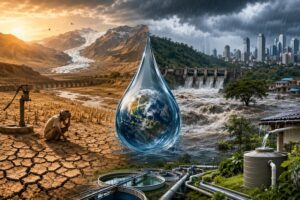
Across the world, a quiet transformation is taking place. Rivers are shrinking, glaciers are retreating, groundwater is being pumped faster than it can recover, and rainfall is becoming increasingly difficult to predict. At the same time, some regions are experiencing intense floods while others are struggling through prolonged droughts. Water, something most of us take for granted when we turn on a tap, is becoming one of the defining challenges of a warming planet.
For decades, the climate crisis has largely been discussed through the language of carbon: tonnes of carbon dioxide emitted, targets for reducing emissions and pathways to net zero. That focus remains essential. But there is another question that deserves equal attention: What happens when climate change begins to disrupt the availability of water on which economies, cities, agriculture and ecosystems depend?
The next climate crisis may not simply be about how much carbon we put into the atmosphere. It could increasingly be about whether we have enough water, where we need it, when we need it.
Disruption in the Water Cycle
The climate crisis is fundamentally a water-cycle crisis as well. As global temperatures rise, the atmosphere becomes capable of holding more moisture. This can intensify rainfall when conditions are favourable for precipitation, but it can also increase evaporation and dry out soils during periods without rain. The result is a water cycle that becomes more energetic and, in many places, less predictable.
This creates an unsettling paradox. A warming world does not necessarily mean a world with less rainfall everywhere. Instead, water can become more unevenly distributed in time and space. One region may receive an extreme downpour in a few hours, causing flooding, while another nearby region experiences weeks of dry weather. Even the same location can swing between the two extremes.
For ordinary people, these changes are not abstract climate statistics. They determine whether a farmer can sow a crop on time, whether a reservoir fills before summer, whether a city needs water tankers or whether a household has to ration its daily consumption.
The disruption is also occurring beneath the surface. Groundwater, which acts as a critical buffer during dry periods, is being depleted in many regions. When rainfall becomes unreliable, dependence on groundwater can increase, creating a dangerous cycle: less predictable rain leads to more pumping, more pumping reduces groundwater reserves, and depleted aquifers leave communities even more vulnerable during the next dry spell.
Glaciers add another dimension. In mountain regions, snow and ice function as natural water storage systems, releasing water into rivers over time. Their retreat may initially increase meltwater, but as ice reserves diminish, the long-term reliability of these flows can be threatened. What appears today as excess water can therefore become tomorrow’s shortage.
The Paradox of a Changing Monsoon
For India, the water story is inseparable from the monsoon. The Indian summer monsoon is not simply a weather event; it is an economic system. It influences agriculture, reservoirs, groundwater recharge, hydropower, food prices and rural livelihoods. Yet its greatest strength has always been its seasonal rhythm—and climate change is making that rhythm harder to rely upon.
The challenge is not necessarily that the monsoon will simply disappear or that India will uniformly become drier. The more complicated concern is greater variability and changing rainfall patterns. Rain may arrive in shorter, more intense bursts, separated by longer dry periods. For a farmer, receiving the same total rainfall over a season does not necessarily mean receiving the same benefit.
Imagine two monsoon seasons delivering exactly the same amount of rain. In the first, rainfall arrives steadily over several weeks, allowing crops and reservoirs to benefit. In the second, much of the rain arrives in a handful of intense events. Roads flood, soil erosion increases and large quantities of water run off before they can be effectively stored or absorbed. Weeks later, fields may once again be dry.
That is the paradox: a place can experience devastating floods and still face water scarcity. This is why India’s water challenge cannot be solved merely by asking how much rain the country receives. We must ask how effectively that rain is captured, stored, recharged and distributed.
When Water Becomes a Limit to Growth
Water is often treated as an environmental issue. Increasingly, it needs to be treated as an economic one.
Every city, industry, power plant, farm and household depends on reliable water. If that reliability declines, growth itself can become constrained. A new industrial facility cannot operate without a dependable water supply. A growing city cannot indefinitely expand if its reservoirs and groundwater sources cannot keep pace with demand. Agriculture cannot maintain productivity when irrigation becomes increasingly uncertain.
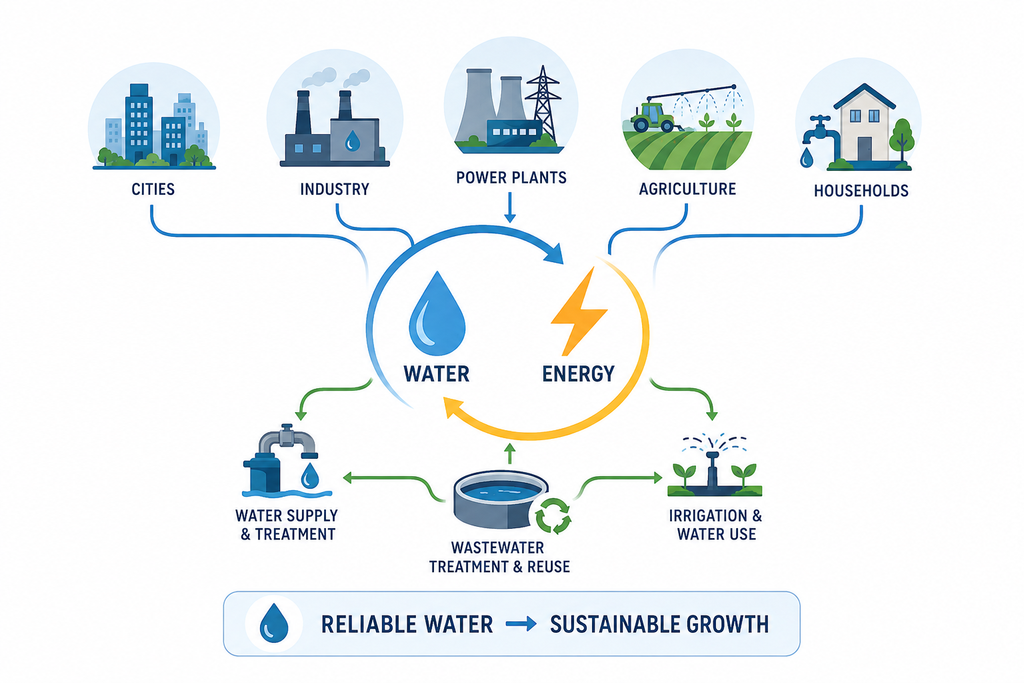
This creates a future in which water availability may influence where industries are located, where cities expand and what crops are grown. The connection with energy makes the issue even more complex. Water is needed to produce and supply energy, while energy is needed to pump, transport and treat water. Agriculture requires water but also energy for irrigation. Wastewater treatment requires energy but can produce a valuable source of reusable water. These interconnections mean that water scarcity can trigger consequences far beyond the water sector itself.
The question is no longer simply, “Do we have enough water?” It is increasingly, “Can our model of development continue with the water that nature can sustainably provide?”
India’s Water Future
India’s water future will depend not only on how much climate change occurs, but on how intelligently the country manages the water it already receives.
The answer cannot be to endlessly search for new sources. It has to involve a fundamental shift from a “use and discharge” model to a “use, treat and reuse” model.
Cities can capture more rainwater, reduce leakage, restore urban lakes and wetlands and make greater use of treated wastewater for applications that do not require freshwater. Industries can move towards water-efficient processes and closed-loop systems. Agriculture can adopt precision irrigation, improve soil moisture management and encourage crops suited to local water availability.
The same thinking can be applied at the level of townships, institutions and industrial facilities. A water balance can reveal where water enters, where it is consumed, where it is lost and how much wastewater can be recovered. Smart metering can identify unusual consumption. Treated sewage can replace freshwater for landscaping and other suitable applications. Rainwater can become a resource rather than something simply drained away. India also needs to think beyond individual projects and towards water-resilient river basins and cities. Rivers, aquifers and watersheds do not follow administrative boundaries. Managing them effectively requires coordination between agriculture, urban development, industry, energy and environmental planning.
The goal should not be to eliminate every risk. That is impossible. The goal should be to make communities less vulnerable when the next drought, flood or unpredictable monsoon arrives.
Can We Build a Water-Resilient Future?
Perhaps the most important change required is not technological but conceptual. We need to stop thinking of water as an infinite service delivered through a tap and start treating it as a finite resource moving through a system.
A water-resilient community would know how much water it receives, how much it consumes, how much it recycles and how much it loses. It would capture rain when it comes, recharge groundwater where possible, reuse treated wastewater and protect the natural ecosystems that help regulate the water cycle. It would also understand that climate mitigation and water resilience cannot be separated. Renewable energy can reduce the carbon footprint of water treatment and pumping. Energy efficiency can reduce both emissions and water demand. Wastewater reuse can reduce pressure on freshwater sources. Protecting forests, wetlands and watersheds can strengthen natural water storage while supporting biodiversity.
This is where the climate conversation needs to evolve. Net zero cannot simply mean counting carbon. A genuinely resilient future must also ask whether communities can secure the energy, water and resources they need without exhausting the natural systems that support them.
The warning signs are already visible. The question is whether we respond before scarcity becomes a crisis. Carbon dioxide may be invisible, but its consequences are becoming increasingly tangible. Water is different. You can see an empty reservoir. You can see a dry riverbed. You can see a farmer waiting for rain. And eventually, you can see it in the most ordinary place of all: an empty glass.
The climate crisis may have begun as a story about carbon. Its next chapter could be written in water.
References:
https://www.sciencedirect.com/science/article/pii/S2468312420300237
https://onlinelibrary.wiley.com/doi/10.1002/wwp2.70055
https://www.researchgate.net/publication/392087209_Climate_resilient_development_for_sustainable_water_security_for_India
https://www.sciencedirect.com/science/article/pii/S295026322500050X
Banner Image: AI Generated
Sections of this article may have been developed with the assistance of artificial intelligence tools to support research, drafting, and language refinement. All information has been reviewed, edited, and verified by the author/editor to ensure accuracy, context, and editorial integrity. The responsibility for the final content, interpretations, and conclusions rests solely with the publisher.