Physical Address
23,24,25 & 26, 2nd Floor, Software Technology Park India, Opp: Garware Stadium,MIDC, Chikalthana, Aurangabad, Maharashtra – 431001 India
Physical Address
23,24,25 & 26, 2nd Floor, Software Technology Park India, Opp: Garware Stadium,MIDC, Chikalthana, Aurangabad, Maharashtra – 431001 India
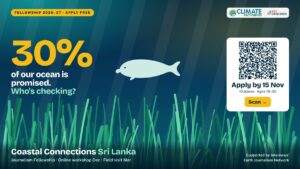
Climate Fact Checks is selecting 10 young journalists and content creators (18–35) to report, film and fact-check Sri Lanka's seagrass and 30x30 story in Sinhala, Tamil and English. Online workshop in December, coastal workshop and field visit in March. Apply by 15 November 2026.


Sri Lanka has promised to protect 30% of its ocean by 2030. Its seagrass meadows store carbon, shelter young fish and feed the dugongs of the Gulf of Mannar and Palk Bay. Who is checking the promise against what happens on the water? This free journalism fellowship will select 10 young journalists and content creators from across Sri Lanka to do exactly that, in Sinhala, Tamil and English.
In August 2024, Sri Lanka launched a national programme to protect 30% of its land and sea by 2030. Since then, the Talawila reef area off Kalpitiya has been declared a sanctuary (March 2026), and in May 2026 the government said it would speed up new marine protected areas in the Northern Province. On paper, the commitments are growing.
On the water, the questions are harder. Is a protected area actually managed, or only drawn on a map? Are seagrass beds inside the boundaries, or outside them? Is the 2017 ban on bottom trawling enforced? Do the fishing families who depend on these waters know what was promised in their name?
Coastal Connections Sri Lanka is an environmental journalism fellowship that trains and supports young journalists to answer those questions with evidence, and to tell the story in the languages coastal communities read, from Puttalam and Negombo to Jaffna, Mannar and Batticaloa.
Recent coastal reporting on Climate Fact Checks: how nets are transforming Sri Lanka’s seas, why coral recovery has bypassed Sri Lanka and the fight over Mandativu island.
Live, interactive sessions you can join from anywhere: seagrass and blue-carbon science, the 30×30 pledge, reading gazettes and budgets, satellite map tools and the IFCN verification workflow.
Meet the cohort in person on the Puttalam–Kalpitiya coast for a hands-on workshop and a boat visit to the seagrass beds with marine scientists, timed for calm seas and clear water.
A stipend for every published piece, plus travel, accommodation and field insurance for project activities.
One-to-one editing and monthly online clinics, with your work published in three languages under your byline.
Help film one of three short documentaries, coached by an experienced environmental documentary maker.
A certificate and a place in a new network of young environment journalists across Sri Lanka.
Training comes in two parts, so you build the skills before you go into the field.
The fellowship runs alongside your regular work. Expect a few days of training and roughly one story every two to three months.
Climate Fact Checks is the climate and environment desk of Fact Crescendo, an independent fact-checking organisation that is a verified signatory of the International Fact-Checking Network (IFCN). We check claims about climate, nature and energy, and explain the science behind the headlines.
In Sri Lanka, Fact Crescendo Sri Lanka publishes fact-checks in Sinhala, Tamil and English. Fellows’ work will reach readers in all three.
Coastal Connections Sri Lanka is supported by Internews’ Earth Journalism Network through its 30×30 Media Grants, which support reporting on countries’ progress toward the global goal of protecting 30% of the ocean by 2030.
No. Staff reporters, freelancers, student journalists, citizen journalists and content creators can all apply. If you work for an outlet, tell us whether your editor supports your taking part.
No. There is no fee. Travel, accommodation and meals for the March workshop and field visit are covered, and you receive a stipend for each published piece.
The December workshop is held online, so you can join from anywhere in Sri Lanka. The March workshop and field visit are held in person on the Puttalam–Kalpitiya coast, with a boat visit to the seagrass beds of Puttalam Lagoon. Dates and venue are confirmed to selected fellows and set around safe sea conditions.
Yes, and we especially want to hear from you. The fellowship is open to applicants from every district of Sri Lanka, and a particular welcome for reporters in Puttalam, Negombo, Jaffna, Mannar and Batticaloa, where seagrass meadows and fishing communities are at the heart of the 30×30 story.
No. The online workshop covers seagrass and blue-carbon science, marine protected areas and the 30×30 target from the basics. Curiosity and careful reporting matter more than a science degree.
Yes. You can report in the language you are strongest in. Our editors handle translation so your work reaches readers in all three languages.
We look at your interest in the coast, your story pitch, your reporting and verification skills, your multimedia skills and your availability. We also aim for a cohort balanced across regions, languages and gender. Shortlisted applicants will have a short online interview.
Coastal Connections Sri Lanka මාධ්ය Fellowship වැඩසටහන 2026–27: වයස අවුරුදු 18–35 අතර තරුණ මාධ්යවේදීන් සහ නිර්මාණකරුවන් 10 දෙනෙකුට මුහුදු තෘණ (seagrass) සහ සාගරයෙන් 30% ආරක්ෂා කිරීමේ (30×30) පොරොන්දුව ගැන වාර්තා කිරීමට, වීඩියෝ නිර්මාණයට සහ කරුණු පරීක්ෂා කිරීමට අවස්ථාව. දෙසැම්බරයේ මාර්ගගත වැඩමුළුවක් සහ මාර්තුවේ පුත්තලම් කලපුවට ක්ෂේත්ර චාරිකාවක්. ගාස්තු නැත. අයදුම්පත් භාරගන්නා අවසන් දිනය නොවැම්බර් 15.
Coastal Connections Sri Lanka ஊடகவியல் ஃபெலோஷிப் 2026–27: 18–35 வயதுடைய 10 இளம் ஊடகவியலாளர்கள் மற்றும் உள்ளடக்க உருவாக்குநர்களுக்கு கடற்புற்கள் (seagrass) மற்றும் கடலின் 30% ஐப் பாதுகாக்கும் (30×30) வாக்குறுதி குறித்து செய்தி அறிக்கையிட, காணொளி தயாரிக்க மற்றும் உண்மை சரிபார்க்க ஒரு வாய்ப்பு. டிசம்பரில் இணையவழிப் பயிற்சிப் பட்டறை, மார்ச்சில் புத்தளம் களப்பில் களப் பயணம். கட்டணம் இல்லை. விண்ணப்பிக்க இறுதித் திகதி: நவம்பர் 15.
The form takes 15 to 20 minutes. Have links to two or three pieces of your work ready, and a short idea for a story on seagrass, marine protection or coastal livelihoods.
Form not showing? Open it in a new tab ↗