Physical Address
23,24,25 & 26, 2nd Floor, Software Technology Park India, Opp: Garware Stadium,MIDC, Chikalthana, Aurangabad, Maharashtra – 431001 India
Physical Address
23,24,25 & 26, 2nd Floor, Software Technology Park India, Opp: Garware Stadium,MIDC, Chikalthana, Aurangabad, Maharashtra – 431001 India

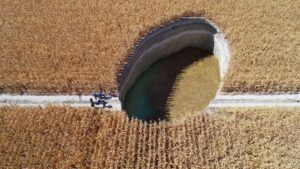
Nearly 700 sinkholes have opened across Türkiye’s Konya agricultural heartland as drought and heavy farm irrigation drain groundwater. Read the analysis.
Hundreds of giant sinkholes are opening up across central Türkiye, threatening farmland, roads and settlements as drought and excessive water extraction increasingly strain the country’s agricultural heartland. The Konya Basin is a major wheat, maize and sugar beet producing area and has seen a dramatic increase in the incidence of sinkholes over the last few decades. Locally known as obruks, these collapses can open suddenly, swallowing parts of cultivated land and highlighting the dangers of unsustainable water use. Türkiye’s Disaster and Emergency Management Authority has documented 684 sinkholes across the provinces of Konya, Karaman and Aksaray. As the country prepares to host the UN climate summit COP31 in November, the crisis highlights the mounting pressure on water resources in a region increasingly vulnerable to drought.
Hundreds of sinkholes expose growing risks beneath Türkiye’s farmland
The Konya Basin has experienced sinkholes for thousands of years, but they have become more frequent in recent decades. Some are tens of metres wide and deep, appearing in agricultural fields and creating hazards for farmers and nearby infrastructure. According to a study examining sinkhole formation between 2000 and 2024, the annual rate rose from approximately three sinkholes between 2000 and 2010 to 32 per year during 2016–2019. The rate subsequently fell to around 22 annually after 2020, even as groundwater depletion continued.
Sinkholes develop when underground cavities become unstable, and the material above them collapses. The Konya Basin contains extensive limestone and other carbonate rocks that groundwater gradually dissolves, creating underground openings and channels. When the layers covering these cavities weaken, the ground can suddenly give way. Falling groundwater levels can further destabilise existing cavities by changing underground water pressure and the movement of sediments. However, the likelihood of collapse also depends on local geological conditions, including the size of underground cavities, the strength of overlying material and the history of groundwater fluctuations.
Drought and intensive irrigation are draining groundwater reserves
The growing sinkhole problem is closely connected to the basin’s dependence on groundwater for agriculture. Rainfall is relatively low and often falls outside the main growing season, making irrigation essential for crops such as maize, sugar beet and fodder. Over time, demand for water has exceeded the rate at which underground reserves can recover. A regional study estimated an average annual loss of groundwater storage equivalent to 3.4 centimetres of water, indicating sustained pressure on the basin’s reserves.
Türkiye experienced one of the worst droughts in decades in 2025, compounding the pressure on farmers. Farmers tend to pump more groundwater during dry spells to keep their crops alive, further depleting water tables. Climate change can worsen water stress through higher temperatures, increased evaporation and changes in rainfall patterns, but sinkholes cannot be explained by climate change alone. Intensive groundwater extraction and pumping from unlicensed wells are also an important part of the problem. Drought, decreasing groundwater reserves and persistent irrigation demand are making it increasingly difficult to sustain agricultural production without further damaging the region’s water resources.
Sinkholes threaten food production and demand changes in water use
The consequences extend beyond the immediate danger of ground collapse. The Konya Basin is an important agricultural region, and continued groundwater depletion could undermine the farming economy that depends on irrigation. Sinkholes can damage fields and threaten roads and buildings, while gradual land subsidence creates additional risks. Satellite measurements have recorded land sinking by as much as 90 millimetres a year in parts of the region. Unlike sinkholes, which can appear suddenly, subsidence occurs as underground sediments compact under changing pressure, potentially damaging infrastructure over time.
Solving the crisis will take more than better irrigation technology. Reliable monitoring of groundwater levels and extraction, enforceable limits on pumping and agricultural policies that encourage farmers to grow crops suited to available water supplies are needed by authorities. More efficient irrigation can reduce water use, but savings may be lost if farmers use the extra water to expand irrigated areas. Any restrictions must also take into account the farmers’ livelihoods and the region’s importance for food production. The sinkhole problem is getting worse, and it illustrates the dangers of treating groundwater like it’s never going to run out. As Türkiye prepares to host COP31, it faces a pressing domestic challenge: protecting agriculture and communities while adapting to worsening water stress.
References:
AFAD’ın çalışmasında Konya Kapalı Havzası’nda 684 obruk tespit edildi
Turkey Sinkholes Climate Change: Growing Crisis in Konya Basin
Banner image: Paleosismolog Post on X
Sections of this article may have been developed with the assistance of artificial intelligence tools to support research, drafting, and language refinement. All information has been reviewed, edited, and verified by the author/editor to ensure accuracy, context, and editorial integrity. The responsibility for the final content, interpretations, and conclusions rests solely with the publisher.