Physical Address
23,24,25 & 26, 2nd Floor, Software Technology Park India, Opp: Garware Stadium,MIDC, Chikalthana, Aurangabad, Maharashtra – 431001 India
Physical Address
23,24,25 & 26, 2nd Floor, Software Technology Park India, Opp: Garware Stadium,MIDC, Chikalthana, Aurangabad, Maharashtra – 431001 India

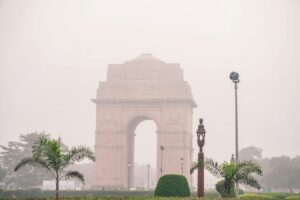
Delhi air pollution persists despite rain. Explore why AQI improvements fade and how emissions cuts could deliver lasting cleaner air.
Delhi recorded just one day of ‘Good’ air quality during the 92-day monsoon season this year, despite receiving substantial rainfall, according to a study by the Centre for Science and Environment (CSE). The city received enough rain to temporarily wash pollutants from the air, but the improvement did not last. CSE found that particulate pollution returned quickly once the rain stopped, pointing to continued emissions from vehicles, industries, waste burning and power generation. The analysis of Delhi’s summer and monsoon air quality shows that rain can provide short-term relief, but it cannot solve the city’s persistent pollution problem without sustained action to reduce emissions.
Rain brought relief, but pollution quickly returned
CSE analysed 61 days of summer, from April 1 to May 31, and 92 days of monsoon, from June 1 to August 31. During the monsoon, Delhi recorded only one ‘Good’ AQI day, on July 9, when the combined average rainfall measured at Safdarjung and Palam was 67.75 mm. Even the season’s highest daily rainfall, 101.05 mm on August 8, could only bring the city’s air quality into the ‘Satisfactory’ category.
Rain did lower pollution levels, but the effect was short-lived. Delhi’s average PM2.5 concentration fell from 60.2 micrograms per cubic metre during summer to 40.2 µg/m³ during the monsoon, a decline of about 33.2%. However, CSE found that PM2.5 levels began rising again as soon as precipitation stopped. During the monsoon, daily PM2.5 still reached 64.5 µg/m³, while the AQI climbed as high as 261, which falls in the ‘Poor’ category.
PM2.5 bounced back within 48 hours
The CSE study also examined six isolated rainfall events during the monsoon to understand how long the cleaning effect of rain lasted. Before rainfall, the average PM2.5 concentration stood at 40.6 µg/m³. During rainfall, it dropped to 32.7 µg/m³, a reduction of about 19.5%. But the improvement did not last. PM2.5 rose to 36.2 µg/m³ 24 hours after the rain and reached 45.1 µg/m³ after 48 hours.
This pattern suggests that rainfall removes some of the particles already present in the atmosphere but does not stop the sources producing new pollution. CSE said emissions from vehicles, industry, waste burning and power generation continue to build up once the atmosphere dries and normal mixing conditions return. The organisation also cautioned that its analysis identified statistical associations between rainfall and PM2.5 changes, rather than separating the effects of rainfall from other weather factors such as wind, humidity and atmospheric mixing.
Winter could bring a sharper pollution crisis
The difference between summer and monsoon air quality was significant, but even the rainy season failed to produce consistently clean air. During the 61 summer days analysed, 38 days, or 62.3%, had ‘Moderate’ air quality, while 17 were ‘Poor’ and six were ‘Satisfactory’. There were no ‘Good’ days. During the monsoon, ‘Poor’ days fell to three, while 53 days remained in the ‘Moderate’ category and 35 were ‘Satisfactory’. Only one day was classified as ‘Good’.
With the southwest monsoon having withdrawn from Delhi on September 23, the city is now moving into the post-monsoon period, when the regular atmospheric washout provided by rain will decline. CSE warned that winter conditions, including shallow atmospheric mixing, temperature inversions and stagnant air, could allow the city’s existing emissions to accumulate more rapidly.
The organisation has called for year-round measures across the National Capital Region rather than relying on rainfall during the monsoon or emergency restrictions during winter. Its recommendations include faster adoption of electric vehicles, cleaner industrial fuels, better public transport, stronger waste management, reduced dependence on diesel generators and coordinated airshed-level governance across NCR districts.
References:
https://www.cseindia.org/Monsoons-and-Delhis-air-quality2026.pdf
Banner image: Photo by Ashish Kushwaha on Unsplash
Sections of this article may have been developed with the assistance of artificial intelligence tools to support research, drafting, and language refinement. All information has been reviewed, edited, and verified by the author/editor to ensure accuracy, context, and editorial integrity. The responsibility for the final content, interpretations, and conclusions rests solely with the publisher.