Physical Address
23,24,25 & 26, 2nd Floor, Software Technology Park India, Opp: Garware Stadium,MIDC, Chikalthana, Aurangabad, Maharashtra – 431001 India
Physical Address
23,24,25 & 26, 2nd Floor, Software Technology Park India, Opp: Garware Stadium,MIDC, Chikalthana, Aurangabad, Maharashtra – 431001 India
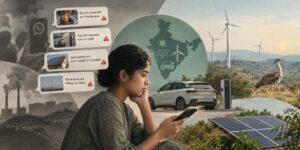
Few people in India still argue that the planet is not warming. The newer argument is that the fixes do not work. We took four popular claims about electric vehicles, solar power and renewables, found the real problem hidden inside each, and checked what happens to the verdict once the missing context is added back.
Nobody forwarding the message claims the climate is fine. The message is subtler than that. Your electric scooter secretly runs on coal. It might catch fire in the parking lot. The solar panels on your neighbour’s roof will be a pile of toxic junk in a decade, and the wind farms in Rajasthan are wiping out a rare bird anyway. Each line holds a sliver of fact. Stacked together, they deliver a verdict the facts do not support: that clean energy is a scam not worth the trouble.
Researchers now have a name for this style of argument, and it is worth learning to spot.
From “it isn’t happening” to “it won’t work”
In 2025 the International Panel on the Information Environment (IPIE), a Zurich-based body of researchers, published a systematic review of 300 peer-reviewed studies from 2015 to 2025 on the state of climate information. Its central finding was that outright denial is giving way to what the authors call strategic scepticism. Campaigns now spend less energy disputing that the climate is changing and more energy questioning whether solutions are effective, affordable or fair.
The goal, the review argues, is not to win a scientific debate but to erode trust, delay responses and obstruct the move from fossil fuels to clean energy. Doubt is cheaper to produce than denial and far harder to disprove, because it usually starts from something true.
The same review flagged a severe research gap on climate information integrity in the Global South, where impacts are likely to be large but are poorly documented. In the United States, legal researchers have catalogued and rebutted 33 recurring false claims about solar, wind and EVs. India’s versions of these claims have their own local flavour, built on local incidents and local data. That is what this explainer examines.
The kernel test
Strategic scepticism works because it is rarely a pure invention. It takes a genuine problem and stretches it into a conclusion the problem cannot carry. Before accepting or dismissing a claim about clean energy, it helps to ask three questions:
Is the underlying fact accurate and current? Old incidents often circulate long after the problem has been addressed.
What is it being compared against? A clean technology with drawbacks is only worse if the alternative has fewer drawbacks.
Does it point to a fix, or only to giving up? Honest criticism usually names a remedy. Scepticism usually stops at the doubt.
Here is how four common Indian claims fare.
Claim 1: “An electric car is just a coal-powered car”
What is true. Coal still produces most of India’s electricity. Even though non-fossil sources now make up more than half of installed capacity, they supplied 29.2% of total generation in 2025-26. An EV charged from the grid today does draw substantially on coal power.
What is missing. The comparison. Earlier modelling by the International Council on Clean Transportation (ICCT) found that a medium-size battery electric car registered in India already had lifetime emissions 19 to 34% lower than a comparable petrol car. A 2025 review of six Indian life-cycle studies by ICCT and IIT Roorkee put the saving at up to 38% per kilometre, and found that three factors (grid carbon intensity, test-cycle energy use and the gap between lab and road) explain roughly three-quarters of the variation between studies.
Even under the deliberately pessimistic assumption that every unit of EV electricity comes from coal and gas plants, ICCT found well-to-wheel CO2 emissions of electric cars still come out lower. For heavy trucks, battery-electric models offered the largest reductions of any current technology despite the coal-heavy grid. And the gap only grows: as the grid gets cleaner, every EV already on the road gets cleaner with it. A petrol car bought today burns the same fuel in 2040.
The fair part. The benefit is not uniform. It depends on the regional electricity mix, and ICCT itself recommends accounting for regional grid variation when judging EV policy. That is an argument for cleaning up the grid alongside electrification, not for delaying electrification.
Verdict: Misleading. EVs do draw on coal power, but on India’s current grid they still produce lower life-cycle emissions than petrol cars, and the advantage widens every year.
Claim 2: “Electric scooters are fire hazards”
What is true. The fires were real. In 2022 a run of electric scooter fires across India prompted a federal investigation, including an incident in which a man and his daughter died. The initial probe identified faulty battery cells and modules as the leading cause, and a report by DRDO’s fire safety laboratory reportedly found defects in battery pack and module design, with companies possibly using lower-grade materials to cut costs and testing too little.
What is missing. What happened next. These were product-quality failures with identified causes, and regulation moved in response. The Ministry of Road Transport and Highways amended the AIS-156 battery safety standard in September 2022, adding requirements for cells, battery management systems and thermal propagation, in two phases from 1 December 2022 and 31 March 2023. Viral posts that recycle 2022 fire videos rarely mention this, and rarely offer any Indian data comparing fire rates per vehicle with petrol two-wheelers. The claim runs on vivid images rather than rates.
The fair part. Standards only work if they are enforced. Questions about uncertified replacement batteries, cheap e-rickshaw packs and indoor charging are legitimate and worth reporting on.
Verdict: Missing context. The 2022 fires exposed real quality failures, which were traced to specific causes and led to tougher national battery standards. They do not show that electric two-wheelers are inherently unsafe.
Claim 3: “Solar panels are worse for the environment than what they replace”
What is true. Solar panels do become waste. A study by the Council on Energy, Environment and Water (CEEW) estimates that India’s installed capacity has produced about 100 kilotonnes of waste so far, and that cumulative solar waste could reach about 600 kilotonnes by 2030 and 19,000 kilotonnes by 2050. Recycling is not yet commercially viable: formal recyclers currently lose Rs 10,000 to 12,000 per tonne. Five states (Rajasthan, Gujarat, Karnataka, Tamil Nadu and Andhra Pradesh) are expected to generate two-thirds of the waste in the next five years.
What is missing. Scale. In 2024-25 alone, India’s coal plants generated more than 340 million tonnes of fly ash. The entire cumulative solar waste projected up to 2030 works out to roughly 0.2% of a single year’s fly ash. The two waste streams are chemically different, so this is not a like-for-like comparison of hazard, but it does dismantle the image of solar “waste mountains” overtaking what coal leaves behind.
Solar waste is also a resource. CEEW notes that the 2030 waste stream will contain silicon, silver, cadmium and tellurium, much of it critical minerals India imports, and estimates that recovering these materials could become a Rs 3,700 crore market by 2047.
The fair part. India does not yet have a working system to collect and recycle panels at scale. That is a real policy gap and a real story. It is an argument for recycling rules, not against solar.
Verdict: Misleading. Solar waste is a genuine and growing challenge, but its volume is tiny compared with coal ash, and much of it is recoverable. The real problem is a missing recycling system.
Claim 4: “Renewables are killing the Great Indian Bustard, so they are not really green”
What is true. This one rests on firm evidence. Surveys by the Wildlife Institute of India along 80 km of power lines in the Thar desert found 289 carcasses of around 40 bird species, including the Great Indian Bustard. In December 2025 the Supreme Court fixed a revised priority area of 14,013 sq km in Rajasthan, ordered 80 km of 33 kV lines in Rajasthan and 79 km in Gujarat moved underground, and barred new wind turbines and solar parks above 2 MW inside the priority zones.
What is missing. What the court actually concluded. It did not treat conservation and clean energy as a choice between the two; it held that both goals must be pursued together. Future power evacuation through the region is to be routed through a single dedicated corridor south of the Desert National Park. The Union government had itself warned that an unworkable blanket order risked stranding projects and increasing reliance on coal, which would harm the climate the bird also depends on.
Verdict: Real problem, wrong conclusion. Power lines serving renewable projects do kill endangered birds. The answer the evidence and the courts point to is better siting and routing, not abandoning renewables.
Critique or scepticism? How to tell
Every energy source has costs, and journalists should report them. The difference between honest criticism and strategic scepticism usually shows up in what the argument does next.
Honest criticism names a specific fix, such as recycling rules for old panels, tougher testing of battery cells or better routing of power lines through bird habitats. Strategic scepticism rarely offers any remedy except dropping the technology altogether.
Honest criticism also compares the clean option with what it replaces, whether that is a petrol scooter, a diesel truck or a coal plant. Scepticism judges the clean option on its own, as though the alternative had no costs.
Timing is another giveaway. A fair critic uses current data and notes what has changed since an incident. A sceptic recycles an old video or statistic as though nothing was learned from it. Finally, honest criticism accepts that every energy source involves trade-offs. Strategic scepticism treats any trade-off as proof that the whole idea is a fraud.
Why this matters now
India added a record 55.3 GW of non-fossil capacity in 2025-26. The engineering is moving fast. The slower contest is over public trust: whether families buy the EV, whether villages accept the solar park, whether voters back the policy. Half-truths do their damage there, not by winning arguments but by making people feel that nothing is certain and waiting is the sensible choice.
The IPIE review warned that too little is known about how this plays out in countries like India. Fact-checkers, newsrooms and readers can help close that gap by asking the same three questions every time a clean-energy scare lands in the family WhatsApp group: is it true, compared with what, and what is the fix?
References
Climate misinformation leads people to lose hope and faith in science: report
How ‘sophisticated’ climate misinformation gets to the heart of power
https://www.pib.gov.in/PressReleasePage.aspx?PRID=2250039&lang=1®=3
https://www.euronews.com/next/2022/05/06/india-electric-fires
https://www.pressreader.com/india/mint-hyderabad/20240416/282132116486094
https://www.deccanherald.com/india/karnataka/where-does-the-debris-of-the-solar-boom-go-3038906
Banner Image: AI Generated
Sections of this article may have been developed with the assistance of artificial intelligence tools to support research, drafting, and language refinement. All information has been reviewed, edited, and verified by the author/editor to ensure accuracy, context, and editorial integrity. The responsibility for the final content, interpretations, and conclusions rests solely with the publisher.