Physical Address
23,24,25 & 26, 2nd Floor, Software Technology Park India, Opp: Garware Stadium,MIDC, Chikalthana, Aurangabad, Maharashtra – 431001 India
Physical Address
23,24,25 & 26, 2nd Floor, Software Technology Park India, Opp: Garware Stadium,MIDC, Chikalthana, Aurangabad, Maharashtra – 431001 India

Climate misinformation turns real risks into viral doomsday hoaxes. Learn why fear spreads online and how to separate evidence from manipulation.
On August 12, 2026, millions of people online were bracing for the world to lose gravity for exactly seven seconds. It did not. Yet by the time that date arrived, the claim had travelled from a single Instagram slideshow to TikTok edits, Facebook shares, and anxious group chats across continents, India included. It is a useful place to start, because the same pattern that carried a fake NASA memo around the internet is now doing the rounds with climate change itself, and the next scheduled doomsday is already on the calendar.
A seven second blackout that never came
The claim was specific in exactly the ways hoaxes tend to be. It cited a leaked, top secret NASA document called Project Anchor, gave it an $89 billion budget, a date and time down to the minute (14:33 UTC), and a death toll running into the tens of millions. Posts claimed two colliding black holes would send out gravitational waves that would briefly cancel Earth’s gravity. NASA’s own scientists pointed out the obvious problem: gravity comes from mass, and Earth was not going anywhere.
Fact-checkers, including Fact Crescendo Sri Lanka and India’s CyberPeace Foundation, traced the story to nothing more than an anonymous slideshow, and found no trace of any NASA project by that name. What made the hoax feel credible, as several fact-checkers noted, was that August 12 happened to be a real total solar eclipse date, so the hoax simply borrowed a genuine astronomical event and grafted an invented catastrophe onto it, as one investigation into the story’s spread documented in detail.
That trick, a real date or a real scientific event dressed up with invented stakes, is the same trick showing up in climate content, except there the underlying science is not invented. It is real, published, peer reviewed research, stretched past what it actually says.
When a real ocean current becomes an overnight apocalypse
The Atlantic Meridional Overturning Circulation, a system of currents that moves warm water north and helps regulate weather across Europe, Africa, and the Americas, is genuinely weakening. That much is well established. But social media versions of this story routinely compress decades of uncertainty into a single, imminent collapse.
A 2025 study warning of a possible shutdown was widely shared with headlines implying the current could stop within years, when the paper’s own authors and independent scientists placed the more credible window decades away, closer to 2040 or 2050, with a full collapse potentially taking a century longer still, as Scientific American’s explainer on the researchlaid out.
Coverage through 2026 has continued to describe the risk in probabilistic, long-term terms, not as a countdown. The distortion is not in the science, which is worth taking seriously, but in the framing: turning a slow-moving, decades-scale risk into a viral countdown clock strips out every caveat scientists actually attached to it.
This matters beyond the Atlantic. A slowdown of this scale would also shift monsoon rainfall patterns that hundreds of millions of people in South Asia depend on, which is exactly the kind of detail that gets lost when a nuanced finding is compressed into a scary headline for engagement.
The next date already circulating: November 13, 2026
Here is the prebunk part. A claim is building online that scientists have calculated the exact date of human extinction: Friday, November 13, 2026. It draws on a real 1960 paper in the journal Science by Heinz von Foerster and colleagues, which modelled historical population growth as a hyperbolic curve and, as a mathematical curiosity, calculated the date that curve would reach infinity.
Viral posts strip out the context and present this six decade old modelling exercise as a scientific prophecy, sometimes misattributing it to Harvard, as Argentina’s Chequeado found when it fact-checked the same claim circulating in Spanish. Von Foerster’s own point was closer to a warning about unchecked growth trends than a prediction, and population growth has in any case long since departed from the hyperbolic path his model assumed. With the date still two months out, it is worth saying plainly now: nothing about that paper points to an actual event on November 13.
Why climate anxiety makes fertile ground
These stories thrive because they land in a moment when the underlying anxiety is not irrational. Record heat, erratic monsoons, and genuine scientific warnings about tipping points are real background noise, in India as much as anywhere. That backdrop lowers people’s guard against claims that borrow the vocabulary of real science, a leaked document, a named research institution, a precise date, while skipping the actual peer review, caveats, and timelines that real science comes with. On platforms built to reward whatever keeps people scrolling, a countdown to catastrophe outperforms a careful paragraph about probability ranges almost every time.
Four questions worth asking before you share
Does it name an exact date and time for something climate scientists themselves describe in ranges or probabilities, not certainties? Real climate research almost never produces a single doomsday date.
Does it cite a document nobody else can find, a leaked report, a suppressed study, a classified memo? Ask whether the underlying paper is published and searchable, the way the Project Anchor hoax’s core document never was.
Does the number attached to it (a budget, a death toll, a percentage chance) sound suspiciously precise for something this uncertain? Manufactured specificity is a classic hoax signature.
Would a scientist in that field actually phrase it this way? The AMOC researchers themselves pushed back publicly on the compressed timelines attached to their work; that pushback is usually one search away.
None of this is an argument for complacency. The AMOC is weakening, the climate is warming, and the science backing both is solid. The argument is narrower: real risk does not need an invented deadline to be worth taking seriously, and every fabricated one that gets shared and later debunked makes it a little easier to dismiss the genuine warnings sitting right next to it.
References
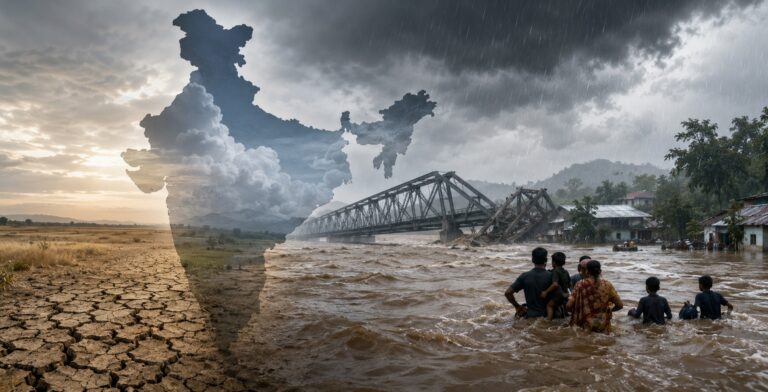
Banner Image: AI generated
Sections of this article may have been developed with the assistance of artificial intelligence tools to support research, drafting, and language refinement. All information has been reviewed, edited, and verified by the author/editor to ensure accuracy, context, and editorial integrity. The responsibility for the final content, interpretations, and conclusions rests solely with the publisher.