Physical Address
23,24,25 & 26, 2nd Floor, Software Technology Park India, Opp: Garware Stadium,MIDC, Chikalthana, Aurangabad, Maharashtra – 431001 India
Physical Address
23,24,25 & 26, 2nd Floor, Software Technology Park India, Opp: Garware Stadium,MIDC, Chikalthana, Aurangabad, Maharashtra – 431001 India

For years, the idea that rising carbon dioxide could help plants grow faster has been used to argue that fossil fuel emissions may have a hidden benefit for forests. A new study published in Science suggests that this picture is far more complicated. By examining fossilised leaf material from a period of rapid global warming about 56 million years ago, scientists found that forests initially became denser as carbon dioxide levels rose, but eventually began to thin dramatically as heat and drying overwhelmed the benefits of extra CO2. The findings offer a warning for today’s forests, which are already facing more frequent heatwaves, drought, wildfires, pests and other pressures as the planet warms.
Ancient forests grew first, then began to collapse
The study examined the Paleocene-Eocene Thermal Maximum, or PETM, a period when enormous quantities of carbon entered the atmosphere over roughly 130,000 years and global temperatures rose by as much as 8°C. Researchers analysed tiny fossilised cells from leaf cuticles to reconstruct how dense ancient forest canopies were before, during and after the warming event. The evidence showed that forests initially responded to higher carbon dioxide by becoming much denser. But as temperatures continued to rise and conditions became drier, that initial benefit disappeared.
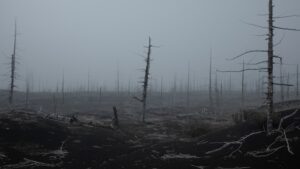
Researchers estimate that around 60% of the biomass of standing vegetation was eventually lost, leaving much more open forest landscapes. The shift from denser to more open forests occurred when the effects of heat and drought stress began to outweigh the benefits of additional CO2. The findings suggest that plants cannot simply continue gaining from higher carbon dioxide when temperatures and water stress move beyond their physiological limits.
Heat and drought can overwhelm the CO2 benefit
Carbon dioxide is essential for photosynthesis, and higher concentrations can increase photosynthetic activity in some plants under suitable conditions. But the new evidence shows that this benefit does not operate independently of temperature and water availability. As the climate becomes hotter, plants lose water more rapidly and can struggle to maintain the physiological processes needed for growth. Heat stress can also increase vulnerability to pests and disease, while dry vegetation becomes more susceptible to wildfires.
The researchers say the transition from forest expansion to forest decline in the PETM provides a useful warning because modern forests are experiencing several of these pressures simultaneously. Regan Dunn, who led the study, said forests are already dying back, being cleared and being consumed by wildfires, with the changes occurring rapidly. The research therefore challenges the idea that higher atmospheric CO2 alone will allow forests to keep expanding as the planet warms.
Today’s forests face a faster climate shock
The ancient warming event is not a replica of today’s climate change. During the PETM, carbon entered the atmosphere over thousands of years, whereas modern emissions from fossil fuel combustion are occurring over decades. That difference matters because ecosystems have less time to adapt when environmental conditions change rapidly. The researchers and other scientists cited in the report warn that modern forests are also dealing with pressures that did not operate in the same way during the PETM, including widespread deforestation, habitat fragmentation, agriculture and altered fire regimes.
Dunn said the ancient carbon release occurred over thousands of years, while today’s emissions are happening over decades, giving ecosystems far less time to adjust. She added that the fossil record shows the benefits of rising CO2 have limits, particularly when warming and drying intensify. The findings suggest that forests may initially gain from higher CO2, but that advantage can quickly be overtaken when heat and water stress become too severe.
References:
https://www.science.org/doi/10.1126/science.aec4776
https://www.britannica.com/science/Paleocene-Eocene-Thermal-Maximum
https://phys.org/news/2026-08-paleontologists-reconstruct-forests-million-years.html
Banner image: Photo by Sergey Nikolaev on Unsplash
Sections of this article may have been developed with the assistance of artificial intelligence tools to support research, drafting and language refinement. All information has been reviewed, edited and verified by the author/editor to ensure accuracy, context and editorial integrity. The responsibility for the final content, interpretations and conclusions rests solely with the publisher.