Physical Address
23,24,25 & 26, 2nd Floor, Software Technology Park India, Opp: Garware Stadium,MIDC, Chikalthana, Aurangabad, Maharashtra – 431001 India
Physical Address
23,24,25 & 26, 2nd Floor, Software Technology Park India, Opp: Garware Stadium,MIDC, Chikalthana, Aurangabad, Maharashtra – 431001 India


The rhythm of the monsoon has always shaped India’s coastline, the rise and fall of tides, and the livelihoods of millions who depend on the sea. Today, that rhythm is changing. The climate projection 2021-2040 report by Azim Premji University paints a troubling picture of what India’s coastal regions could look like by 2040. Far from being a distant concern, climate change is already altering temperatures, rainfall patterns, sea levels and weather extremes across the country’s 11,000-kilometre coastline. The report suggests that many coastal districts are likely to experience hotter summers, more humid conditions, changing monsoon behaviour, stronger rainfall events and growing risks from sea-level rise and erosion in the coming years. These changes are expected to affect not only ecosystems and infrastructure but also fisheries, agriculture, public health and the lives of millions living along India’s shores.
The Rising Heat Threat Along India’s Shoreline
One of the clearest messages emerging from the report is that India’s coastal districts are set to become considerably hotter. Across much of the coastline, annual maximum temperatures, summer temperatures and winter minimum temperatures are projected to rise by roughly 0.6°C to 1.4°C by 2040 compared to historical baselines. Several coastal districts in Kerala and Karnataka are expected to witness summer temperature increases exceeding 1°C.
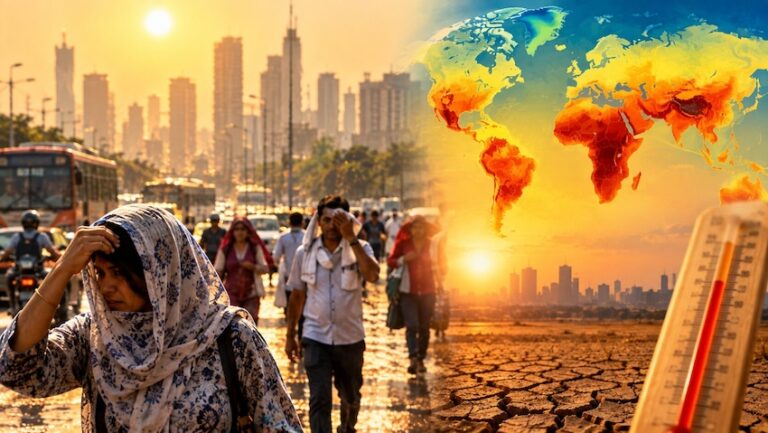
Equally concerning is the rise in wet-bulb temperatures, a measure that combines heat and humidity. High wet-bulb temperatures make it increasingly difficult for the human body to cool itself through sweating. The report projects increases of around 1°C in wet-bulb temperatures across many coastal districts, including Odisha, West Bengal, Kerala and Karnataka.
For coastal communities, this means more than discomfort. Heat stress can reduce labour productivity, increase health risks and place additional pressure on already strained healthcare systems. Fisherfolk, construction workers, salt-pan workers and others whose livelihoods depend on outdoor work could face longer periods of dangerous working conditions. The report’s projections reinforce broader scientific findings that India’s coastal regions are becoming hotspots of compound climate risks where heat and humidity interact to create conditions that are increasingly difficult to adapt to.
Why India’s West Coast Is Getting Wetter While the East Faces Uncertainty
While rising temperatures affect nearly all coastal regions, rainfall patterns are becoming far more uneven. The report identifies a clear trend of increasing monsoon rainfall along large parts of India’s western coast, particularly in Gujarat, Maharashtra, Karnataka and Kerala. Several districts are projected to receive significantly higher southwest monsoon rainfall by 2040, with increases reaching double digits in some locations. Districts such as Udupi, Dakshina Kannada, Ernakulam and Alappuzha are expected to become both hotter and wetter. Udupi, already India’s rainiest coastal district during the southwest monsoon, could see rainfall rise further in the coming years.
The eastern coast presents a more complex picture. While some districts in Odisha and West Bengal may witness increases in northeast monsoon rainfall, southwest monsoon rainfall is projected to remain stable or even decline slightly in places such as Puri. This does not necessarily mean less climate risk. Scientists increasingly warn that climate change is causing rainfall to become concentrated into shorter and more intense bursts. The result is a cycle of floods, waterlogging, and infrastructure damage during extreme rain events, followed by longer dry periods that can affect agriculture and water availability.
Recent years have already provided glimpses of this future. Kerala’s devastating floods, recurring urban flooding in coastal cities and increasingly erratic monsoon behaviour suggest that rainfall variability may become one of the defining climate challenges for India’s coastal regions.
Rising Seas and Eroding Coasts
Even as temperatures and rainfall patterns change, another transformation is unfolding more gradually along India’s shores. Rising sea levels and coastal erosion are already altering landscapes that have supported communities for generations. The report notes that under a moderate emissions scenario, global sea levels are projected to rise by around 15 centimetres between 2020 and 2050. Rising seas, combined with stronger storms, higher waves and coastal flooding, are expected to intensify erosion along vulnerable stretches of coastline.
The consequences are already visible. Across parts of Odisha, Kerala, Tamil Nadu, Andhra Pradesh and Gujarat, homes, roads and protective green belts have been damaged or lost to advancing seas and repeated erosion events. The report documents several examples of villages where residents have been relocated inland after years of losing land to the sea.
Sea-level rise also threatens freshwater resources. In low-lying coastal regions, saltwater intrusion can contaminate groundwater and agricultural land. The Sundarbans already offer a warning of what this future may look like. Communities there continue to struggle with increasing salinity, declining agricultural productivity and challenges in accessing safe drinking water following repeated cyclone impacts. Natural buffers such as mangroves remain among the most effective forms of coastal protection. Yet many mangrove ecosystems are themselves under pressure from development, erosion and extreme weather events.
Life on the Frontlines of Climate Change
For millions of people living along India’s coastline, climate change is not simply an environmental issue. It is becoming a question of livelihoods, health and survival.
Fishing communities face growing uncertainty as warming oceans affect marine ecosystems and fish distribution. Agriculture is increasingly threatened by salinity intrusion, flooding and changing rainfall patterns. In regions such as the Sundarbans, repeated cyclones have already damaged farmland and freshwater resources, forcing many families to adapt their farming practices or seek alternative sources of income.
A warming ocean also raises concerns about future cyclone activity. The report notes that global sea surface temperatures have been rising at an accelerating pace and that warmer ocean waters create favourable conditions for tropical cyclones. These storms bring destructive winds, storm surges and intense rainfall that can cause severe damage when they make landfall.
The challenge extends beyond physical damage. Heat stress, water insecurity, disease risks and displacement are increasingly becoming part of everyday life in many coastal regions. Communities that contribute the least to global greenhouse gas emissions often face the greatest consequences. As climate impacts intensify, adaptation measures such as stronger infrastructure, restored mangroves, improved drainage systems and climate-resilient livelihoods will become increasingly important.
The projections presented by Azim Premji University do not describe a distant future. They describe a future that is already beginning to emerge. By 2040, India’s coastline is likely to be hotter, wetter and more vulnerable to climate extremes than it is today. Whether coastal communities can adapt successfully will depend not only on climate action at the national level but also on how quickly governments, institutions and local communities prepare for the changes that are already underway.
References:
https://publications.azimpremjiuniversity.edu.in/7394/1/Web-V2-Coastal-Booklet.pdf
Wet-Bulb Temperature Explained: The Deadly Mix of Heat and Humidity in India and Pakistan
https://azimpremjiuniversity.edu.in/indian-coastal-region-climate-projections-2021-2040
Risk of saltwater intrusion into coastal groundwater spans the globe: Study
https://www.sciencedirect.com/science/article/pii/S2211464525002763
Banner image: Photo by Austin Curtis on Unsplash
Sections of this article may have been developed with the assistance of artificial intelligence tools to support research, drafting and language refinement. All information has been reviewed, edited and verified by the author/editor to ensure accuracy, context and editorial integrity. The responsibility for the final content, interpretations and conclusions rests solely with the publisher.