Physical Address
23,24,25 & 26, 2nd Floor, Software Technology Park India, Opp: Garware Stadium,MIDC, Chikalthana, Aurangabad, Maharashtra – 431001 India
Physical Address
23,24,25 & 26, 2nd Floor, Software Technology Park India, Opp: Garware Stadium,MIDC, Chikalthana, Aurangabad, Maharashtra – 431001 India

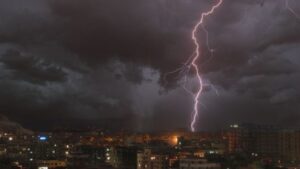
The rain had already begun to swallow the city by the time the alerts arrived.
Across Guwahati, phones buzzed late into the night; warning messages flashing long after streets had turned into streams recently. In neighbourhoods like Anil Nagar and Nabin Nagar, water had already entered homes. Vehicles stalled mid-road, engines choked by rising water. Families sat trapped inside cars for hours, gridlocked in traffic that refused to move. By the time the warnings came, for many, there was nowhere left to go.
This is not a story about the absence of forecasting. India’s systems have improved significantly over the past decade, led by the India Meteorological Department, with better models, Doppler radars, and satellite inputs.
But prediction, however sophisticated, is only one part of the equation. The real test lies in whether warnings reach people in time, and in a form that allows them to act.
From Forecast to Failure
India operates a layered warning system. The India Meteorological Department issues forecasts, while the National Disaster Management Authority coordinates response frameworks. Forecasts are structured, verified, and regularly updated.
“Our daily reports provide detailed regional forecasts and local outlooks for cities like Guwahati, based on multiple observations and model inputs, and are issued after due verification,” said Dr Sanjay O’Neill Shaw, Head of the Regional Meteorological Centre, Guwahati, adding that updates are shared regularly.
But when flooding unfolds on the ground, these forecasts do not always translate into timely, actionable alerts.
That gap between prediction and response is where failure begins.
As CFC’s in house expert, Dr Partha Jyoti Das, Director and Head of the Water, Climate & Hazard Division at Aaranyak, puts it: “The purpose of producing early warning is to provide crucial information about floods (or any disaster) in advance to specific target groups such as disaster management agencies, NGOs and vulnerable communities so that they use the lead time in preparing to deal with the flood situations. We must not forget that the success of flood warning depends on three important factors, (i) reliability of the flood forecasts robustness of the hydrologic models based on which the early warning information or messages are generated, (ii) the clarity of the EW messages that tell people about where and when flooding is likely to occur and also for how long as precisely as possible, (iii) disseminating the EW on time so that the information reaches target populations before the flood wave giving them reasonable time to act to reduce the adverse impact of floods on them and (iv) Timely action taken by responsible agencies to help the people on ground in rescue, relief, medical support, security and safety.”
Dr Das emphasises that early warning is not a single step, but a chain: “There must be an efficient mechanism to forge coordination among multiple government agencies, NGOs and the affected citizens for all these conditions to be fulfilled so that the EWs translate into appropriate action to reduce the risk of the suffering people.”
Caught Off Guard: Communities Pay the Price
What unfolded in Guwahati is no longer an isolated event. In Guwahati itself, intense rainfall in April 2026 triggered widespread waterlogging, submerging roads and disrupting daily life, with schools shut and transport hit across the city. Even 48 hours later, large parts of the city remained inundated, exposing deep-rooted drainage and planning failures. Officials described the event as “cloudburst-like,” with around 120 mm of rain falling within hours.
In Pune and other urban centres, short bursts of intense rainfall have repeatedly overwhelmed drainage systems; part of a broader national trend where infrastructure struggles to cope with extreme weather.
In New Delhi and across the National Capital Region, waterlogging during heavy rain continues to disrupt mobility, reflecting persistent drainage and planning gaps.
Meanwhile, Gurgaon has seen repeated flooding episodes where even a few hours of rain can paralyse traffic and submerge roads, with deaths reported during severe events. Experts link this to the loss of natural water bodies and drainage pathways, while recent reporting continues to flag inadequate drainage infrastructure and rising flood risks.
In Chennai, authorities are now turning to advanced tools like AI-driven urban “digital twins” specifically to anticipate and manage flooding, an acknowledgment of how persistent and complex the problem has become .
Across these cities, a consistent pattern is emerging: rainfall events are becoming more intense, flooding develops rapidly, and urban systems struggle to cope. People are often caught in transit; on roads or inside vehicles when conditions deteriorate.
One of the most critical gaps lies in interpretation.
Meteorological forecasts communicate probability, not certainty. Terms like “light rain” or “isolated rainfall” have precise scientific meanings. But in cities like Guwahati, even moderate rainfall can trigger flooding due to drainage constraints and land-use changes. A forecast may be technically accurate and still fail to convey real-world risk.
This disconnect raises fundamental questions, as Dr Das, referring to the recent flooding in Guwahati city, notes: “Was there any trustworthy EW system in place to alert about the possible flooding from heavy rains? Did it work? Did the people of the affected areas get the EW on time? Did the concerned government agencies take timely action to alert the people and provide necessary help and support to them on time? More importantly, was there any robust disaster management plan in place to deal with such intense rain spells and consequent flash floods, given the experience that the city suffers from such calamities several times every rainy season?”
The Scale and Timing Problem
Forecasts are issued at district or regional levels. Flooding, however, is hyperlocal.
“Forecasts are generally issued at district or regional scales to capture broader weather patterns, but the impacts of heavy rainfall are often highly localised, sometimes affecting specific neighbourhoods or even individual stretches of road,” said Sanjay O’Neill Shaw.
A single blocked drain or encroached wetland can flood a neighbourhood within minutes, even if surrounding areas remain unaffected. This mismatch limits how useful forecasts are for real-time decisions.
Timing is not just about when a forecast is issued; it is about when it becomes actionable. Even where forecasts exist, delays in dissemination or unclear communication reduce their effectiveness. For commuters already on the road, minutes matter.
Urban Vulnerability Meets Communication Gaps
Urban flooding is not just a weather issue, it is a systems issue. Across India, cities face a combination of shrinking wetlands, rapid concretisation, and inadequate drainage. Experts note that urban flooding is now a recurring reality driven by both climate change and planning failures. At the same time, urban populations are highly mobile. Many are exposed to risk while commuting, making last-mile communication even more critical.
“Lack of coordination among the various actors designated for disaster risk reduction is often a primary reason why plans fail to provide desired results,” says Dr Das.
India has invested heavily in forecasting infrastructure. But prediction without communication is not protection. Even accurate forecasts lose value if they are not translated into clear, localised, and actionable alerts.
Warnings only work if people easily understand and trust them. Terms like “yellow alert” or “orange alert” maybe in use but aren’t always intuitive. Without clear instructions, alerts risk being ignored. Repeated warnings without visible impact can also lead to complacency.
As climate change influences weather patterns, rainfall is becoming more variable, with increasing instances of short-duration, high-intensity events.
According to the India Meteorological Department, India’s 2026 southwest monsoon is projected to be around 92% of the Long Period Average, indicating a below-normal season. This outlook has also been communicated through public updates, including by IMD scientists:
However, a below-normal monsoon does not necessarily eliminate the risk of flooding. Climate patterns such as El Niño are often associated with increased variability in rainfall, including the possibility of intense precipitation over short periods. This creates a complex risk landscape: lower overall rainfall, but the potential for sudden, localised extremes.
The result is a paradox: even when seasonal rainfall is below average, cities can still face severe flooding.
Beyond the Alert
The scenes from Guwahati of families stranded, roads submerged and hours lost in gridlock point to a deeper systemic gap. India does not lack forecasts. It lacks last-mile effectiveness.
Across Guwahati, Pune, New Delhi, Chennai, and Gurgaon, the pattern is consistent: warnings exist, but they do not always reach people in time or in a form that enables action. As climate variability increases, the challenge is no longer just predicting rainfall. It is ensuring that warnings are timely, localised, and actionable. Because in a climate shaped by extremes, even a below-normal monsoon can flood a city.
And a warning that arrives too late cannot prevent it.
References
https://archive.org/details/weather-20-04-2026
https://www.hindustantimes.com/india-news/no-easy-fix-to-urban-flooding-101753038442500.html
Banner Image: Canva
Sections of this article may have been developed with the assistance of artificial intelligence tools to support research, drafting and language refinement. All information has been reviewed, edited and verified by the author/editor to ensure accuracy, context and editorial integrity. The responsibility for the final content, interpretations and conclusions rests solely with the publisher.