Physical Address
23,24,25 & 26, 2nd Floor, Software Technology Park India, Opp: Garware Stadium,MIDC, Chikalthana, Aurangabad, Maharashtra – 431001 India
Physical Address
23,24,25 & 26, 2nd Floor, Software Technology Park India, Opp: Garware Stadium,MIDC, Chikalthana, Aurangabad, Maharashtra – 431001 India

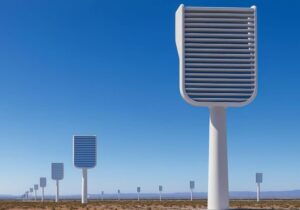
Social media has recently been abuzz with images of futuristic “artificial trees” and headlines claiming that Columbia University scientists have built devices that can pull CO₂ from the air “1,000 times” faster than real trees. In reality, those viral posts mix fact and fiction. The only prototype was developed by ASU, Arizona State University, engineer Klaus Lackner and a private startup—not Columbia—and it looks nothing like the tuning-fork designs seen online. In short, the hype outpaced the science. Below we unpack what’s true and what’s not about the so-called artificial trees, explain how the actual “Mechanical Tree” works, and why comparisons to real forests can be misleading.

Viral “Synthetic Tree” Claims vs. Reality
Myth: Social posts showed a sleek, tuning-fork–shaped device with slatted “blinds” and claimed Columbia’s scientists built it to suck CO₂ from the air 1,000× faster than a real tree.
Fact: The only such prototype—the Mechanical Tree™—was developed by Professor Klaus Lackner, now at Arizona State University in partnership with Dublin-based Carbon Collect, and it was installed on ASU’s Tempe campus in 2022. It is a cylindrical machine with extendable disks, not a tuning fork. The viral image is actually an old concept image rendering from the 2010s—Lackner’s initial sketch of the idea—not a photo of a built device. The image of viral social media posts can be CGI or AI generated. A news article published by Snopes on this can be read here. Snopes and ASU News confirm the real prototype is a 9‑foot metal cylinder that rises to 33 feet with many carbon-absorbing disks.
These social posts mixed truths and errors. It is true that Lackner conceived of “artificial trees” and helped patent the technology, but the completed prototype was developed at ASU with Carbon Collect—not Columbia—and it was unveiled in spring 2022. Lackner did work at Columbia in the 2000s, but he left in 2014, and no working device ever emerged from that period.
Klaus Lackner and the Rise of the Mechanical Tree
Klaus Lackner is a veteran of carbon-capture research. He began studying ways to remove CO₂ from air back in the 1990s at Los Alamos and became a Columbia University faculty member in 2001. There, along with colleagues, he worked on “synthetic tree” concepts—even co-founding a startup, Global Research Technologies, that would use sorbent materials to grab CO₂ from the atmosphere. In 2010 Columbia’s climate school wrote that Lackner’s early “synthetic trees” aimed to absorb CO₂ “at a rate a thousand times faster than natural trees,” using special resins. However, that was a forward-looking description of a concept, not a report of a completed machine. In fact, Lackner never installed a working prototype while at Columbia.
In 2014 Lackner moved to Arizona State University to continue his work. He partnered with investors and engineers initially under the name Silicon Kingdom Holdings, now Carbon Collect. In 2022 they finally built and installed the first Mechanical Tree™ on ASU’s campus. ASU News reported the tree’s arrival with a metal canister on a flatbed truck—the 9-foot-tall base of the device. Carbon Collect holds the rights to Lackner’s ASU research and is commercializing the technology.

The point of the Mechanical Tree is to act as a passive direct air capture PDAC system. Unlike many DAC machines that use large fans to pull in air, Lackner’s design relies on the natural wind. Each Mechanical Tree is essentially a tower of rotating disk-shaped “leaves” coated with a special CO₂-absorbing material. As air passes over the disks, the sorbent captures CO₂. When a disk is fully saturated, it retracts into the cylinder and is heated or exposed to a vacuum to release the captured CO₂ for collection. In this way the system continuously “breathes” ambient air and concentrates its CO₂ for storage or use. The ASU team emphasizes that this is a low-energy, passive process—no blowers or fans are needed.
How the Mechanical Tree Works
In practice, the Mechanical Tree operates in a cycle: it extends upward with dozens of round disks spread out like petals. Ambient air drifts through these disks, where CO₂ molecules stick to the sorbent material. Once a cycle is complete, the entire disk assembly lowers back into the base canister. There it is briefly isolated and gently heated; the heat causes the sorbent to release the bound CO₂, which is then collected and compressed. The clean disks are then redeployed to capture more CO₂. .
The ASU news release described the device acting “like a tree”: when fully extended, the disks are in the open air, and when full of carbon, they “collapse in on themselves… to give up the carbon” for processing . Because it doesn’t require pumping massive volumes of air only ambient wind, the system avoids the high energy cost of fans. Carbon Collect calls this approach Passive Direct Air Capture PDAC. A news article published about this in 2021 can be read here .
Each unit is modular. ASU’s first prototype is fairly small scale: a 9-ft-tall base raising to 33 ft with five-foot-diameter disks, each disk holding six “leaves” of sorbent. ASU reported that in continuous operation the prototype can capture on the order of 90 kg, 200 pounds of carbon per day. For comparison, a mature oak tree only absorbs roughly 10–20 kg of CO₂ per year through growth, so the Mechanical Tree collects more per day than a tree does per year, but it takes significant infrastructure to operate it continuously. To have a meaningful climate impact, one would need many such devices. Carbon Collect talks of “carbon farms” of dozens or hundreds of trees to capture tons of CO₂.
The “1,000× Efficient” Claim
Carbon Collect and media reports do promote the idea that each mechanical tree captures CO₂ far faster than a real tree of the same size. Their website and press releases quote a figure on the order of “up to 1,000 times more efficient than a natural tree” of the same dimensions. What does this mean? It’s essentially a comparison of rates: a mature tree might only fix a tiny fraction of a pound of carbon per day, whereas the Mechanical Tree running 24/7 can capture on the order of 90 kg per day in its prototype form. If one compares those rates directly, the device can collect CO₂ much faster—hence the “1000×” soundbite.
However, experts caution that this does not mean one tree can instantly “replace” thousands of natural trees in solving climate change. Photosynthesis in a tree sequesters carbon in wood and bark over decades, whereas the Mechanical Tree must periodically offload all its CO₂ for storage. The “1000×” figure is a useful headline, but real performance depends on operating conditions. It also requires a sustainable energy source, even though the fan energy is saved, heat or vacuum to regenerate the sorbent still costs some energy.
In summary, the claim is backed by Carbon Collect’s technical literature, but it’s not a magical multiplier in itself—it’s a way to compare one device’s capture rate versus a single natural tree’s uptake rate. In practice, as noted above, a lone Mechanical Tree captures on the order of 90–100 kg CO₂ per day in its current form. Achieving gigatons of removal would require scaling this to millions of trees or very large “carbon farms.” For now, the 1,000× figure simply highlights that the device is designed for continuous, intensive capture, whereas a tree’s process is slower and intermittent.
Deployment Status and Timeline
Despite the hype, only one Mechanical Tree unit exists so far. The first commercial-scale prototype was installed at ASU in April 2022. It performed tests and demonstrations on campus. According to Carbon Collect, a second-generation design using improved materials was developed in 2024, with plans for commercial deployment beginning in 2025. In an April 2025 interview, Carbon Collect’s CEO said the ASU prototype would soon be replaced by the Gen‑II system and that additional trees would be built .
As of mid-2025, no other installations have been publicized. In fact, Snopes notes that “as of July 11, 2025, no other Mechanical Trees have been installed” besides the ASU prototype. Carbon Collect’s own site claims it will have “first commercial deployments in 2025” after Gen-II testing, but real-world timelines for such emerging tech can slip. In short, the Mechanical Tree is still at the pilot/demonstration stage, not mass production.
How the Confusion Spread
Why did social media credit Columbia University and use a tuning-fork image? This comes down to the history and the graphics. During his Columbia days, Lackner popularized the idea by sketching a “tuning fork” design: two vertical posts with slatted panels in between. Columbia Press even ran articles in the early 2000s describing this concept, calling it a “synthetic tree” to illustrate the vision. A 2010 press release said that these trees would “absorb CO₂ at a rate a thousand times faster than natural trees,” referring to that concept.

Those older Columbia magazine images have been floating around the web for years. In July 2025, some social posts appear to have repurposed an artist’s rendering from decades ago—perhaps re-rendered by AI—and mislabeled it as a new Columbia breakthrough. The posts also simply assumed “Columbia scientists” because Lackner had been associated with Columbia. In reality, Lackner left the university in 2014 to join ASU, and his current work including Carbon Collect is unrelated to Columbia.

In summary, the misleading posts mixed old concept art, a legendary promise “1000×”, and partial truths about Lackner’s name but conflated them into a catchy narrative. The device in the pictures isn’t a real prototype, and the real prototype was built by ASU/Carbon Collect, not Columbia.
Conclusion
The viral story of Columbia’s “1,000× carbon tree” turned out to be more hype than reality. The true story is a bit more mundane but also intriguing: a decades-long research effort culminating in a proof-of-concept called the Mechanical Tree, developed by Klaus Lackner and a private company at ASU. This device does indeed capture CO₂ from air, and in principle at a higher rate per device than a real tree of the same size. But there are no magic trees ready to be planted everywhere—just one prototype and a lot of engineering still to do.
In debunking the myth, we see the real science is nuanced. Mechanical trees represent a creative approach in the toolkit against climate change, but they are not an instant fix. As with any emerging tech, it’s vital for the public to hear the accurate story: scientists are experimenting with exciting solutions, but they also caution against overselling results. By comparing the viral claim to the facts as confirmed by news reports, readers can appreciate both the promise of innovation and the importance of separating fact from fiction in social media.
Banner image: Facebook post
Copyedited by Aayushi Gour