Physical Address
23,24,25 & 26, 2nd Floor, Software Technology Park India, Opp: Garware Stadium,MIDC, Chikalthana, Aurangabad, Maharashtra – 431001 India
Physical Address
23,24,25 & 26, 2nd Floor, Software Technology Park India, Opp: Garware Stadium,MIDC, Chikalthana, Aurangabad, Maharashtra – 431001 India

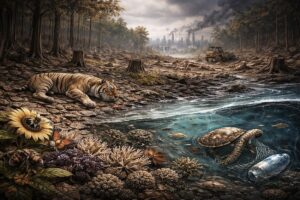
The triple planetary crisis: climate change, biodiversity loss, and pollution form a tightly woven web of environmental risk that is reshaping the future of the planet. As highlighted in a recent study, these crises do not unfold in isolation. Instead, they trigger cascading failures across ecosystems and economies, with impacts that could derail development pathways by 2050. Climate change scorches habitats, biodiversity loss weakens nature’s resilience, and pollution further erodes what remains. Together, they create a vicious cycle that threatens ecological stability and human well-being alike.
This article is Part of the Triple Planetary Crisis series and focuses on biodiversity loss, the often-underestimated pillar of the triple crisis, yet one that underpins climate stability, food security, and economic resilience.
What Is Biodiversity Loss in the Context of the Crisis?
Biodiversity loss refers to the rapid decline in the variety and abundance of life on Earth—across species, ecosystems, and genetic diversity. Human activity is the primary driver. Since 1970, global wildlife populations have declined by nearly 68 percent, a result of deforestation, overfishing, land-use change, pollution, and climate stress.
Each year, roughly 10 million hectares of forests are cleared for agriculture, infrastructure, and urban expansion. Oceans are overexploited, wetlands are drained, and cities continue to sprawl into natural habitats. Scientists now warn that around one million species face the risk of extinction within decades, many within our lifetime.
Key Impacts of Biodiversity Loss
Ecosystem Tipping Points
Nature has limits. When ecosystems are pushed beyond critical thresholds, they can collapse abruptly and irreversibly. The Amazon rainforest, for example, risks transitioning from a carbon sink to a carbon source if deforestation and warming continue. Such a shift would release vast amounts of stored carbon, accelerating climate change. Similarly, the loss of nearly 14 percent of global coral reefs has already undermined fisheries and coastal protection for millions of people.
Economic Costs
Biodiversity loss carries enormous economic consequences. Degraded ecosystems reduce productivity across agriculture, fisheries, forestry, and tourism. Globally, nature loss is estimated to cost the economy around $10 trillion annually. Pollination services alone—vital for fruits, vegetables, and nuts—are valued at approximately $577 billion per year, while the loss of natural flood protection increases disaster-related costs.
Human and Food Security Impacts
Around 75 percent of global food crops depend, at least in part, on animal pollinators such as bees, butterflies, and birds—many of which are in decline. As ecosystems weaken, food systems become more fragile, nutrition suffers, and rural livelihoods face increasing uncertainty.
Expert Insight: A Systemic Economic Risk
As Expert Parthaa Bosu, Aerosol Pollution & Mitigation Expert, Environmental Defense Fund USA, told CFC India, “Nature loss alone costs trillions of dollars annually. Like the Great Depression, it risks resetting growth trajectories, especially in vulnerable economies.”
The burden is uneven, with developing countries experiencing the greatest losses despite contributing least to global environmental degradation.
https://www.aiu.edu/innovative/how-declining-pollinators-are-impacting-global-food-production
https://pmc.ncbi.nlm.nih.gov/articles/PMC10866695
https://www.un.org/en/climatechange/science/climate-issues/biodiversity
https://www.fao.org/state-of-forests/en
Banner Image: AI Generated